inglese Edizione
Letteratura
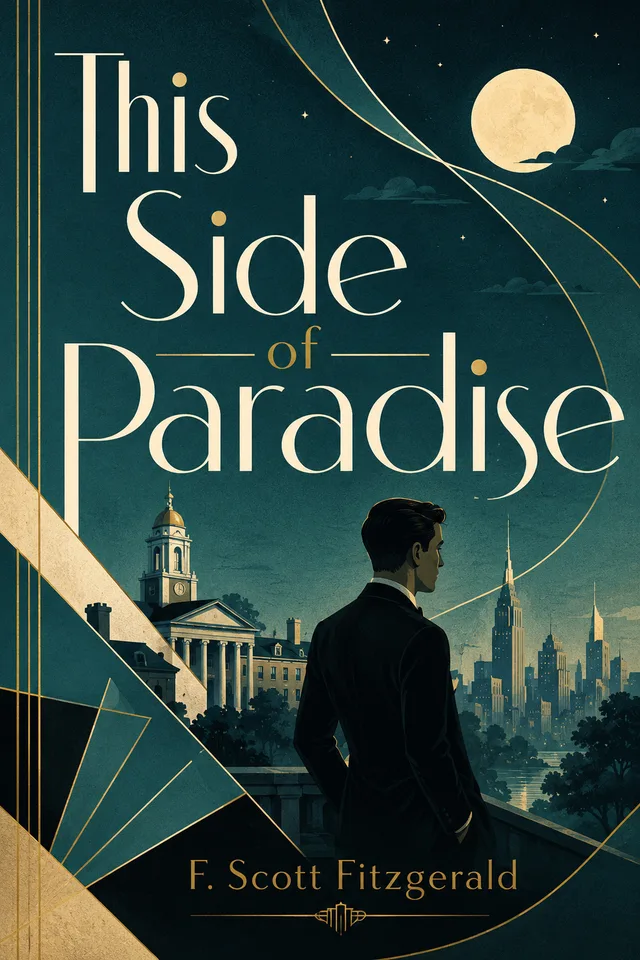
This Side of Paradise
Edizione BooksWhale in inglese di F. Scott Fitzgerald
Youth, privilege, love, and restlessness define Fitzgerald’s first Jazz Age breakthrough.
- Anteprima
- Estratto dal testo preparato
- Formati
- Lettore online, EPUB, PDF
- Accesso
- Claim Libreria
Introduzione al libro
This Side of Paradise
F. Scott Fitzgerald’s debut follows Amory Blaine from prep school and Princeton into romance, disillusion, and self-invention. Its shifting style, campus atmosphere, and confessional energy made it a landmark portrait of postwar youth and the emerging Jazz Age.
Edizione BooksWhale
Come è stata preparata
Questa edizione si basa su un testo di pubblico dominio ed è stata preparata da BooksWhale per la lettura digitale.
Base di pubblico dominio
Perché può essere condivisa
Original English novel first published in 1920. Fitzgerald died in 1940; this edition is public domain under expired U.S. publication copyright and life-plus-70 rules.
Leggi anteprima
Estratto dal testo preparato
Anteprima selezionata dal testo preparato per la lettura.
Capitolo in anteprimaFull textLeggi anteprima
This Side of Paradise
F. Scott Fitzgerald
Capitolo in anteprimaBOOK ONE—The Romantic EgotistAnteprima
CHAPTER 1. Amory, Son of Beatrice
Amory Blaine inherited from his mother every trait, except the stray inexpressible few, that made him worth while. His father, an ineffectual, inarticulate man with a taste for Byron and a habit of drowsing over the Encyclopedia Britannica, grew wealthy at thirty through the death of two elder brothers, successful Chicago brokers, and in the first flush of feeling that the world was his, went to Bar Harbor and met Beatrice O’Hara. In consequence, Stephen Blaine handed down to posterity his height of just under six feet and his tendency to waver at crucial moments, these two abstractions appearing in his son Amory. For many years he hovered in the background of his family’s life, an unassertive figure with a face half-obliterated by lifeless, silky hair, continually occupied in “taking care” of his wife, continually harassed by the idea that he didn’t and couldn’t understand her.
But Beatrice Blaine! There was a woman! Early pictures taken on her father’s estate at Lake Geneva, Wisconsin, or in Rome at the Sacred Heart Convent—an educational extravagance that in her youth was only for the daughters of the exceptionally wealthy—showed the exquisite delicacy of her features, the consummate art and simplicity of her clothes. A brilliant education she had—her youth passed in renaissance glory, she was versed in the latest gossip of the Older Roman Families; known by name as a fabulously wealthy American girl to Cardinal Vitori and Queen Margherita and more subtle celebrities that one must have had some culture even to have heard of. She learned in England to prefer whiskey and soda to wine, and her small talk was broadened in two senses during a winter in Vienna. All in all Beatrice O’Hara absorbed the sort of education that will be quite impossible ever again; a tutelage measured by the number of things and people one could be contemptuous of and charming about; a culture rich in all arts and traditions, barren of all ideas, in the last of those days when the great gardener clipped the inferior roses to produce one perfect bud.
In her less important moments she returned to America, met Stephen Blaine and married him—this almost entirely because she was a little bit weary, a little bit sad. Her only child was carried through a tiresome season and brought into the world on a spring day in ninety-six.
When Amory was five he was already a delightful companion for her. He was an auburn-haired boy, with great, handsome eyes which he would grow up to in time, a facile imaginative mind and a taste for fancy dress. From his fourth to his tenth year he did the country with his mother in her father’s private car, from Coronado, where his mother became so bored that she had a nervous breakdown in a fashionable hotel, down to Mexico City, where she took a mild, almost epidemic consumption. This trouble pleased her, and later she made use of it as an intrinsic part of her atmosphere—especially after several astounding bracers.
So, while more or less fortunate little rich boys were defying governesses on the beach at Newport, or being spanked or tutored or read to from “Do and Dare,” or “Frank on the Mississippi,” Amory was biting acquiescent bell-boys in the Waldorf, outgrowing a natural repugnance to chamber music and symphonies, and deriving a highly specialized education from his mother.
“Amory.”
“Yes, Beatrice.” (Such a quaint name for his mother; she encouraged it.)
“Dear, don’t _think_ of getting out of bed yet. I’ve always suspected that early rising in early life makes one nervous. Clothilde is having your breakfast brought up.”
“All right.”
“I am feeling very old to-day, Amory,” she would sigh, her face a rare cameo of pathos, her voice exquisitely modulated, her hands as facile as Bernhardt’s. “My nerves are on edge—on edge. We must leave this terrifying place to-morrow and go searching for sunshine.”
Capitolo in anteprimaA KISS FOR AMORYAnteprima
His lip curled when he read it.
“I am going to have a bobbing party,” it said, “on Thursday, December the seventeenth, at five o’clock, and I would like it very much if you could come. Yours truly, R.S.V.P. Myra St. Claire.
He had been two months in Minneapolis, and his chief struggle had been the concealing from “the other guys at school” how particularly superior he felt himself to be, yet this conviction was built upon shifting sands. He had shown off one day in French class (he was in senior French class) to the utter confusion of Mr. Reardon, whose accent Amory damned contemptuously, and to the delight of the class. Mr. Reardon, who had spent several weeks in Paris ten years before, took his revenge on the verbs, whenever he had his book open. But another time Amory showed off in history class, with quite disastrous results, for the boys there were his own age, and they shrilled innuendoes at each other all the following week:
“Aw—I b’lieve, doncherknow, the Umuricun revolution was _lawgely_ an affair of the middul _clawses_,” or
“Washington came of very good blood—aw, quite good—I b’lieve.”
Amory ingeniously tried to retrieve himself by blundering on purpose. Two years before he had commenced a history of the United States which, though it only got as far as the Colonial Wars, had been pronounced by his mother completely enchanting.
His chief disadvantage lay in athletics, but as soon as he discovered that it was the touchstone of power and popularity at school, he began to make furious, persistent efforts to excel in the winter sports, and with his ankles aching and bending in spite of his efforts, he skated valiantly around the Lorelie rink every afternoon, wondering how soon he would be able to carry a hockey-stick without getting it inexplicably tangled in his skates.
The invitation to Miss Myra St. Claire’s bobbing party spent the morning in his coat pocket, where it had an intense physical affair with a dusty piece of peanut brittle. During the afternoon he brought it to light with a sigh, and after some consideration and a preliminary draft in the back of Collar and Daniel’s “First-Year Latin,” composed an answer:
My dear Miss St. Claire: Your truly charming envitation for the evening of next Thursday evening was truly delightful to receive this morning. I will be charm and inchanted indeed to present my compliments on next Thursday evening. Faithfully, Amory Blaine.
On Thursday, therefore, he walked pensively along the slippery, shovel-scraped sidewalks, and came in sight of Myra’s house, on the half-hour after five, a lateness which he fancied his mother would have favored. He waited on the door-step with his eyes nonchalantly half-closed, and planned his entrance with precision. He would cross the floor, not too hastily, to Mrs. St. Claire, and say with exactly the correct modulation:
“My _dear_ Mrs. St. Claire, I’m _frightfully_ sorry to be late, but my maid”—he paused there and realized he would be quoting—“but my uncle and I had to see a fella—Yes, I’ve met your enchanting daughter at dancing-school.”
Then he would shake hands, using that slight, half-foreign bow, with all the starchy little females, and nod to the fellas who would be standing ’round, paralyzed into rigid groups for mutual protection.
A butler (one of the three in Minneapolis) swung open the door. Amory stepped inside and divested himself of cap and coat. He was mildly surprised not to hear the shrill squawk of conversation from the next room, and he decided it must be quite formal. He approved of that—as he approved of the butler.
“Miss Myra,” he said.
To his surprise the butler grinned horribly.
“Oh, yeah,” he declared, “she’s here.” He was unaware that his failure to be cockney was ruining his standing. Amory considered him coldly.
Indice
In questa edizione
- 01Full text
- 02BOOK ONE—The Romantic Egotist
- 03A KISS FOR AMORY
- 04SNAPSHOTS OF THE YOUNG EGOTIST
- 05CODE OF THE YOUNG EGOTIST
- 06PREPARATORY TO THE GREAT ADVENTURE
- 07THE EGOTIST DOWN
- 08INCIDENT OF THE WELL-MEANING PROFESSOR
- 09INCIDENT OF THE WONDERFUL GIRL
- 10HEROIC IN GENERAL TONE
- 11THE PHILOSOPHY OF THE SLICKER
- 12CHAPTER 2. Spires and Gargoyles
- 13A DAMP SYMBOLIC INTERLUDE
- 14HISTORICAL
- 15“HA-HA HORTENSE!”
- 16“PETTING”
- 17DESCRIPTIVE
- 18ISABELLE
- 19BABES IN THE WOODS
- 20CARNIVAL
- 21UNDER THE ARC-LIGHT
- 22CRESCENDO!
- 23CHAPTER 3. The Egotist Considers
- 24THE SUPERMAN GROWS CARELESS
- 25AFTERMATH
- 26FINANCIAL
- 27FIRST APPEARANCE OF THE TERM “PERSONAGE”
- 28THE DEVIL
- 29IN THE ALLEY
- 30AT THE WINDOW
- 31CHAPTER 4. Narcissus Off Duty
- 32AMORY WRITES A POEM
- 33STILL CALM
- 34CLARA
- 35ST. CECILIA
- 36AMORY IS RESENTFUL
- 37THE END OF MANY THINGS
- 38INTERLUDE
- 39MY DEAR BOY:
- 40EMBARKING AT NIGHT
- 41DEAR BAUDELAIRE:—
- 42BOOK TWO—The Education of a Personage
- 43CHAPTER 1. The Debutante
- 44SEVERAL HOURS LATER
- 45KISMET
- 46A LITTLE INTERLUDE
- 47BITTER SWEET
- 48AQUATIC INCIDENT
- 49FIVE WEEKS LATER
- 50CHAPTER 2. Experiments in Convalescence
- 51STILL ALCOHOLIC
- 52AMORY ON THE LABOR QUESTION
- 53A LITTLE LULL
- 54TEMPERATURE NORMAL
- 55RESTLESSNESS
- 56TOM THE CENSOR
- 57LOOKING BACKWARD
- 58ANOTHER ENDING
- 59MY DEAR BOY:—
- 60CHAPTER 3. Young Irony
- 61SEPTEMBER
- 62THE END OF SUMMER
- 63CHAPTER 4. The Supercilious Sacrifice
- 64THE COLLAPSE OF SEVERAL PILLARS
- 65CHAPTER 5. The Egotist Becomes a Personage
- 66IN THE DROOPING HOURS
- 67STILL WEEDING
- 68MONSIGNOR
- 69THE BIG MAN WITH GOGGLES
- 70AMORY COINS A PHRASE
- 71GOING FASTER
- 72THE LITTLE MAN GETS HIS
Disponibilità lingue
Altre lingue
Altre edizioni linguistiche non sono ancora pubblicate. Qui appariranno quando disponibili.
Richiedi un'altra lingua