inglese Edizione
Scienza
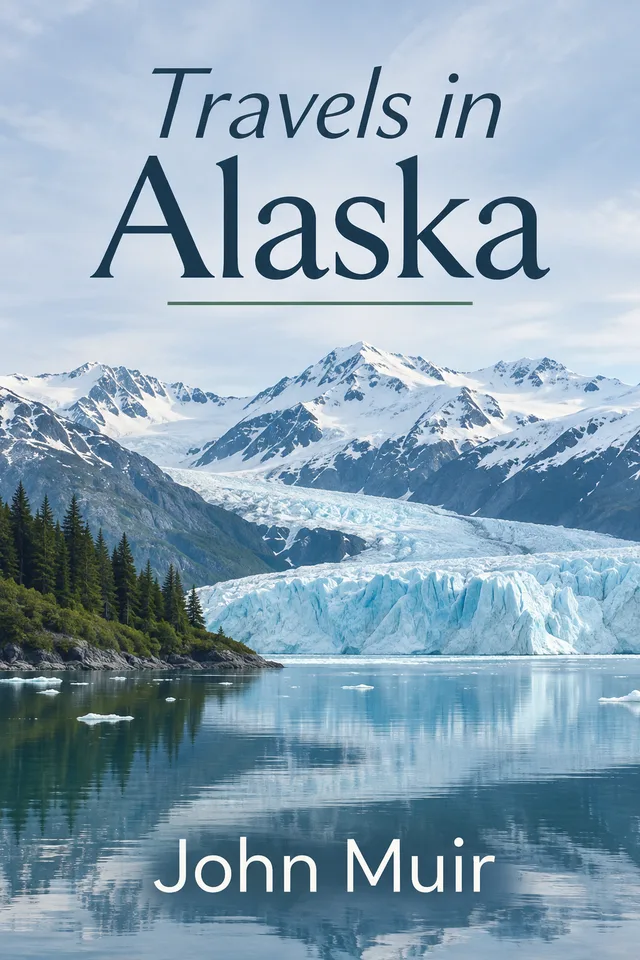
Travels in Alaska
Edizione BooksWhale in inglese di John Muir
John Muir records journeys through Alaska, tracing glaciers, observing coastal landscapes, and recounting travel by canoe and on foot.
- Anteprima
- Estratto dal testo preparato
- Formati
- Lettore online, EPUB, PDF
- Accesso
- Claim Libreria
Introduzione al libro
Travels in Alaska
Muir’s account covers journeys in 1879, 1880, and 1890. He follows the waterways of southeastern Alaska, describes the movement and shape of glaciers, and records encounters with Indigenous communities and travelling companions. The three parts and the glossary of Chinook Jargon follow the scope of the posthumous volume.
Edizione BooksWhale
Come è stata preparata
Questa edizione si basa su un testo di pubblico dominio ed è stata preparata da BooksWhale per la lettura digitale.
Base di pubblico dominio
Perché può essere condivisa
John Muir died in 1914. The original English work dates to 1915; this edition uses the text provided by Project Gutenberg and marked public domain in the United States.
Leggi anteprima
Estratto dal testo preparato
Anteprima selezionata dal testo preparato per la lettura.
Capitolo in anteprimaPart I The Trip of 1879Leggi anteprima
Part I The Trip of 1879
Capitolo in anteprimaChapter I — Puget Sound and British ColumbiaAnteprima
After eleven years of study and exploration in the Sierra Nevada of California and the mountain-ranges of the Great Basin, studying in particular their glaciers, forests, and wild life, above all their ancient glaciers and the influence they exerted in sculpturing the rocks over which they passed with tremendous pressure, making new landscapes, scenery, and beauty which so mysteriously influence every human being, and to some extent all life, I was anxious to gain some knowledge of the regions to the northward, about Puget Sound and Alaska. With this grand object in view I left San Francisco in May, 1879, on the steamer Dakota, without any definite plan, as with the exception of a few of the Oregon peaks and their forests all the wild north was new to me.
To the mountaineer a sea voyage is a grand, inspiring, restful change. For forests and plains with their flowers and fruits we have new scenery, new life of every sort; water hills and dales in eternal visible motion for rock waves, types of permanence.
It was curious to note how suddenly the eager countenances of the passengers were darkened as soon as the good ship passed through the Golden Gate and began to heave on the waves of the open ocean. The crowded deck was speedily deserted on account of seasickness. It seemed strange that nearly every one afflicted should be more or less ashamed.
Next morning a strong wind was blowing, and the sea was gray and white, with long breaking waves, across which the Dakota was racing half-buried in spray. Very few of the passengers were on deck to enjoy the wild scenery. Every wave seemed to be making enthusiastic, eager haste to the shore, with long, irised tresses streaming from its tops, some of its outer fringes borne away in scud to refresh the wind, all the rolling, pitching, flying water exulting in the beauty of rainbow light. Gulls and albatrosses, strong, glad life in the midst of the stormy beauty, skimmed the waves against the wind, seemingly without effort, oftentimes flying nearly a mile without a single wing-beat, gracefully swaying from side to side and tracing the curves of the briny water hills with the finest precision, now and then just grazing the highest.
And yonder, glistening amid the irised spray, is still more striking revelation of warm life in the so-called howling waste,—a half-dozen whales, their broad backs like glaciated bosses of granite heaving aloft in near view, spouting lustily, drawing a long breath, and plunging down home in colossal health and comfort. A merry school of porpoises, a square mile of them, suddenly appear, tossing themselves into the air in abounding strength and hilarity, adding foam to the waves and making all the wilderness wilder. One cannot but feel sympathy with and be proud of these brave neighbors, fellow citizens in the commonwealth of the world, making a living like the rest of us. Our good ship also seemed like a thing of life, its great iron heart beating on through calm and storm, a truly noble spectacle. But think of the hearts of these whales, beating warm against the sea, day and night, through dark and light, on and on for centuries; how the red blood must rush and gurgle in and out, bucketfuls, barrelfuls at a beat!
The cloud colors of one of the four sunsets enjoyed on the voyage were remarkably pure and rich in tone. There was a well-defined range of cumuli a few degrees above the horizon, and a massive, dark-gray rain-cloud above it, from which depended long, bent fringes overlapping the lower cumuli and partially veiling them; and from time to time sunbeams poured through narrow openings and painted the exposed bosses and fringes in ripe yellow tones, which, with the reflections on the water, made magnificent pictures. The scenery of the ocean, however sublime in vast expanse, seems far less beautiful to us dry-shod animals than that of the land seen only in comparatively small patches; but when we contemplate the whole globe as one great dewdrop, striped and dotted with continents and islands, flying through space with other stars all singing and shining together as one, the whole universe appears as an infinite storm of beauty.
Capitolo in anteprimaChapter II — Alexander Archipelago and the Home I found in AlaskaAnteprima
To the lover of pure wildness Alaska is one of the most wonderful countries in the world. No excursion that I know of may be made into any other American wilderness where so marvelous an abundance of noble, newborn scenery is so charmingly brought to view as on the trip through the Alexander Archipelago to Fort Wrangell and Sitka. Gazing from the deck of the steamer, one is borne smoothly over calm blue waters, through the midst of countless forest-clad islands. The ordinary discomforts of a sea voyage are not felt, for nearly all the whole long way is on inland waters that are about as waveless as rivers and lakes. So numerous are the islands that they seem to have been sown broadcast; long tapering vistas between the largest of them open in every direction.
Day after day in the fine weather we enjoyed, we seemed to float in true fairyland, each succeeding view seeming more and more beautiful, the one we chanced to have before us the most surprisingly beautiful of all. Never before this had I been embosomed in scenery so hopelessly beyond description. To sketch picturesque bits, definitely bounded, is comparatively easy—a lake in the woods, a glacier meadow, or a cascade in its dell; or even a grand master view of mountains beheld from some commanding outlook after climbing from height to height above the forests. These may be attempted, and more or less telling pictures made of them; but in these coast landscapes there is such indefinite, on-leading expansiveness, such a multitude of features without apparent redundance, their lines graduating delicately into one another in endless succession, while the whole is so fine, so tender, so ethereal, that all pen-work seems hopelessly unavailing. Tracing shining ways through fiord and sound, past forests and waterfalls, islands and mountains and far azure headlands, it seems as if surely we must at length reach the very paradise of the poets, the abode of the blessed.
Some idea of the wealth of this scenery may be gained from the fact that the coast-line of Alaska is about twenty-six thousand miles long, more than twice as long as all the rest of the United States. The islands of the Alexander Archipelago, with the straits, channels, canals, sounds, passages, and fiords, form an intricate web of land and water embroidery sixty or seventy miles wide, fringing the lofty icy chain of coast mountains from Puget Sound to Cook Inlet; and, with infinite variety, the general pattern is harmonious throughout its whole extent of nearly a thousand miles. Here you glide into a narrow channel hemmed in by mountain walls, forested down to the water’s edge, where there is no distant view, and your attention is concentrated on the objects close about you—the crowded spires of the spruces and hemlocks rising higher and higher on the steep green slopes; stripes of paler green where winter avalanches have cleared away the trees, allowing grasses and willows to spring up; zigzags of cascades appearing and disappearing among the bushes and trees; short, steep glens with brawling streams hidden beneath alder and dogwood, seen only where they emerge on the brown algæ of the shore; and retreating hollows, with lingering snow-banks marking the fountains of ancient glaciers. The steamer is often so near the shore that you may distinctly see the cones clustered on the tops of the trees, and the ferns and bushes at their feet.
But new scenes are brought to view with magical rapidity. Rounding some bossy cape, the eye is called away into far-reaching vistas, bounded on either hand by headlands in charming array, one dipping gracefully beyond another and growing fainter and more ethereal in the distance. The tranquil channel stretching river-like between, may be stirred here and there by the silvery plashing of upspringing salmon, or by flocks of white gulls floating like water-lilies among the sun spangles; while mellow, tempered sunshine is streaming over all, blending sky, land, and water in pale, misty blue. Then, while you are dreamily gazing into the depths of this leafy ocean lane, the little steamer, seeming hardly larger than a duck, turning into some passage not visible until the moment of entering it, glides into a wide expanse—a sound filled with islands, sprinkled and clustered in forms and compositions such as nature alone can invent; some of them so small the trees growing on them seem like single handfuls culled from the neighboring woods and set in the water to keep them fresh, while here and there at wide intervals you may notice bare rocks just above the water, mere dots punctuating grand, outswelling sentences of islands.
Indice
In questa edizione
- 01Part I The Trip of 1879
- 02Chapter I — Puget Sound and British Columbia
- 03Chapter II — Alexander Archipelago and the Home I found in Alaska
- 04Chapter III — Wrangell Island and Alaska Summers
- 05Chapter IV — The Stickeen River
- 06Chapter V — A Cruise in the Cassiar
- 07Chapter VI — The Cassiar Trail
- 08Chapter VII — Glenora Peak
- 09Chapter VIII — Exploration of the Stickeen Glaciers
- 10Chapter IX — A Canoe Voyage to Northward
- 11Chapter X — The Discovery of Glacier Bay
- 12Chapter XI — The Country of the Chilcats
- 13Chapter XII — The Return to Fort Wrangell
- 14Chapter XIII — Alaska Indians
- 15Part II The Trip of 1880
- 16Chapter XIV — Sum Dum Bay
- 17Chapter XV — From Taku River to Taylor Bay
- 18Chapter XVI — Glacier Bay
- 19Part III The Trip of 1890
- 20Chapter XVII — In Camp at Glacier Bay
- 21Chapter XVIII — My Sled-Trip on the Muir Glacier
- 22Chapter XIX — Auroras
- 23Glossary of Words in the Chinook Jargon
Disponibilità lingue
Altre lingue
Altre edizioni linguistiche non sono ancora pubblicate. Qui appariranno quando disponibili.
Richiedi un'altra lingua