inglese Edizione
Letteratura
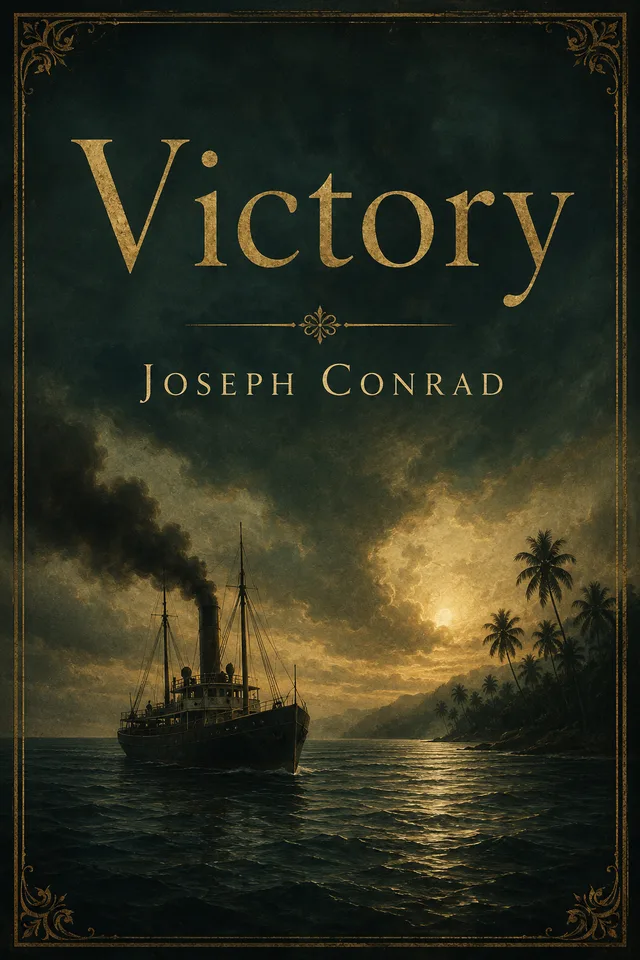
Victory
Edizione BooksWhale in inglese di Joseph Conrad
A late Conrad novel of isolation, moral danger, and psychological tension in the tropics.
- Anteprima
- Estratto dal testo preparato
- Formati
- Lettore online, EPUB, PDF
- Accesso
- Claim Libreria
Introduzione al libro
Victory
Victory follows Axel Heyst, a detached observer drawn into human attachment and menace on a remote island. Joseph Conrad combines adventure, irony, and psychological suspense in a dark meditation on isolation, evil, and the cost of withdrawing from the world.
Edizione BooksWhale
Come è stata preparata
Questa edizione si basa su un testo di pubblico dominio ed è stata preparata da BooksWhale per la lettura digitale.
Base di pubblico dominio
Perché può essere condivisa
Joseph Conrad died in 1924, and Victory was first published in 1915; these dates support the public-domain basis for this original English edition.
Leggi anteprima
Estratto dal testo preparato
Anteprima selezionata dal testo preparato per la lettura.
Capitolo in anteprimaPart 1Leggi anteprima
Victory
Joseph Conrad
PART ONE
CHAPTER ONE
There is, as every schoolboy knows in this scientific age, a very close chemical relation between coal and diamonds. It is the reason, I believe, why some people allude to coal as “black diamonds.” Both these commodities represent wealth; but coal is a much less portable form of property. There is, from that point of view, a deplorable lack of concentration in coal. Now, if a coal-mine could be put into one's waistcoat pocket--but it can't! At the same time, there is a fascination in coal, the supreme commodity of the age in which we are camped like bewildered travellers in a garish, unrestful hotel. And I suppose those two considerations, the practical and the mystical, prevented Heyst--Axel Heyst--from going away.
The Tropical Belt Coal Company went into liquidation. The world of finance is a mysterious world in which, incredible as the fact may appear, evaporation precedes liquidation. First the capital evaporates, and then the company goes into liquidation. These are very unnatural physics, but they account for the persistent inertia of Heyst, at which we “out there” used to laugh among ourselves--but not inimically. An inert body can do no harm to anyone, provokes no hostility, is scarcely worth derision. It may, indeed, be in the way sometimes; but this could not be said of Axel Heyst. He was out of everybody's way, as if he were perched on the highest peak of the Himalayas, and in a sense as conspicuous. Everyone in that part of the world knew of him, dwelling on his little island. An island is but the top of a mountain. Axel Heyst, perched on it immovably, was surrounded, instead of the imponderable stormy and transparent ocean of air merging into infinity, by a tepid, shallow sea; a passionless offshoot of the great waters which embrace the continents of this globe. His most frequent visitors were shadows, the shadows of clouds, relieving the monotony of the inanimate, brooding sunshine of the tropics. His nearest neighbour--I am speaking now of things showing some sort of animation--was an indolent volcano which smoked faintly all day with its head just above the northern horizon, and at night levelled at him, from amongst the clear stars, a dull red glow, expanding and collapsing spasmodically like the end of a gigantic cigar puffed at intermittently in the dark. Axel Heyst was also a smoker; and when he lounged out on his veranda with his cheroot, the last thing before going to bed, he made in the night the same sort of glow and of the same size as that other one so many miles away.
In a sense, the volcano was company to him in the shades of the night--which were often too thick, one would think, to let a breath of air through. There was seldom enough wind to blow a feather along. On most evenings of the year Heyst could have sat outside with a naked candle to read one of the books left him by his late father. It was not a mean store. But he never did that. Afraid of mosquitoes, very likely. Neither was he ever tempted by the silence to address any casual remarks to the companion glow of the volcano. He was not mad. Queer chap--yes, that may have been said, and in fact was said; but there is a tremendous difference between the two, you will allow.
On the nights of full moon the silence around Samburan--the “Round Island” of the charts--was dazzling; and in the flood of cold light Heyst could see his immediate surroundings, which had the aspect of an abandoned settlement invaded by the jungle: vague roofs above low vegetation, broken shadows of bamboo fences in the sheen of long grass, something like an overgrown bit of road slanting among ragged thickets towards the shore only a couple of hundred yards away, with a black jetty and a mound of some sort, quite inky on its unlighted side. But the most conspicuous object was a gigantic blackboard raised on two posts and presenting to Heyst, when the moon got over that side, the white letters “T. B. C. Co.” in a row at least two feet high. These were the initials of the Tropical Belt Coal Company, his employers--his late employers, to be precise.
Capitolo in anteprimaPart 2Anteprima
“It's a villainous plot. Unluckily, one is helpless. That scoundrel Cousinho--Andreas, you know--has been coveting the brig for years. Naturally, I would never sell. She is not only my livelihood; she's my life. So he has hatched this pretty little plot with the chief of the customs. The sale, of course, will be a farce. There's no one here to bid. He will get the brig for a song--no, not even that--a line of a song. You have been some years now in the islands, Heyst. You know us all; you have seen how we live. Now you shall have the opportunity to see how some of us end; for it is the end, for me. I can't deceive myself any longer. You see it--don't you?”
Morrison had pulled himself together, but one felt the snapping strain on his recovered self-possession. Heyst was beginning to say that he “could very well see all the bearings of this unfortunate--” when Morrison interrupted him jerkily.
“Upon my word, I don't know why I have been telling you all this. I suppose seeing a thoroughly white man made it impossible to keep my trouble to myself. Words can't do it justice; but since I've told you so much I may as well tell you more. Listen. This morning on board, in my cabin I went down on my knees and prayed for help. I went down on my knees!”
“You are a believer, Morrison?” asked Heyst with a distinct note of respect.
“Surely I am not an infidel.”
Morrison was swiftly reproachful in his answer, and there came a pause, Morrison perhaps interrogating his conscience, and Heyst preserving a mien of unperturbed, polite interest.
“I prayed like a child, of course. I believe in children praying--well, women, too, but I rather think God expects men to be more self-reliant. I don't hold with a man everlastingly bothering the Almighty with his silly troubles. It seems such cheek. Anyhow, this morning I--I have never done any harm to any God's creature knowingly--I prayed. A sudden impulse--I went flop on my knees; so you may judge--”
They were gazing earnestly into each other's eyes. Poor Morrison added, as a discouraging afterthought:
“Only this is such a God-forsaken spot.”
Heyst inquired with a delicate intonation whether he might know the amount for which the brig was seized.
Morrison suppressed an oath, and named curtly a sum which was in itself so insignificant that any other person than Heyst would have exclaimed at it. And even Heyst could hardly keep incredulity out of his politely modulated voice as he asked if it was a fact that Morrison had not that amount in hand.
Morrison hadn't. He had only a little English gold, a few sovereigns, on board. He had left all his spare cash with the Tesmans, in Samarang, to meet certain bills which would fall due while he was away on his cruise. Anyhow, that money would not have been any more good to him than if it had been in the innermost depths of the infernal regions. He said all this brusquely. He looked with sudden disfavour at that noble forehead, at those great martial moustaches, at the tired eyes of the man sitting opposite him. Who the devil was he? What was he, Morrison, doing there, talking like this? Morrison knew no more of Heyst than the rest of us trading in the Archipelago did. Had the Swede suddenly risen and hit him on the nose, he could not have been taken more aback than when this stranger, this nondescript wanderer, said with a little bow across the table:
“Oh! If that's the case I would be very happy if you'd allow me to be of use!”
Morrison didn't understand. This was one of those things that don't happen--unheard of things. He had no real inkling of what it meant, till Heyst said definitely:
Capitolo in anteprimaPart 3Anteprima
These manifestations shook the soberest minds. For a time everybody in the islands was talking of the Tropical Belt Coal, and even those who smiled quietly to themselves were only hiding their uneasiness. Oh, yes; it had come, and anybody could see what would be the consequences--the end of the individual trader, smothered under a great invasion of steamers. We could not afford to buy steamers. Not we. And Heyst was the manager.
“You know, Heyst, enchanted Heyst.”
“Oh, come! He has been no better than a loafer around here as far back as any of us can remember.”
“Yes, he said he was looking for facts. Well, he's got hold of one that will do for all of us,” commented a bitter voice.
“That's what they call development--and be hanged to it!” muttered another.
Never was Heyst talked about so much in the tropical belt before.
“Isn't he a Swedish baron or something?”
“He, a baron? Get along with you!”
For my part I haven't the slightest doubt that he was. While he was still drifting amongst the islands, enigmatical and disregarded like an insignificant ghost, he told me so himself on a certain occasion. It was a long time before he materialized in this alarming way into the destroyer of our little industry--Heyst the Enemy.
It became the fashion with a good many to speak of Heyst as the Enemy. He was very concrete, very visible now. He was rushing all over the Archipelago, jumping in and out of local mail-packets as if they had been tram-cars, here, there, and everywhere--organizing with all his might. This was no mooning about. This was business. And this sudden display of purposeful energy shook the incredulity of the most sceptical more than any scientific demonstration of the value of these coal-outcrops could have done. It was impressive. Schomberg was the only one who resisted the infection. Big, manly in a portly style, and profusely bearded, with a glass of beer in his thick paw, he would approach some table where the topic of the hour was being discussed, would listen for a moment, and then come out with his invariable declaration:
“All this is very well, gentlemen; but he can't throw any of his coal-dust in my eyes. There's nothing in it. Why, there can't be anything in it. A fellow like that for manager? Phoo!”
Was it the clairvoyance of imbecile hatred, or mere stupid tenacity of opinion, which ends sometimes by scoring against the world in a most astonishing manner? Most of us can remember instances of triumphant folly; and that ass Schomberg triumphed. The T.B.C. Company went into liquidation, as I began by telling you. The Tesmans washed their hands of it. The Government cancelled those famous contracts, the talk died out, and presently it was remarked here and there that Heyst had faded completely away. He had become invisible, as in those early days when he used to make a bolt clear out of sight in his attempts to break away from the enchantment of “these isles,” either in the direction of New Guinea or in the direction of Saigon--to cannibals or to cafes. The enchanted Heyst! Had he at last broken the spell? Had he died? We were too indifferent to wonder overmuch. You see we had on the whole liked him well enough. And liking is not sufficient to keep going the interest one takes in a human being. With hatred, apparently, it is otherwise. Schomberg couldn't forget Heyst. The keen, manly Teutonic creature was a good hater. A fool often is.
“Good evening, gentlemen. Have you got everything you want? So! Good! You see? What was I always telling you? Aha! There was nothing in it. I knew it. But what I would like to know is what became of that--Swede.”
He put a stress on the word Swede as if it meant scoundrel. He detested Scandinavians generally. Why? Goodness only knows. A fool like that is unfathomable. He continued:
Indice
In questa edizione
- 01Part 1
- 02Part 2
- 03Part 3
- 04Part 4
- 05Part 5
- 06Part 6
- 07Part 7
- 08Part 8
- 09Part 9
- 10Part 10
- 11Part 11
- 12Part 12
- 13Part 13
- 14Part 14
- 15Part 15
- 16Part 16
- 17Part 17
- 18Part 18
- 19Part 19
- 20Part 20
- 21Part 21
- 22Part 22
- 23Part 23
- 24Part 24
- 25Part 25
- 26Part 26
- 27Part 27
- 28Part 28
- 29Part 29
- 30Part 30
- 31Part 31
- 32Part 32
- 33Part 33
- 34Part 34
- 35Part 35
- 36Part 36
- 37Part 37
- 38Part 38
Disponibilità lingue
Altre lingue
Altre edizioni linguistiche non sono ancora pubblicate. Qui appariranno quando disponibili.
Richiedi un'altra lingua