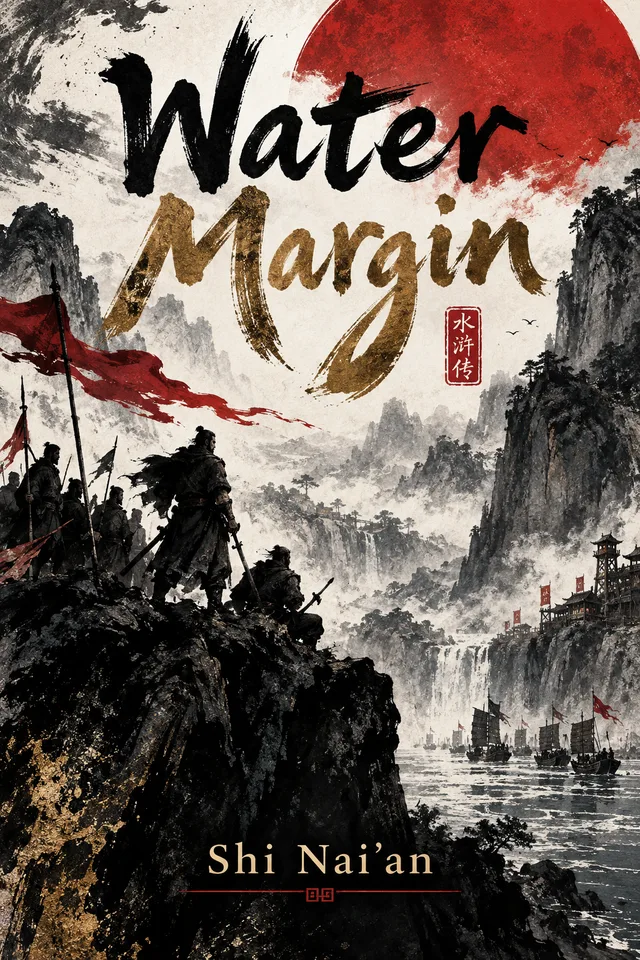
inglese Edizione
Letteratura
Water Margin
Edizione BooksWhale in inglese di Shi Nai’an; Luo Guanzhong & Luo Guanzhong
Titolo originale: 水浒传
The opening volume of the Chinese hero epic about Liangshan, outlaw brotherhood, justice, rebellion, and tragic loyalty.
- Anteprima
- Estratto dal testo preparato
- Formati
- Lettore online, EPUB, PDF
- Accesso
- Claim Libreria
Introduzione al libro
Water Margin
Water Margin, Volume One introduces the outlaws and displaced heroes who gather at Liangshan. Its episodes of corrupt officials, brotherhood, revenge, courage, and moral ambiguity make it one of the great Chinese traditions of popular storytelling and historical adventure.
Edizione BooksWhale
Come è stata preparata
Questa edizione è una traduzione assistita da IA e revisionata da persone, preparata da BooksWhale per leggibilità, formattazione e coerenza.
Base di pubblico dominio
Perché può essere condivisa
Water Margin is a Chinese classical novel whose composition and circulation date to the Ming period. The Chinese source text is public domain; this English volume must use a verified public-domain or BooksWhale-authorized translation workflow.
Leggi anteprima
Estratto dal testo preparato
Anteprima selezionata dal testo preparato per la lettura.
Capitolo in anteprimaFull textLeggi anteprima
Water Margin
Shi Nai’an
Capitolo in anteprimaChapter One: Celestial Master Zhang Prays to Dispel the Plague; Grand Marshal Hong Mistakenly Releases the DemonsAnteprima
A poem says:
The crimson-turbaned cock-crow officer reports the dawn watch;
the imperial wardrobe has just presented the jade-cloud fur robe.
The palace gates of the Nine Heavens open;
officials from ten thousand states bow before the imperial crown tassels.
Sunlight has only just reached the immortal palm when it moves;
incense smoke is about to drift around the dragon robe.
After court, a five-colored edict must be drafted;
the sound of pendants returns to the Phoenix Pool.
It is said that during the reign of Emperor Renzong of the Great Song, on the third day of the third month in the third year of Jiayou, at the third watch after the fifth drum, the emperor seated himself in Zichen Hall and received the congratulations of the hundred officials. One saw:
Auspicious clouds veiled the Phoenix Pavilion; blessed qi covered the Dragon Tower. Smoke-wreathed imperial willows brushed the banners and flags; dew-laden palace flowers greeted swords and halberds. In the shadow of heavenly fragrance, jade hairpins and pearl shoes gathered on the vermilion steps; amid immortal music, embroidered coats and brocade robes supported the imperial carriage. The pearl curtains were rolled up, and on the golden hall the imperial carriage appeared; phoenix-tail fans opened, and before the white jade steps the precious chariot halted. Faintly, three cracks of the purification whip sounded; rank upon rank, the civil and military officials stood in two orderly lines.
At that moment, an officer at the head of the hall cried out, “Those with business, step from the ranks and memorialize early; those without business, roll up the curtains and withdraw from court.” From among the ranks, Prime Minister Zhao Zhe and Councillor Wen Yanbo stepped forward and memorialized: “At present, plague is rampant in the capital. The people cannot live, and many soldiers and civilians have been harmed. We humbly hope Your Majesty will release offenders and extend grace, reduce punishments and lighten taxes, so as to avert Heaven’s disaster and aid the myriad people.” When the Son of Heaven heard the memorial, he hastily ordered the Hanlin Academy to draft an edict at once: on the one hand, a general pardon would be issued for all prisoners throughout the realm, and all taxes and levies among the people would be remitted; on the other hand, the palaces, temples, and monasteries in the capital were ordered to perform meritorious services to avert calamity. Unexpectedly, that year the plague grew still worse. When Emperor Renzong learned of it, his imperial body became uneasy, and he again assembled the hundred officials. All took counsel. From among the ranks, a high minister stepped out of line and presented a memorial. When the Son of Heaven looked, it was Fan Zhongyan, Participant in Governmental Affairs. After bowing and making his greetings, he memorialized: “At present Heaven’s disaster is widespread, and soldiers and civilians are plunged into misery. Day and night they cannot live; the people suffer the calamity of imprisonment and distress. In my foolish opinion, to avert this disaster, Your Majesty may summon the Hereditary Celestial Master of the Han line to come to court by night, and in the forbidden precincts of the capital establish a great Luotian ritual of three thousand six hundred divisions, reporting to the Supreme Emperor above. This can avert and protect the people from the plague.” Emperor Renzong approved the memorial. He hurriedly ordered a Hanlin scholar to draft an edict, wrote it personally with the imperial brush, and issued one stick of imperial incense. He specially appointed Hong Xin, the Palace Grand Marshal in charge of internal and external inspections, as imperial envoy, to go to Dragon Tiger Mountain in Xinzhou, Jiangxi, and summon the Hereditary Celestial Master, Perfected Zhang, to come to court by night and pray to dispel the plague. There in the Golden Hall, the imperial incense was lit, and the emperor personally handed the cinnabar edict to Grand Marshal Hong as envoy, who immediately set out on his journey.
Capitolo in anteprimaChapter Two: Instructor Wang Privately Flees to Yan’an Prefecture; Nine-Dragoned Shi Raises Havoc in Shi Family VillageAnteprima
A poem says:
The ancient hidden gate opened in a single day;
the Heavenly Spirits and Earthly Fiends emerged from the springs below.
From no affair since ancient times, many affairs arise;
what was meant to avert disaster instead provoked disaster.
From now on the state will be clouded and disturbed;
wherever weapons go, there will be turmoil and battle.
Though Gao Qiu the treacherous sycophant may be hated,
from Hong Xin onward the seed of calamity was brewed.
At that time, the presiding Perfected said to Grand Marshal Hong, “Grand Marshal, you do not know. Within this hall, in former days, our old ancestral Celestial Master, Perfected Dongxuan, passed down a dharma talisman and gave instructions, saying: ‘Within this hall are locked and suppressed thirty-six Heavenly Spirit stars and seventy-two Earthly Fiend stars, altogether one hundred and eight demon lords. Above them stands a stone stele carved with dragon patterns, phoenix seal script, and heavenly talismans to suppress them here. If they are allowed to go out into the world, they will surely trouble the living beings below.’ Now the grand marshal has let them go. What can be done? In days to come they will surely become a later calamity.” When Grand Marshal Hong heard this, cold sweat broke out all over his body, and he trembled without ceasing. He hurriedly packed his luggage, led his attendants, and descended the mountain to return to the capital. After the Perfected and the Daoists had seen the officials off, they returned to the palace to repair the halls and set the stone stele upright again, which need not be described.
Now, on the road, Grand Marshal Hong instructed his attendants not to tell outsiders anything about the demons escaping, lest the Son of Heaven learn of it and blame him. Nothing happened on the way, and by night and starlight he returned to the capital. When he entered Bianliang, he heard people saying that the Celestial Master had performed rites in the forbidden precincts of the eastern capital for seven days and seven nights, broadly distributing talismans, averting and rescuing people from illness, and that the plague had completely disappeared, while soldiers and civilians were safe and at peace. The Celestial Master had taken leave of the court and, riding a crane and driving the clouds, had returned to Dragon Tiger Mountain. The next morning at court, Grand Marshal Hong saw the Son of Heaven and memorialized, “The Celestial Master rode a crane and drove clouds and arrived first in the capital. We ministers came by courier stations and only just arrived here.” Renzong approved the memorial, rewarded Hong Xin, and restored him to his former office, which need not be further described.
Later, Emperor Renzong reigned for forty-two years in all before he passed away. Having no crown prince, he passed the throne to the son of Prince Pu’anyi Yunrang, a grandson of Emperor Taizu. His imperial title was established as Yingzong. He reigned for four years and passed the throne to the crown prince, Emperor Shenzong. Shenzong reigned for eighteen years and passed the throne to the crown prince, Emperor Zhezong, who ascended the throne. At that time, the whole realm was at peace and all four quarters were without incident.
Now in the eastern capital, Kaifeng Prefecture, Bianliang, under the Xuanwu Army, there was the son of a ruined, drifting household, surnamed Gao, ranked second. From childhood he neglected family livelihood and liked only thrusting spears and wielding staves. He was especially good at kicking air-ball. People in the capital spoke conveniently and did not call him Gao the Second, but all called him Gao Qiu. Later, when he prospered, he removed the “fur” radical from the character for ball and added the “person” radical, changing his name to Gao Qiu. This man could play wind and string instruments, sing and dance, thrust spears and wield staves, wrestle and amuse himself, and he was fairly capable in poetry, documents, lyrics, and rhapsodies. But as for benevolence, righteousness, propriety, wisdom, trustworthiness, conduct, loyalty, and goodness, he knew none of them. He merely idled in and around the eastern capital. Because he helped the son of Iron-born Wang the gentleman spend money, passing every day in the pleasure quarters, amid romance and moonlit pleasures, the man’s father filed a complaint in Kaifeng Prefecture. The prefect sentenced Gao Qiu to forty strokes on the back and exiled him beyond the district boundary. The people of the eastern capital were forbidden to allow him to lodge or eat at their homes. Gao Qiu had no plan and no choice but to go to Linhuai Prefecture in Huaixi and seek shelter with an idle fellow who ran a gambling house, Liu Dalang, named Liu Shiquan. His whole life he loved cherishing guests and keeping idle men, recruiting dry-land rascals from the four quarters. Gao Qiu sought refuge at Liu Dalang’s house and stayed there for three years.
Indice
In questa edizione
- 01Full text
- 02Chapter One: Celestial Master Zhang Prays to Dispel the Plague; Grand Marshal Hong Mistakenly Releases the Demons
- 03Chapter Two: Instructor Wang Privately Flees to Yan’an Prefecture; Nine-Dragoned Shi Raises Havoc in Shi Family Village
- 04Chapter Three: Shi Dalang Leaves Huayin County by Night; Constable Lu Beats the Guarder of the West Pass with His Fists
- 05Chapter Four: Squire Zhao Rebuilds Wenshu Monastery; Lu Zhishen Raises Havoc on Mount Wutai
- 06Chapter Five: Little Hegemon Drunkenly Enters the Gold-Curtained Bedchamber; the Flowered Monk Raises Havoc in Peach Blossom Village
- 07Chapter Six: Nine-Dragoned Shi Robs the Road in Red Pine Forest; Lu Zhishen Burns Down Earthen Jar Temple
- 08Chapter Seven: The Flowered Monk Uproots a Drooping Willow; Panther-Head Mistakenly Enters White Tiger Hall
- 09Chapter Eight: Instructor Lin Is Tattooed and Exiled on the Road to Cangzhou; Lu Zhishen Raises Havoc in Wild Boar Forest
- 10Chapter Nine: Chai Jin’s Gate Invites Guests from All Under Heaven; Lin Chong Beats Instructor Hong with a Staff
- 11Chapter Ten: Instructor Lin in the Wind and Snow at the Mountain God Temple; Lu the Aide-de-Camp Burns the Forage Yard
- 12Chapter Eleven: Zhu Gui Sends a Signal Arrow from the Waterside Pavilion; Lin Chong Goes Up Liangshan on a Snowy Night
- 13Chapter Twelve: Lin Chong Becomes an Outlaw at Liangshan Marsh; Yang Zhi Sells His Sword in Bianjing City
- 14Chapter Thirteen: Urgent Vanguard Contends for Merit at the Eastern Suburb; Blue-Faced Beast Fights in Beijing
- 15Chapter Fourteen: Red-Haired Ghost Lies Drunk in Lingguan Hall; Heavenly King Chao Acknowledges Righteousness in East Creek Village
- 16Chapter Fifteen: Wu the Scholar Persuades the Three Ruan Brothers to Join the Scheme; Gongsun Sheng Responds to the Seven Stars’ Gathering of Righteousness
- 17Chapter Sixteen: Yang Zhi Escorts the Loads of Gold and Silver; Wu Yong Cleverly Seizes the Birthday Convoy
- 18Chapter Seventeen: The Flowered Monk Single-Handedly Attacks Two Dragon Mountain; Blue-Faced Beast Seizes Jewel Temple Together
- 19Chapter Eighteen: Beautiful Beard Cleverly Calms Winged Tiger; Song Jiang Privately Releases Heavenly King Chao
- 20Chapter Nineteen: Lin Chong Launches the Great Internal Clash at the Water Stronghold; Chao Gai Slightly Seizes the Marsh at Liangshan
- 21Chapter Twenty: The Righteous Men of Liangshan Marsh Honor Chao Gai; Liu Tang Travels by Moonlit Night to Yuncheng County
- 22Chapter Twenty-One: The Bawd, Drunk, Beats Tang Niu’er; Song Jiang, in Anger, Kills Yan Poxi
- 23Chapter Twenty-Two: Granny Yan Raises Havoc in Yuncheng County; Zhu Tong Righteously Releases Song Jiang
- 24Chapter Twenty-Three: Chai Jin of Henghai Commandery Keeps a Guest; Wu Song Fights the Tiger on Jingyang Ridge
- 25Chapter Twenty-Four: Granny Wang, Greedy for Bribes, Speaks of Romance; Yunge, Indignant, Makes Trouble in the Tea Shop
- 26Chapter Twenty-Five: Granny Wang Schemes to Coax Ximen Qing; The Lustful Woman Poisons Wu Dalang
Disponibilità lingue
Altre lingue
cinese
cinese Edizione
水浒传
Shi Nai’an; Luo Guanzhong & Luo Guanzhong · Letteratura
中国古典英雄传奇,写梁山好汉的聚义、反抗、义气与悲剧。
portoghese
portoghese Edizione
水浒传卷一
Shi Nai’an; Luo Guanzhong & Luo Guanzhong · Letteratura
Clássico de Shi Nai’an e Luo Guanzhong: 水浒传卷一, apresentado em tradução própria da BooksWhale.