英語 エディション
哲学
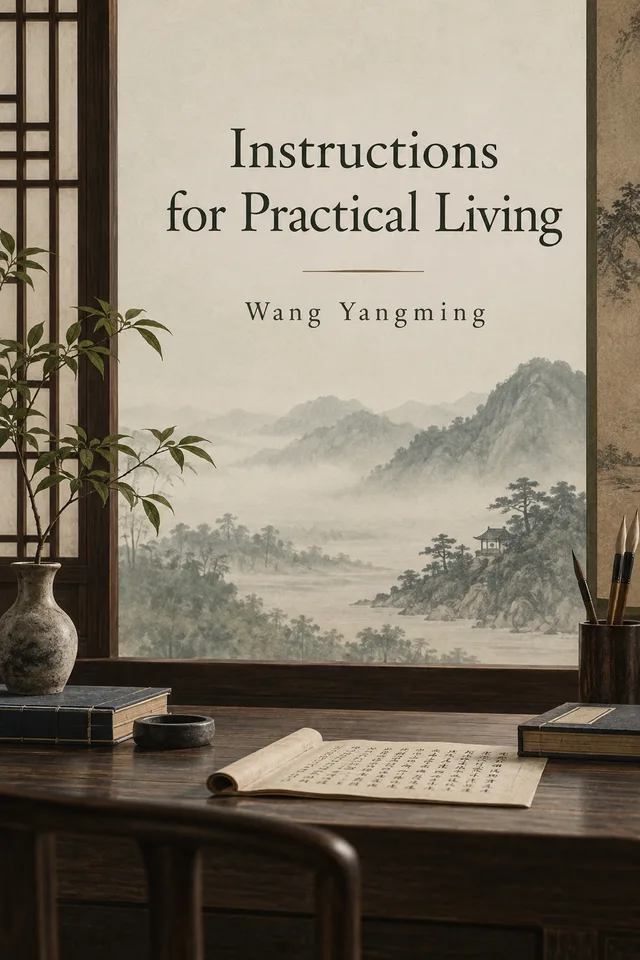
Instructions for Practical Living
英語 BooksWhale エディション · Wang Yangming
原題: 传习录
Wang Yangming’s conversations and letters on conscience, knowledge, action, self-cultivation, and moral practice.
- プレビュー
- 準備済みテキストからの抜粋
- 形式
- オンラインリーダー, EPUB, PDF
- アクセス
- ライブラリ claim
本の紹介
Instructions for Practical Living
Instructions for Practical Living presents Wang Yangming’s central claim that genuine knowledge must become action. Through dialogues, letters, and brief reflections, it explores the unity of mind and world, the discovery of innate moral knowledge, and the discipline of acting rightly in ordinary life.
BooksWhale エディション
このエディションの準備
このエディションはパブリックドメイン本文に基づき、BooksWhale がデジタル読書向けに準備しました。
パブリックドメイン根拠
このエディションを共有できる理由
Wang Yangming died in 1529; the Chinese philosophical work was compiled from his teachings in the sixteenth century. This English edition is a new BooksWhale translation authorized for publication under the applicable U.S. and E.U. rules.
プレビューを読む
準備済みテキストからの抜粋
準備済み読書テキストから選んだプレビューです。
プレビュー章Full textプレビューを読む
Instructions for Practical Living
王守仁
Instructions for Practical Living 王守仁 They did not know that during the three years Master Yangming spent in exile among the peoples of the remote frontier, he endured hardship and cultivated inner tranquility. His practice of “being refined and being single-minded” had already carried him beyond the ordinary realm into that of the sages, attaining the perfectly balanced and supremely upright Way. I have constantly received instruction under Master Yangming. His teachings seem easy to approach, yet the more one looks up to them, the loftier they become. At first they appear simple, yet the more deeply one investigates them, the more profound they prove. They seem not far away, yet the closer one seeks to attain them, the more inexhaustible they appear. After more than ten years, I still have not been able to glimpse the full extent of his attainment. Among the gentlemen of the world, some have met Master Yangming only once, some have never heard him speak, and others approach him already harboring contempt, arrogance, anger, or prejudice. They then hastily attempt to judge and conjecture about his teachings from a brief conversation or secondhand reports. How could they possibly understand the level he has attained? Even those who have studied under Master Yangming and heard his instruction often grasp one aspect while overlooking another. They perceive the outward appearance but fail to recognize the essential substance, just as Duke Mu of Qin's horse expert could notice a horse's sex and color without recognizing its capacity to gallop a thousand li.
For this reason, I have carefully recorded the teachings I have heard from the Master in ordinary conversation and privately shown them to fellow students of the same aspiration, so that we might examine and correct them together. I hope thereby not to prove unworthy of the Master's instruction. Respectfully recorded by his disciple, Xu Ai. Xu Ai asked, “In The Great Learning, the phrase ‘to be close to the people’ was said by Master Zhu to mean ‘to renew the people.’ The expression ‘to inspire the people to renew themselves’ in a later chapter also seems to support his interpretation. You, Master, believe that we should follow the old text and read it as ‘to be close to the people.’ Is there evidence for this interpretation as well?” Master Yangming replied: “The word ‘renew’ in ‘to inspire the people to renew themselves’ refers to people who renew themselves. It is different from the word ‘renew’ in ‘to renew the people.’ How could it serve as evidence for that interpretation? The word ‘inspire,’ however, corresponds to the idea of ‘being close,’ rather than conveying the meaning of ‘renewal.’ “The subsequent discussion of ‘governing the state and bringing peace to the world’ contains no elaboration on the word ‘renew.’
“Expressions such as ‘The gentleman esteems those whom the people esteem and loves those whom the people love; he delights in what they delight in and benefits them in what they find beneficial,’ ‘as though protecting an infant,’ and ‘Love what the people love and hate what the people hate; this is what it means to be the father and mother of the people,’ all express the meaning of ‘being close.’ “‘Being close to the people’ is like what Mencius meant when he said, ‘Love one's own family and extend benevolence to the people.’ To be close to them is to treat them with benevolence. “It was precisely because the people could not love one another that Shun appointed Xie as Minister of Education and instructed him to ‘reverently spread the five teachings,’ with the purpose of enabling the people to love one another. “In the Canon of Yao, ‘being able to illuminate one's great virtue’ corresponds to ‘manifesting one's luminous virtue.’ The expressions ‘bringing harmony to the nine clans,’ ‘distinguishing and ordering the various families,’ and ‘bringing peace and harmony to all states’ correspond to ‘being close to the people’ and ‘manifesting luminous virtue throughout the world.’ “Similarly, when Confucius spoke of ‘cultivating oneself in order to bring peace to the people,’ ‘cultivating oneself’ meant ‘manifesting luminous virtue,’ while ‘bringing peace to the people’ meant ‘being close to the people.’
プレビュー章Part of it read:プレビュー
“Why should innate moral knowledge depend upon extensive hearing? “Its marvelous unity planted the root long ago. “To follow its judgments of love and hate is the learning of the sages; “Without contrived anticipation or welcome, the creative source is present everywhere.” Master Yangming said: “If you had not come here to study the learning of the sages, I wonder what you would have meant by ‘following its judgments of love and hate.’” Wang Fuying, who was present, said: “Indeed. “I once read the Master's Preface to the Ancient Text of The Great Learning. “At the time, I had no idea what its words meant. “Only after coming here and listening to the teachings for a considerable period did I begin to understand their general meaning.” Xia Yuzhong, Shu Guoshang, and several others were attending upon Master Yangming during a meal. Master Yangming said: “The purpose of eating and drinking is simply to nourish our bodies. “After food is consumed, it must be digested. “If it merely accumulates in the stomach, it becomes an obstruction. “How could it then nourish the flesh? “Later scholars seek only to hear extensively and memorize large quantities of information. “But they allow everything they have learned to remain undigested within their minds.
“This is an illness caused by excessive consumption.” Master Yangming said: “Sages also acquire knowledge through learning, and ordinary people also possess knowledge from birth.” Someone asked: “Why?” Master Yangming replied: “Everyone possesses innate moral knowledge. “The sages merely preserve it completely, without allowing obstacles or obscurations to interfere with it. “They remain constantly careful, earnest, and reverent, so their efforts naturally never cease. “This too is learning. “But because knowledge from birth predominates in them, they are described as ‘knowing from birth and acting with natural ease.’ “Ordinary people likewise possess innate moral knowledge in its completeness from earliest childhood. “But they have more obstacles and obscurations. “Nevertheless, the innate moral knowledge belonging to their original substance cannot truly be extinguished. “Even when they study, inquire, examine themselves, and overcome their faults, they rely entirely upon this innate moral knowledge. “But because knowledge acquired through learning predominates in their case, they are described as ‘acquiring knowledge through learning and acting because they recognize its benefits.’”
Record of Huang Zhi Huang Yifang asked: “Master, your teaching concerning investigating things and extending knowledge means investigating and rectifying things as they arise in order to extend one's knowledge. “But this seems to produce knowledge only of individual matters rather than knowledge in its completeness. “How, then, can one attain the condition described as ‘vast and extensive as Heaven, deep and inexhaustible as a spring’?” Master Yangming replied: “The human mind is itself Heaven and the deep spring. “The original substance of the mind encompasses everything. “It is originally as vast as Heaven. “But when selfish desires obstruct it, it loses the appearance of its original heavenly vastness. “The Heavenly Principle within the mind is inexhaustible. “It is originally as deep as a spring. “But when selfish desires block its movement, it loses the appearance of its original depth. “If you now devote every thought to extending innate moral knowledge and completely remove these obstructions, its original condition will be restored. “It will once again be Heaven and the deep spring.” Master Yangming then pointed toward the sky and said to Yifang: “Consider the sky before us.
“The portion visible directly ahead is the bright sky. “The portions visible in every direction are also the same bright sky. “But many houses and walls obstruct our view, so we cannot see the sky in its entirety. “If those houses and walls were removed, we would perceive the same single sky everywhere. “We cannot say that the sky visible immediately before us is bright, while the sky beyond the walls is not bright. “From this we can understand that knowledge of a particular matter is knowledge of the whole, and knowledge of the whole is present in knowledge of a particular matter. “All belong to the same original substance.” (The following passages were recorded by the disciple Huang Zhi.) Master Yangming said: “Sages and worthies certainly possess great achievements and moral integrity. “But they simply follow Heavenly Principle, which is the Way. “Sages and worthies cannot properly be defined by their accomplishments or displays of moral courage.” “‘Becoming so absorbed in one's efforts that one forgets to eat’ describes the aspiration of the sage, which truly never ceases. “‘Finding such joy in the Way that one forgets one's worries’ describes the sage's practice of the Way, which is genuinely free from sorrow.
目次
このエディションの内容
- 01Full text
- 02Part of it read:
言語の提供状況
他の言語
中国語
中国語 エディション
传习录
Wang Yangming · 哲学
阳明心学代表作,集中呈现知行合一、致良知与工夫论。
フランス語
フランス語 エディション
Instructions pour la vie pratique
Wang Yangming · 哲学
Un classique du néoconfucianisme sur l'unité du savoir et de l'action.
ドイツ語
ドイツ語 エディション
Aufzeichnungen über die praktische Unterweisung
Wang Yangming · 哲学
Eine deutsche Ausgabe von Wang Yangmings Gesprächen über Wissen, Handeln, Gewissen und Selbstkultivierung.
スペイン語
スペイン語 エディション
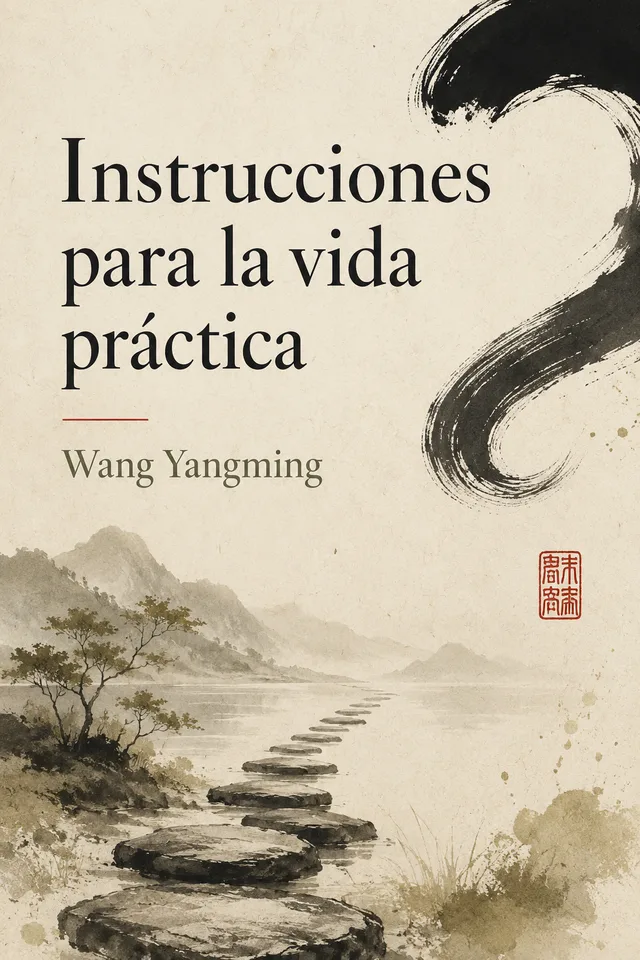
Instrucciones para la vida práctica
Wang Yangming · 哲学
La filosofía de Wang Yangming sobre conocimiento y acción, conciencia moral, estudio y vida cotidiana.