英語 エディション
文学
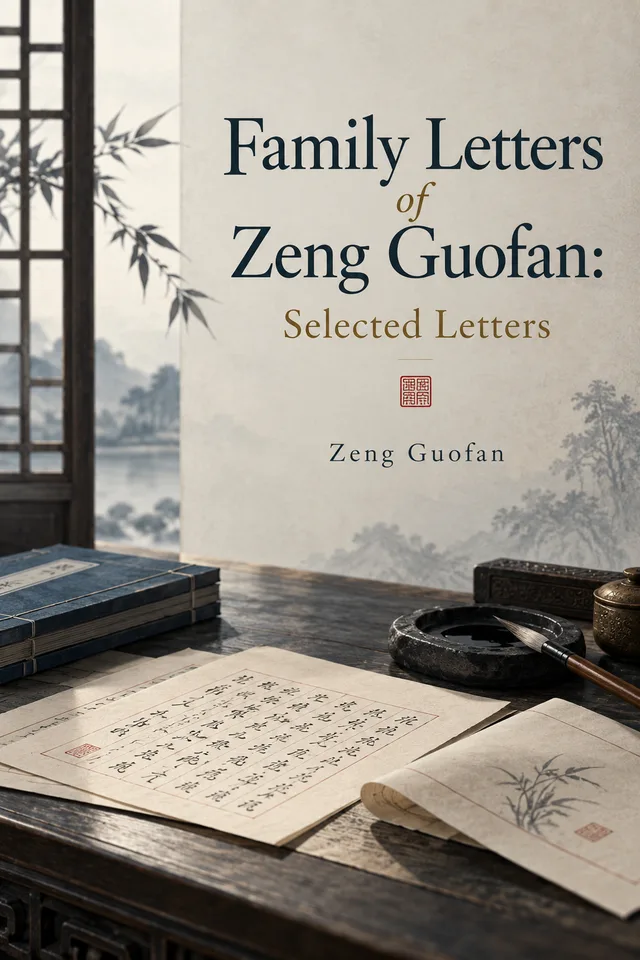
Family Letters of Zeng Guofan: Selected Letters
英語 BooksWhale エディション · Zeng Guofan
原題: 曾国藩家书
Selected family correspondence explores learning, self-examination, household affairs, responsibility, and the demands of public service across ten thematic groups.
- プレビュー
- 準備済みテキストからの抜粋
- 形式
- オンラインリーダー, EPUB, PDF
- アクセス
- ライブラリ claim
本の紹介
Family Letters of Zeng Guofan: Selected Letters
Zeng Guofan’s letters address relatives about study, conduct, finances, health, family responsibilities, and official work. Personal advice repeatedly returns to perseverance and the discipline of examining one’s own actions. This English selection contains ten groups of correspondence and retains letter numbers, salutations, and dates. It is a selected collection rather than the complete surviving correspondence, using the supplied AI-assisted translation revised by the user.
BooksWhale エディション
このエディションの準備
このエディションは BooksWhale が準備した AI 支援・人間確認済み翻訳で、読みやすさ、書式、一貫性を確認しています。
パブリックドメイン根拠
このエディションを共有できる理由
The underlying Chinese work is by Zeng Guofan, who died in 1872. This edition uses a newly prepared AI-assisted English translation commissioned and revised by the user; the supplied translation is distinct from the public-domain source text.
プレビューを読む
準備済みテキストからの抜粋
準備済み読書テキストから選んだプレビューです。
プレビュー章Chapter One — Letter 1プレビューを読む
The son, kneeling before the honorable father and mother, conveys his respectful wishes for your well-being:
On the 28th of June, I received the letter sent from home on the 24th of March, and learned that on the 19th of that month, my fourth younger brother had a son. The entire family sincerely congratulates them! Although there were some difficulties during the childbirth of my fourth brother's wife, fainting due to excessive bleeding is not uncommon. Now that everything is safe, it should become easier in the future. Before receiving this letter, I was worried, but now that I have it, I feel like a weight has been lifted, and my heart is much lighter.
At the end of June, an official from our county came to the capital to donate his service. He stayed in Ningxiang County and during the April county examination, he stayed with Peng Xingqi and Ding Xinfeng in the city. He met my fourth and sixth younger brothers and learned that Wu Dingwu had ranked first. Thirteen years ago, I was studying at the Chen Clan Ancestral Hall, and at that time, Wu Dingwu had just started learning the introduction of eight-legged essays with Yang Weizhai . He was studying under Yang Weizhai. Last year, I heard from Wu Chungang that Ding Wu was especially diligent and hardworking. Now he has indeed fulfilled his aspirations, and it can be said that he achieved great success in a very short time. He has already forgotten the names of the other top ten examinees and the topics for each examination. I hope that in the future, when you send letters, my fourth brother can provide more details.
My fourth and sixth brothers' exam results may not have been good, but there's no need to worry all the time. As the saying goes, "Better to enter late than fail to reach." In the past, Senior Shao Danqi (Shao Jiaming) entered school at the age of 43 and became the Imperial Commissioner of Education at the age of 52, currently serving in Guangxi. Wang Langqu (Wang Mingxiang) entered school in the 12th year of the Daoguang era and became the top scholar in the 13th year of the Daoguang era. Ruan Yuntai (Ruan Yun) entered the county examination in the 53rd year of the Qianlong era and didn't even pass the first round, but he became a Jinshi when he entered school that year. In the 54th year, he was chosen as a Hanlin scholar, in the 55th year, he became an official Hanlin of the Hanlin Academy, and in the 56th year, he ranked first in the major examination and was appointed as the Superintendent of Education in Zhejiang. Small gains and losses are nothing to fear; what we should fear most is a lack of diligence in our studies. If my two younger brothers are satisfied with the essays they wrote in the examination hall, they can request their original papers and send them to the capital for me to review. If they are not satisfied, there's no need to send them.
I am waiting in the capital for everything to be safe. My nephews and nieces, Ji Ze, are all in good health, but their skin is slightly dark.
Foreigners caused trouble in Jiangsu, capturing Zhenjiang on June 11th. There are dozens of large ships cruising on the river. The cities of Jiangning and Yangzhou are in great danger. However, heaven does not bring calamity, and the sage is above, so people in the capital still have relatively stable hearts.
Fellow townsman Wang Hancheng has left the capital, and my son and Chen Daiyun also plan to send their families back to the south, along with Zheng Xintian, Wang Hancheng, and their families. My son and the Chen family had originally planned this at the end of June and then sought divination on the first day of July. It seemed that they should not act recklessly at that time, so they suspended their plans. As of now, my son and the Chen family still have not sent their families back to the south.
プレビュー章Letter 2プレビュー
Your son, kneeling before the esteemed parents, conveys his well wishes to you both:
On the 29th of August, I sent my tenth letter, which detailed the birth of my daughter on the 28th and the return of my brother-in-law Wang Lüe to our family in the southern homeland. I wonder if you have received this letter? My health is good, and my wife is also healthy during her postpartum recovery. The health issues she experienced during her confinement last year have now been completely resolved. Our grandson and granddaughter are doing well as well.
On the 10th day, the results of the Shuntian Township Examination were posted. In Hunan, three individuals passed the examination, and a person from Changsha, Zhou Xingnong, secured the second place. .
Regarding my brother-in-law Wang Lüe's return home, I had initially intended to entrust the matter to Jiaxin Zhai. However, Lüe was unwilling to travel by cart, so I entrusted it to my brother-in-law Chen Daiyun's younger brother, who traveled back to the south on a grain transport ship. Yesterday, Daiyun returned from Tianjin and mentioned, "The ship isn't in the best condition." This has me quite worried. Fortunately, there are many people on board, so nothing major should occur.
I've heard that my younger brothers have resumed their studies in Xiaoluoxiang after the exams. I wonder if they are diligent or lazy? Now, only my youngest brother is still quite young, while the other three brothers have all passed twenty years of age. They should prioritize their studies as a daily routine. In our hometown, only Mr. Peng Boshu reads quite a bit. After him, there's hardly anyone who pays attention to it, probably because they are preoccupied with the imperial examinations. However, it should be known that reading and taking exams are not mutually exclusive. Neglecting to read will still affect one's performance in the exams. So, all my brothers at home should not focus on whether the exams go well or on writing eloquent essays but should prioritize reading every day. Otherwise, as the years go by, if not only the imperial exams remain elusive but also the goal of learning is not achieved, even if you wish to become a village schoolteacher in the future, there may be no one willing to hire you. Whether it's classics, history, poetry collections, or anthologies, you should read at least twenty pages every day. Since the beginning of this year, there hasn't been a day when I didn't read, even though various matters have kept me busy. I never neglect this essential duty.
I've heard that my ninth brother is planning to study with Liu Xiaxian. Lately, Xiaxian has made significant progress in his studies. If my ninth brother goes, it would be greatly beneficial. I hope that our esteemed father will carefully consider this matter. I dare not make decisions on my own. This matter should be decided by my ninth brother himself. If he has the determination to work hard and is fully committed to his studies, this journey for learning won't be in vain. However, if he remains as indecisive and unable to focus on his studies as before, he can still lead a comfortable life close to home, so why travel a hundred miles away to squander his time? I hope our esteemed father will first observe my ninth brother's aspirations and then make a decision. I will provide further updates on other matters when I have the opportunity.
Reported by your son
September 19, 1844
プレビュー章Letter 3プレビュー
To my dear sixth brother Wen Fu:
On May 29th and June 1st, I received your consecutive letters sent on March 1st, April 25th, and May 1st, along with two essays, which I truly appreciate for their excellent penmanship.
In your letters, you mentioned: "In front of brothers, I can openly express my inner thoughts, but when it comes to father, son, and grandchild relationships, I must be more cautious in expressing the things that are hard to speak of." These words are indeed very wise. When I conduct myself, I have always felt my heart is sincere, and I can be straightforward without reservation, without any harm. However, I realized yesterday upon receiving your letter that even among close family, there are times when one must be tactful. This is indeed my fault!
Xianghai is a person of good character. Although I did not stay with him for long, I know him well, and you can regard him as an elder brother. As for Ding Zhichen and Wang Hengchen, I haven't met them, but I assume I could treat them as teachers. Whether to consider them as teachers or friends is your own decision. If they truly exhibit dignity, serve as role models, possess sincerity, and are broad-minded, then considering them as teachers is suitable. However, if they are only learned and literary, regarding them as friends is enough. Regardless of whether you regard them as teachers or friends, you should approach your interactions with respect and not with indifference, or you will gradually neglect their influence, and you won't benefit from it.
In your March letter, you set too many tasks for yourself. Having too many tasks can lead to scattered focus and a lack of specialization. So, avoid doing that. In later letters, you mentioned that you borrowed a copy of the "Records of the Grand Historian" from Chen Jimu. This is a book that you must read thoroughly. If you're reading "Records of the Grand Historian," you shouldn't be simultaneously reading other books. There is no one-size-fits-all method for studying, but the most important thing is to focus.
I used to advise my brothers to limit their studies, but I now understand that if you're unwilling to do so, it's difficult to enforce such restrictions. Although you may follow the process of limiting your studies every day, it doesn't necessarily bring benefits. Therefore, now I advise my brothers to focus on a single word, "专" (specialize). Besides "专," there are a few sentences I want to say to you. I've written them with a cold gold pen, and you can paste them on the right side of your desk. Keep reading them and then copy a set to send to our three brothers at home.
Xianghai mentioned that if you want to study contemporary essays (such as eight-legged essays or four-book essays), you should be familiar with the "Donglai Boyi." He is absolutely correct. You can start by underlining the text with a pen and then select a few pieces to study thoroughly. Even if you don't study them thoroughly, as long as you're reading any book, you must read it from cover to cover. Otherwise, if you just flip through a few pages at will or excerpt some parts, you won't understand the book's structure, layout, and its most impressive sections.
If you want to learn how to write poems, you can start with the "Zhongzhou Collection." However, I think it's better to read a specific poet's collected works rather than reading a collection of general poetry. Each person has different views and preferences on this matter. My preference is, for five-character ancient poems, I enjoy reading the "Wenxuan"; for seven-character ancient poems, I like reading the "Changli Collection"; for five-character regulated poems, I enjoy reading the "Du Collection"; and for seven-character regulated poems, I especially like reading Du Fu's poems. But because I'm not able to reach the high standards he set in my own poetry writing, I also read the "Yuan Yishan Collection."
目次
このエディションの内容
- 01Chapter One — Letter 1
- 02Letter 2
- 03Letter 3
- 04Letter 4
- 05Letter 5
- 06Letter 6
- 07Letter 7
- 08Letter 8
- 09Letter 9
- 10Letter 10
- 11Letter 11
- 12Letter 12
- 13Letter 13
- 14Letter 14
- 15Chapter Two — Letter 15
- 16Letter 16
- 17Letter 17
- 18Letter 18
- 19Letter 19
- 20Letter 20
- 21Letter 21
- 22Letter 22
- 23Letter 23
- 24Letter 24
- 25Letter 25
- 26Letter 26
- 27Letter 27
- 28Letter 28
- 29Letter 29
- 30Letter 30
- 31Letter 31
- 32Letter 32
- 33Letter 33
- 34Letter 34
- 35Chapter Three — Letter 35
- 36Letter 36
- 37Letter 37
- 38Letter 38
- 39Letter 39
- 40Letter 40
- 41Letter 41
- 42Letter 42
- 43Letter 43
- 44Letter 44
- 45Letter 45
- 46Letter 46
- 47Letter 47
- 48Letter 48
- 49Letter 49
- 50Letter 50
- 51Letter 51
- 52Letter 52
- 53Letter 53
- 54Letter 54
- 55Letter 55
- 56Letter 56
- 57Letter 57
- 58Letter 58
- 59Letter 59
- 60Letter 60
- 61Chapter Four — Letter 61
- 62Letter 62
- 63Letter 63
- 64Letter 64
- 65Letter 65
- 66Letter 66
- 67Letter 67
- 68Letter 68
- 69Letter 69
- 70Letter 70
- 71Letter 71
- 72Letter 72
- 73Letter 73
- 74Letter 74
- 75Chapter Five — Letter 75
- 76Letter 76
- 77Letter 77
- 78Letter 78
- 79Letter 79
- 80Letter 80
- 81Letter 81
- 82Letter 82
- 83Letter 83
- 84Letter 84
- 85Letter 85
- 86Letter 86
- 87Letter 87
- 88Chapter Six — Letter 88
- 89Letter 89
- 90Letter 90
- 91Letter 91
- 92Letter 92
- 93Letter 93
- 94Letter 94
- 95Letter 95
- 96Letter 96
- 97Letter 97
- 98Letter 98
- 99Letter 99
- 100Chapter Seven — Letter 100
- 101Letter 101
- 102Letter 102
- 103Letter 103
- 104Letter 104
- 105Letter 105
- 106Letter 106
- 107Letter 107
- 108Letter 108
- 109Letter 109
- 110Letter 110
- 111Letter 111
- 112Letter 112
- 113Letter 113
- 114Chapter Eight — Letter 114
- 115Letter 115
- 116Letter 116
- 117Letter 117
- 118Letter 118
- 119Letter 119
- 120Letter 120
- 121Letter 121
- 122Letter 122
- 123Letter 123
- 124Letter 124
- 125Letter 125
- 126Letter 126
- 127Letter 127
- 128Letter 128
- 129Letter 129
- 130Chapter Nine — Letter 130
- 131Letter 131
- 132Letter 132
- 133Letter 133
- 134Letter 134
- 135Letter 135
- 136Letter 136
- 137Letter 137
- 138Letter 138
- 139Letter 139
- 140Chapter Ten — Letter 140
- 141Letter 141
- 142Letter 142
- 143Letter 143
- 144Letter 144
- 145Letter 145
- 146Letter 146
- 147Letter 147
- 148Letter 148
- 149Letter 149
- 150Letter 150
- 151Letter 151
- 152Letter 152
- 153Letter 153
言語の提供状況
他の言語
中国語
中国語 エディション
曾国藩家书
Zeng Guofan · 教育
晚清重臣的家书汇编,谈修身、治家、读书、用人、军政与处世。
フランス語
フランス語 エディション
Lettres de Zeng Guofan
Zeng Guofan · 教育
Une correspondance familiale sur la discipline, l’étude, le travail et la conduite publique.
ポルトガル語
ポルトガル語 エディション
Cartas de família de Zeng Guofan
Zeng Guofan · 教育
Cartas sobre estudo, disciplina, família, trabalho e formação do caráter, escritas entre a vida doméstica e a responsabilidade pública.
スペイン語
スペイン語 エディション
Cartas de familia de Zeng Guofan: selección de 153 cartas
Zeng Guofan · 歴史
Una selección de 153 cartas de Zeng Guofan sobre la familia, el estudio, el trabajo y las obligaciones públicas.