英語 エディション
心理学
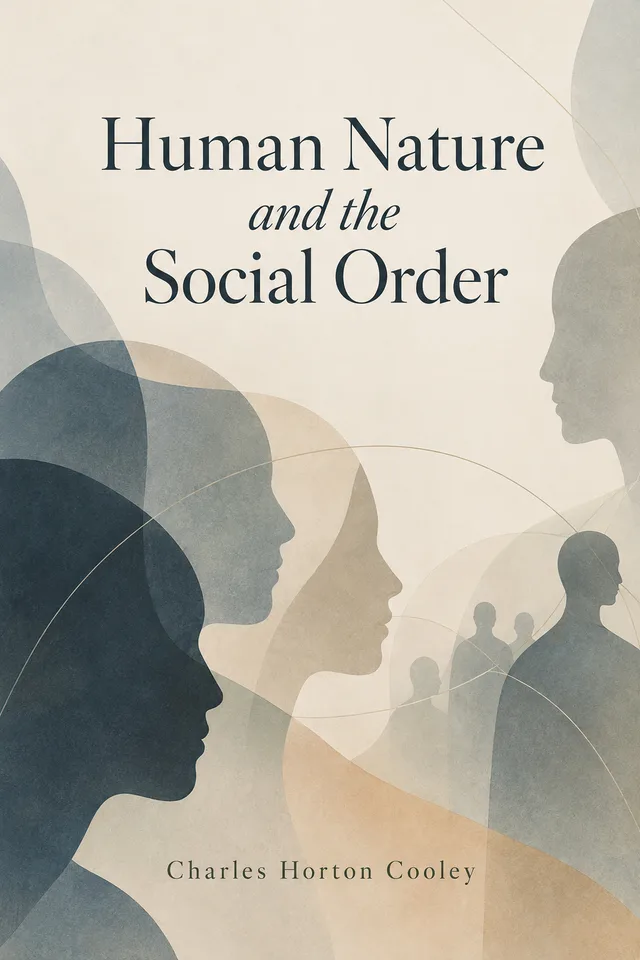
Human Nature and the Social Order
英語 BooksWhale エディション · Charles Horton Cooley
Cooley explains how sympathy, selfhood and everyday relationships connect individual experience with the wider organization of society.
- プレビュー
- 準備済みテキストからの抜粋
- 形式
- オンラインリーダー, EPUB, PDF
- アクセス
- ライブラリ claim
本の紹介
Human Nature and the Social Order
Charles Horton Cooley examines the social roots of personal identity, bringing individual experience into conversation with sympathy, leadership, conscience and freedom. His account of the looking-glass self shows how imagined judgments shape our sense of who we are. The English work develops an accessible framework for understanding the reciprocal formation of persons and social life.
BooksWhale エディション
このエディションの準備
このエディションはパブリックドメイン本文に基づき、BooksWhale がデジタル読書向けに準備しました。
パブリックドメイン根拠
このエディションを共有できる理由
Charles Horton Cooley died in 1929. This edition is based on the public-domain English original available from Project Gutenberg; later editorial additions and illustrations are not part of its underlying rights basis.
プレビューを読む
準備済みテキストからの抜粋
準備済み読書テキストから選んだプレビューです。
プレビュー章Full textプレビューを読む
Human Nature and the Social Order
Charles Horton Cooley
プレビュー章CHAPTER I SOCIETY AND THE INDIVIDUALプレビュー
Are Aspects of the Same Thing—The Fallacy of Setting them in Opposition—Various Forms of this Fallacy.
“Society and the Individual” is really the subject of this whole book, and not merely of Chapter One. It is my general aim to set forth, from various points of view, what the individual is, considered as a member of a social whole; while the special purpose of this chapter is only to offer a preliminary statement of the matter, as I conceive it, afterward to be unfolded at some length and variously illustrated.
A separate individual is an abstraction unknown to experience, and so likewise is society when regarded as something apart from individuals. The real thing is Human Life, which may be considered either in an individual aspect or in a social, that is to say a general, aspect; but is always, as a matter of fact, both individual and general. In other words, “society” and “individuals” do not denote separable phenomena, but are simply collective and distributive aspects of the same thing, the relation between them being like that between other expressions one of which denotes a group as a whole and the other the members of the group, such as the army and the soldiers, the class and the students, and so on. This holds true of any social aggregate, great or small; of a family, a city, a nation, a race; of mankind as a whole: no matter how extensive, complex, or enduring a group may be, no good reason can be given for regarding it as essentially different in this respect from the smallest, simplest, or most transient.
So far, then, as there is any difference between the two, it is rather in our point of view than in the object we are looking at: when we speak of society, or use any other collective term, we fix our minds upon some general view of the people concerned, while when we speak of individuals we disregard the general aspect and think of them as if they were separate. Thus “the Cabinet” may consist of President Lincoln, Secretary Stanton, Secretary Seward, and so on; but when I say “the Cabinet” I do not suggest the same idea as when I enumerate these gentlemen separately. Society, or any complex group, may, to ordinary observation, be a very different thing from all of its members viewed one by one—as a man who beheld General Grant’s army from Missionary Ridge would have seen something other than he would by approaching every soldier in it. In the same way a picture is made up of so many square inches of painted canvas; but if you should look at these one at a time, covering the others, until you had seen them all, you would still not have seen the picture. There may, in all such cases, be a system or organization in the whole that is not apparent in the parts. In this sense, and in no other, is there a difference between society and the individuals of which it is composed; a difference not residing in the facts themselves but existing to the observer on account of the limits of his perception. A complete view of society would also be a complete view of all the individuals, and vice versa; there would be no difference between them.
And just as there is no society or group that is not a collective view of persons, so there is no individual who may not be regarded as a particular view of social groups. He has no separate existence; through both the hereditary and the social factors in his life a man is bound into the whole of which he is a member, and to consider him apart from it is quite as artificial as to consider society apart from individuals.
If this is true there is, of course, a fallacy in that not uncommon manner of speaking which sets the social and the individual over against each other as separate and antagonistic. The word “social” appears to be used in at least three fairly distinct senses, but in none of these does it mean something that can properly be regarded as opposite to individual or personal.
プレビュー章CHAPTER II SUGGESTION AND CHOICEプレビュー
The Meaning of these Terms and their Relation to each Other—Individual and Social Aspects of Will or Choice—Suggestion and Choice in Children—The Scope of Suggestion commonly Underestimated—Practical Limitations upon Deliberate Choice—Illustrations of the Action of the Milieu—The Greater or Less Activity of Choice Reflects the State of Society—Suggestibility.
The antithesis between suggestion and choice is another of those familiar ideas which are not always so clear as they should be.
The word suggestion is used here to denote an influence that works in a comparatively mechanical or reflex way, without calling out that higher selective activity of the mind implied in choice or will. Thus the hypnotic subject who performs apparently meaningless actions at the word of the operator is said to be controlled by suggestion; so also is one who catches up tricks of speech and action from other people without meaning to. From such instances the idea is extended to embrace any thought or action which is mentally simple and seems not to involve choice. The behavior of people under strong emotion is suggestive; crowds are suggestible; habit is a kind of suggestion, and so on.
I prefer this word to imitation, which some use in this or a similar sense, because the latter, as ordinarily understood, seems to cover too little in some directions and too much in others. In common use it means an action that results in visible or audible resemblance. Now although our simple reactions to the influence of others are largely of this sort, they are by no means altogether so; the actions of a child during the first six months of life, for instance, are very little imitative in this sense; on the other hand, the imitation that produces a visible resemblance may be a voluntary process of the most complex sort imaginable, like the skilful painting of a portrait. However, it makes little difference what words we use if we have sound meanings back of them, and I am far from intending to find fault with writers, like Professor Baldwin and M. Tarde, who adopt the word and give it a wide and unusual application. For my purpose, however, it does not seem expedient to depart so far from ordinary usage.
The distinction between suggestion and choice is not, I think, a sharp opposition between separable or radically different things, but rather a way of indicating the lower and higher stages of a series. What we call choice or will appears to be an ill-defined area of more strenuous mental activity within a much wider field of activity similar in kind but less intense. It is not sharply divisible from the mass of involuntary thought. The truth is that the facts of the mind, of society, indeed of any living whole, seldom admit of sharp division, but show gradual transitions from one thing to another: there are no fences in these regions. We speak of suggestion as mechanical; but it seems probable that all psychical life is selective, or, in some sense, choosing, and that the rudiments of consciousness and will may be discerned or inferred in the simplest reaction of the lowest living creature. In our own minds the comparatively simple ideas which are called suggestions are by no means single and primary, but each one is itself a living, shifting, multifarious bit of life, a portion of the fluid “stream of thought” formed by some sort of selection and synthesis out of simpler elements. On the other hand, our most elaborate and volitional thought and action is suggested in the sense that it consists not in creation out of nothing, but in a creative synthesis or reorganization of old material.
The distinction, then, is one of degree rather than of kind; and choice, as contrasted with suggestion, is, in its individual aspect, a comparatively elaborate process of mental organization or synthesis, of which we are reflectively aware, and which is rendered necessary by complexity in the elements of our thought. In its social aspect—for all, or nearly all, our choices relate in one way or another to the social environment—it is an organization of comparatively complex social relations. Precisely as the conditions about us and the ideas suggested by those conditions become intricate, are we forced to think, to choose, to define the useful and the right, and, in general, to work out the higher intellectual life. When life is simple, thought and action are comparatively mechanical or suggestive; the higher consciousness is not aroused, the reflective will has little or nothing to do; the captain stays below and the inferior officers work the ship. But when life is diverse, thought is so likewise, and the mind must achieve the higher synthesis, or suffer that sense of division which is its peculiar pain. In short, the question of suggestion and choice is only another view of the question of uniformity and complexity in social relations.
目次
このエディションの内容
- 01Full text
- 02CHAPTER I SOCIETY AND THE INDIVIDUAL
- 03CHAPTER II SUGGESTION AND CHOICE
- 04CHAPTER III SOCIABILITY AND PERSONAL IDEAS
- 05CHAPTER IV SYMPATHY OR COMMUNION AS AN ASPECT OF SOCIETY
- 06CHAPTER V THE SOCIAL SELF—1. THE MEANING OF “I”
- 07CHAPTER VI THE SOCIAL SELF—2. VARIOUS PHASES OF “I”
- 08CHAPTER VII HOSTILITY
- 09CHAPTER VIII EMULATION
- 10CHAPTER IX LEADERSHIP OR PERSONAL ASCENDENCY
- 11CHAPTER X THE SOCIAL ASPECT OF CONSCIENCE
- 12CHAPTER XI PERSONAL DEGENERACY
- 13CHAPTER XII FREEDOM