英語 エディション
科学
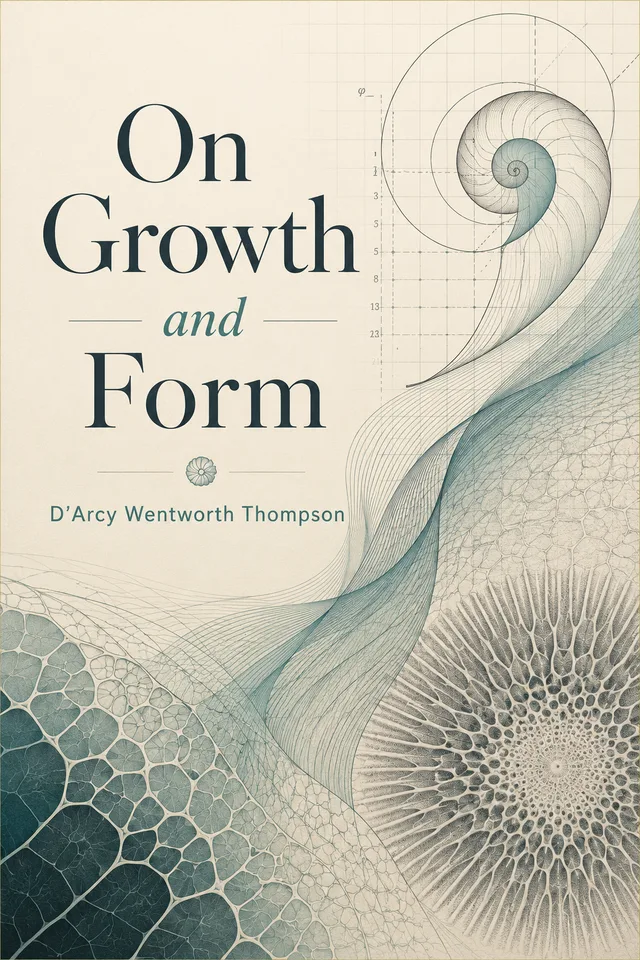
On Growth and Form
英語 BooksWhale エディション · D’Arcy Wentworth Thompson
A landmark study connecting biology, mathematics, morphology, and the visible forms of living organisms.
- プレビュー
- 準備済みテキストからの抜粋
- 形式
- オンラインリーダー, EPUB, PDF
- アクセス
- ライブラリ claim
本の紹介
On Growth and Form
On Growth and Form is D’Arcy Wentworth Thompson’s influential exploration of biological shape, proportion, growth, and physical law. This original English edition presents a foundational science classic for readers interested in natural history, mathematical biology, evolution, and the enduring search for order in living forms.
BooksWhale エディション
このエディションの準備
このエディションはパブリックドメイン本文に基づき、BooksWhale がデジタル読書向けに準備しました。
パブリックドメイン根拠
このエディションを共有できる理由
D’Arcy Wentworth Thompson died in 1948, and On Growth and Form was first published in 1917; these dates support the public-domain basis for this original English edition.
プレビューを読む
準備済みテキストからの抜粋
準備済み読書テキストから選んだプレビューです。
プレビュー章Part 1プレビューを読む
On Growth and Form
D’Arcy Wentworth Thompson
ON GROWTH AND FORM
BY
D’ARCY WENTWORTH THOMPSON
Cambridge: at the University Press
“The reasonings about the wonderful and intricate operations of nature are so full of uncertainty, that, as the Wise-man truly observes, _hardly do we guess aright at the things that are upon earth, and with labour do we find the things that are before us_.” Stephen Hales, _Vegetable Staticks_ , p. 318, 1738.
PREFATORY NOTE
This book of mine has little need of preface, for indeed it is “all preface” from beginning to end. I have written it as an easy introduction to the study of organic Form, by methods which are the common-places of physical science, which are by no means novel in their application to natural history, but which nevertheless naturalists are little accustomed to employ.
It is not the biologist with an inkling of mathematics, but the skilled and learned mathematician who must ultimately deal with such problems as are merely sketched and adumbrated here. I pretend to no mathematical skill, but I have made what use I could of what tools I had; I have dealt with simple cases, and the mathematical methods which I have introduced are of the easiest and simplest kind. Elementary as they are, my book has not been written without the help—the indispensable help—of many friends. Like Mr Pope translating Homer, when I felt myself deficient I sought assistance! And the experience which Johnson attributed to Pope has been mine also, that men of learning did not refuse to help me.
My debts are many, and I will not try to proclaim them all: but I beg to record my particular obligations to Professor Claxton Fidler, Sir George Greenhill, Sir Joseph Larmor, and Professor A. McKenzie; to a much younger but very helpful friend, Mr John Marshall, Scholar of Trinity; lastly, and (if I may say so) most of all, to my colleague Professor William Peddie, whose advice has made many useful additions to my book and whose criticism has spared me many a fault and blunder.
I am under obligations also to the authors and publishers of many books from which illustrations have been borrowed, and especially to the following:―
To the Controller of H.M. Stationery Office, for leave to reproduce a number of figures, chiefly of Foraminifera and of Radiolaria, from the Reports of the Challenger Expedition. {vi}
To the Council of the Royal Society of Edinburgh, and to that of the Zoological Society of London:—the former for letting me reprint from their _Transactions_ the greater part of the text and illustrations of my concluding chapter, the latter for the use of a number of figures for my chapter on Horns.
To Professor E. B. Wilson, for his well-known and all but indispensable figures of the cell (figs. 42–51, 53); to M. A. Prenant, for other figures (41, 48) in the same chapter; to Sir Donald MacAlister and Mr Edwin Arnold for certain figures (335–7), and to Sir Edward Schäfer and Messrs Longmans for another , illustrating the minute trabecular structure of bone. To Mr Gerhard Heilmann, of Copenhagen, for his beautiful diagrams (figs. 388–93, 401, 402) included in my last chapter. To Professor Claxton Fidler and to Messrs Griffin, for letting me use, with more or less modification or simplification, a number of illustrations (figs. 339–346) from Professor Fidler’s _Textbook of Bridge Construction_. To Messrs Blackwood and Sons, for several cuts (figs. 127–9, 131, 173) from Professor Alleyne Nicholson’s _Palaeontology_; to Mr Heinemann, for certain figures (57, 122, 123, 205) from Dr Stéphane Leduc’s _Mechanism of Life_; to Mr A. M. Worthington and to Messrs Longmans, for figures (71, 75) from _A Study of Splashes_, and to Mr C. R. Darling and to Messrs E. and S. Spon for those (fig. 85) from Mr Darling’s _Liquid Drops and Globules_. To Messrs Macmillan and Co. for two figures (304, 305) from Zittel’s _Palaeontology_, to the Oxford University Press for a diagram (fig. 28) from Mr J. W. Jenkinson’s _Experimental Embryology_; and to the Cambridge University Press for a number of figures from Professor Henry Woods’s _Invertebrate Palaeontology_, for one (fig. 210) from Dr Willey’s _Zoological Results_, and for another (fig. 321) from “Thomson and Tait.”
プレビュー章Part 2プレビュー
282. Construction for determining the length of the coiled spire . . . 551
283. Section of the shell of _Triton corrugatus_ (Woodward) . . . 554
284. _Lamellaria perspicua_ and _Sigaretus haliotoides_ (_do._) . . . 555
285, 6. Sections of the shells of _Terebra maculata_ and _Trochus niloticus_ . . . 559, 60
287–9. Diagrams illustrating the lines of growth on a lamellibranch shell . . . 563–5
290. _Caprinella adversa_ (Woodward) . . . 567
291. Section of the shell of _Productus_ (Woods) . . . 567
292. The “skeletal loop” of _Terebratula_ (_do._) . . . 568
293, 4. The spiral arms of _Spirifer_ and of _Atrypa_ (_do._) . . . 569
295–7. Shells of _Cleodora_, _Hyalaea_ and other pteropods (Boas) . . . 570, 1
298, 9. Coordinate diagrams of the shell-outline in certain pteropods . . . 572, 3
300. Development of the shell of _Hyalaea tridentata_ (Tesch) . . . 573
301. Pteropod shells, of _Cleodora_ and _Hyalaea_, viewed from the side (Boas) . . . 575
302, 3. Diagrams of septa in a conical shell . . . 579
304. A section of _Nautilus_, shewing the logarithmic spirals of the septa to which the shell-spiral is the evolute . . . 581
305. Cast of the interior of the shell of _Nautilus_, to shew the contours of the septa at their junction with the shell-wall . . . 582
306. _Ammonites Sowerbyi_, to shew septal outlines (Zittel, after Steinmann and Döderlein) . . . 584
307. Suture-line of _Pinacoceras_ (Zittel, after Hauer) . . . 584
308. Shells of _Hastigerina_, to shew the “mouth” (Brady) . . . 588
309. _Nummulina antiquior_ (V. von Möller) . . . 591
310. _Cornuspira foliacea_ and _Operculina complanata_ (Brady) . . . 594
311. _Miliolina pulchella_ and _linnaeana_ (Brady) . . . 596
312, 3. _Cyclammina cancellata_ (_do._), and diagrammatic figure of the same . . . 596, 7
314. _Orbulina universa_ (Brady) . . . 598
315. _Cristellaria reniformis_ (_do._) . . . 600
316. _Discorbina bertheloti_ (_do._) . . . 603
317. _Textularia trochus_ and _concava_ (_do._) . . . 604
318. Diagrammatic figure of a ram’s horns (Sir V. Brooke) . . . 615
319. Head of an Arabian wild goat (Sclater) . . . 616
320. Head of _Ovis Ammon_, shewing St Venant’s curves . . . 621
321. St Venant’s diagram of a triangular prism under torsion (Thomson and Tait) . . . 623
322. Diagram of the same phenomenon in a ram’s horn . . . 623
323. Antlers of a Swedish elk (Lönnberg) . . . 629
324. Head and antlers of _Cervus duvauceli_ (Lydekker) . . . 630
325, 6. Diagrams of spiral phyllotaxis (P. G. Tait) . . . 644, 5
327. Further diagrams of phyllotaxis, to shew how various spiral appearances may arise out of one and the same angular leaf-divergence . . . 648
328. Diagrammatic outlines of various sea-urchins . . . 664
329, 30. Diagrams of the angle of branching in blood-vessels (Hess) . . . 667, 8
331, 2. Diagrams illustrating the flexure of a beam . . . 674, 8
333. An example of the mode of arrangement of bast-fibres in a plant-stem (Schwendener) . . . 680
334. Section of the head of a femur, to shew its trabecular structure (Schäfer, after Robinson) . . . 681
335. Comparative diagrams of a crane-head and the head of a femur (Culmann and H. Meyer) . . . 682
336. Diagram of stress-lines in the human foot (Sir D. MacAlister, after H. Meyer) . . . 684
337. Trabecular structure of the _os calcis_ (_do._) . . . 685
338. Diagram of shearing-stress in a loaded pillar . . . 686
339. Diagrams of tied arch, and bowstring girder (Fidler) . . . 693
340, 1. Diagrams of a bridge: shewing proposed span, the corresponding stress-diagram and reciprocal plan of construction (_do._) . . . 696
342. A loaded bracket and its reciprocal construction-diagram (Culmann) . . . 697
343, 4. A cantilever bridge, with its reciprocal diagrams (Fidler) . . . 698
345. A two-armed cantilever of the Forth Bridge (_do._) . . . 700
346. A two-armed cantilever with load distributed over two pier-heads, as in the quadrupedal skeleton . . . 700
347–9. Stress-diagrams. or diagrams of bending moments, in the backbones of the horse, of a Dinosaur, and of _Titanotherium_ . . . 701–4
350. The skeleton of _Stegosaurus_ . . . 707
351. Bending-moments in a beam with fixed ends, to illustrate the mechanics of chevron-bones . . . 709
352, 3. Coordinate diagrams of a circle, and its deformation into an ellipse . . . 729
354. Comparison, by means of Cartesian coordinates, of the cannon-bones of various ruminant animals . . . 729
プレビュー章Part 3プレビュー
The difficulties which surround the concept of active or “real” causation, in Bacon’s sense of the word, difficulties of which Hume and Locke and Aristotle were little aware, need scarcely hinder us in our physical enquiry. As students of mathematical and of empirical physics, we are content to deal with those antecedents, or concomitants, of our phenomena, without which the phenomenon does not occur,—with causes, in short, which, _aliae ex aliis aptae et necessitate nexae_, are no more, and no less, than conditions _sine quâ non_. Our purpose is still adequately fulfilled: inasmuch as we are still enabled to correlate, and to equate, our particular phenomena with more and ever more of the physical phenomena around, and so to weave a web of connection and interdependence which shall serve our turn, though the metaphysician withhold from that interdependence the title of causality. We come in touch with what the schoolmen called a _ratio cognoscendi_, though the true _ratio efficiendi_ is still enwrapped in many mysteries. And so handled, the quest of physical causes merges with another great Aristotelian theme,—the search for relations between things apparently disconnected, and for “similitude in things to common view unlike.” Newton did not shew the cause of the apple falling, but he shewed a similitude between the apple and the stars.
Moreover, the naturalist and the physicist will continue to speak of “causes,” just as of old, though it may be with some mental reservations: for, as a French philosopher said, in a kindred difficulty: “ce sont là des manières de s’exprimer, {7} et si elles sont interdites il faut renoncer à parler de ces choses.”
The search for differences or essential contrasts between the phenomena of organic and inorganic, of animate and inanimate things has occupied many mens’ minds, while the search for community of principles, or essential similitudes, has been followed by few; and the contrasts are apt to loom too large, great as they may be. M. Dunan, discussing the “Problème de la Vie” in an essay which M. Bergson greatly commends, declares: “Les lois physico-chimiques sont aveugles et brutales; là où elles règnent seules, au lieu d’un ordre et d’un concert, il ne peut y avoir qu’incohérence et chaos.” But the physicist proclaims aloud that the physical phenomena which meet us by the way have their manifestations of form, not less beautiful and scarce less varied than those which move us to admiration among living things. The waves of the sea, the little ripples on the shore, the sweeping curve of the sandy bay between its headlands, the outline of the hills, the shape of the clouds, all these are so many riddles of form, so many problems of morphology, and all of them the physicist can more or less easily read and adequately solve: solving them by reference to their antecedent phenomena, in the material system of mechanical forces to which they belong, and to which we interpret them as being due. They have also, doubtless, their _immanent_ teleological significance; but it is on another plane of thought from the physicist’s that we contemplate their intrinsic harmony and perfection, and “see that they are good.”
Nor is it otherwise with the material forms of living things. Cell and tissue, shell and bone, leaf and flower, are so many portions of matter, and it is in obedience to the laws of physics that their particles have been moved, moulded and conformed. {8} They are no exception to the rule that Θεὸς ἀεὶ γεωμετρεῖ. Their problems of form are in the first instance mathematical problems, and their problems of growth are essentially physical problems; and the morphologist is, _ipso facto_, a student of physical science.
Apart from the physico-chemical problems of modern physiology, the road of physico-mathematical or dynamical investigation in morphology has had few to follow it; but the pathway is old. The way of the old Ionian physicians, of Anaxagoras, of Empedocles and his disciples in the days before Aristotle, lay just by that highwayside. It was Galileo’s and Borelli’s way. It was little trodden for long afterwards, but once in a while Swammerdam and Réaumur looked that way. And of later years, Moseley and Meyer, Berthold, Errera and Roux have been among the little band of travellers. We need not wonder if the way be hard to follow, and if these wayfarers have yet gathered little. A harvest has been reaped by others, and the gleaning of the grapes is slow.
目次
このエディションの内容
- 01Part 1
- 02Part 2
- 03Part 3
- 04Part 4
- 05Part 5
- 06Part 6
- 07Part 7
- 08Part 8
- 09Part 9
- 10Part 10
- 11Part 11
- 12Part 12
- 13Part 13
- 14Part 14
- 15Part 15
- 16Part 16
- 17Part 17
- 18Part 18
- 19Part 19
- 20Part 20
- 21Part 21
- 22Part 22
- 23Part 23
- 24Part 24
- 25Part 25
- 26Part 26
- 27Part 27
- 28Part 28
- 29Part 29
- 30Part 30
- 31Part 31
- 32Part 32
- 33Part 33
- 34Part 34
- 35Part 35
- 36Part 36
- 37Part 37
- 38Part 38
- 39Part 39
- 40Part 40
- 41Part 41
- 42Part 42
- 43Part 43
- 44Part 44
- 45Part 45
- 46Part 46
- 47Part 47
- 48Part 48
- 49Part 49
- 50Part 50
- 51Part 51
- 52Part 52
- 53Part 53
- 54Part 54
- 55Part 55
- 56Part 56
- 57Part 57
- 58Part 58
- 59Part 59
- 60Part 60
- 61Part 61
- 62Part 62
- 63Part 63
- 64Part 64
- 65Part 65
- 66Part 66
- 67Part 67
- 68Part 68
- 69Part 69
- 70Part 70
- 71Part 71
- 72Part 72
- 73Part 73
- 74Part 74
- 75Part 75
- 76Part 76
- 77Part 77
- 78Part 78
- 79Part 79
- 80Part 80
- 81Part 81
- 82Part 82
- 83Part 83
- 84Part 84
- 85Part 85
- 86Part 86
- 87Part 87
- 88Part 88
- 89Part 89
- 90Part 90
- 91Part 91