英語 エディション
文学
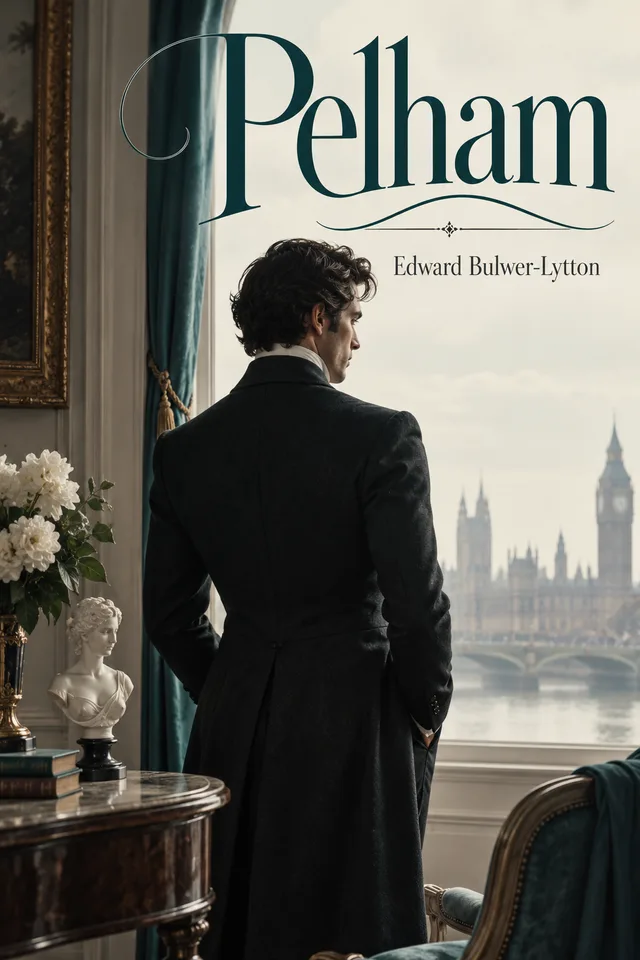
Pelham
英語 BooksWhale エディション · Edward Bulwer-Lytton
Pelham explores fashion, rivalry, manners, reputation, and sophisticated society.
- プレビュー
- 準備済みテキストからの抜粋
- 形式
- オンラインリーダー, EPUB, PDF
- アクセス
- ライブラリ claim
本の紹介
Pelham
Edward Bulwer-Lytton builds the work around fashion, rivalry, manners, reputation, and sophisticated society, making its period, characters, arguments, and images vivid for modern readers.
BooksWhale エディション
このエディションの準備
このエディションはパブリックドメイン本文に基づき、BooksWhale がデジタル読書向けに準備しました。
パブリックドメイン根拠
このエディションを共有できる理由
The original work is public-domain source material; this edition uses the original text.
プレビューを読む
準備済みテキストからの抜粋
準備済み読書テキストから選んだプレビューです。
プレビュー章Full textプレビューを読む
Pelham
Edward George Bulwer-Lytton
Ou peut-on etre mieux qu’au sein de sa famille?—French Song. [Where can one be better than in the bosom of one’s family?]
I am an only child. My father was the younger son of one of our oldest earls; my mother the dowerless daughter of a Scotch peer. Mr. Pelham was a moderate whig, and gave sumptuous dinners; Lady Frances was a woman of taste, and particularly fond of diamonds and old china.
Vulgar people know nothing of the necessaries required in good society, and the credit they give is as short as their pedigree. Six years after my birth, there was an execution in our house. My mother was just setting off on a visit to the Duchess of D_____; she declared it was impossible to go without her diamonds. The chief of the bailiffs declared it was impossible to trust them out of his sight. The matter was compromised—the bailiff went with my mother to C___, and was introduced as my tutor. “A man of singular merit,” whispered my mother, “but so shy!” Fortunately, the bailiff was abashed, and by losing his impudence he kept the secret. At the end of the week, the diamonds went to the jeweller’s, and Lady Frances wore paste.
I think it was about a month afterwards that a sixteenth cousin left my mother twenty thousand pounds. “It will just pay off our most importunate creditors, and equip me for Melton,” said Mr. Pelham.
“It will just redeem my diamonds, and refurnish the house,” said Lady Frances.
The latter alternative was chosen. My father went down to run his last horse at Newmarket, and my mother received nine hundred people in a Turkish tent. Both were equally fortunate, the Greek and the Turk; my father’s horse lost, in consequence of which he pocketed five thousand pounds; and my mother looked so charming as a Sultana, that Seymour Conway fell desperately in love with her.
Mr. Conway had just caused two divorces; and of course, all the women in London were dying for him—judge then of the pride which Lady Frances felt at his addresses. The end of the season was unusually dull, and my mother, after having looked over her list of engagements, and ascertained that she had none remaining worth staying for, agreed to elope with her new lover.
The carriage was at the end of the square. My mother, for the first time in her life, got up at six o’clock. Her foot was on the step, and her hand next to Mr. Conway’s heart, when she remembered that her favourite china monster and her French dog were left behind. She insisted on returning—re-entered the house, and was coming down stairs with one under each arm, when she was met by my father and two servants. My father’s valet had discovered the flight (I forget how), and awakened his master.
When my father was convinced of his loss, he called for his dressing-gown—searched the garret and the kitchen—looked in the maid’s drawers and the cellaret—and finally declared he was distracted. I have heard that the servants were quite melted by his grief, and I do not doubt it in the least, for he was always celebrated for his skill in private theatricals. He was just retiring to vent his grief in his dressing-room, when he met my mother. It must altogether have been an awkward rencontre, and, indeed, for my father, a remarkably unfortunate occurrence; for Seymour Conway was immensely rich, and the damages would, no doubt, have been proportionably high. Had they met each other alone, the affair might easily have been settled, and Lady Frances gone off in tranquillity;—those d—d servants are always in the way!
I have, however, often thought that it was better for me that the affair ended thus,—as I know, from many instances, that it is frequently exceedingly inconvenient to have one’s mother divorced.
プレビュー章MAXIMS.プレビュー
1. Do not require your dress so much to fit, as to adorn you. Nature is not to be copied, but to be exalted by art. Apelles blamed Protogenes for being too natural.
2. Never in your dress altogether desert that taste which is general. The world considers eccentricity in great things, genius; in small things, folly.
3. Always remember that you dress to fascinate others, not yourself.
4. Keep your mind free from all violent affections at the hour of the toilet. A philosophical serenity is perfectly necessary to success. Helvetius says justly, that our errors arise from our passions.
5. Remember that none but those whose courage is unquestionable, can venture to be effeminate. It was only in the field that the Lacedemonians were accustomed to use perfumes and curl their hair.
6. Never let the finery of chains and rings seem your own choice; that which naturally belongs to women should appear only worn for their sake. We dignify foppery, when we invest it with a sentiment.
7. To win the affection of your mistress, appear negligent in your costume—to preserve it, assiduous: the first is a sign of the passion of love; the second, of its respect.
8. A man must be a profound calculator to be a consummate dresser. One must not dress the same, whether one goes to a minister or a mistress; an avaricious uncle, or an ostentatious cousin: there is no diplomacy more subtle than that of dress.
9. Is the great man whom you would conciliate a coxcomb?—go to him in a waistcoat like his own. “Imitation,” says the author of Lacon, “is the sincerest flattery.”
10. The handsome may be shewy in dress, the plain should study to be unexceptionable; just as in great men we look for something to admire—in ordinary men we ask for nothing to forgive.
11. There is a study of dress for the aged, as well as for the young. Inattention is no less indecorous in one than in the other; we may distinguish the taste appropriate to each, by the reflection that youth is made to be loved—age, to be respected.
12. A fool may dress gaudily, but a fool cannot dress well—for to dress well requires judgment; and Rochefaucault says with truth, “On est quelquefois un sot avec de l’esprit, mais on ne lest jamais avec du jugement.”
13. There may be more pathos in the fall of a collar, or the curl of a lock, than the shallow think for. Should we be so apt as we are now to compassionate the misfortunes, and to forgive the insincerity of Charles I., if his pictures had pourtrayed him in a bob wig and a pigtail? Vandyke was a greater sophist than Hume.
14. The most graceful principle of dress is neatness—the most vulgar is preciseness.
15. Dress contains the two codes of morality—private and public. Attention is the duty we owe to others—cleanliness that which we owe to ourselves.
16. Dress so that it may never be said of you “What a well dressed man!”—but, “What a gentlemanlike man!”
17. Avoid many colours; and seek, by some one prevalent and quiet tint, to sober down the others. Apelles used only four colours, and always subdued those which were more florid, by a darkening varnish.
18. Nothing is superficial to a deep observer! It is in trifles that the mind betrays itself. “In what part of that letter,” said a king to the wisest of living diplomatists, “did you discover irresolution?”—“In its ns and gs!” was the answer.
19. A very benevolent man will never shock the feelings of others, by an excess either of inattention or display; you may doubt, therefore, the philanthropy both of a sloven and a fop.
20. There is an indifference to please in a stocking down at heel—but there may be a malevolence in a diamond ring.
プレビュー章THE HISTORY OF SIR REGINALD GLANVILLE.プレビュー
“You remember my character at school—the difficulty with which you drew me from the visionary and abstracted loneliness which, even at that time, was more consonant to my taste, than all the sports and society resorted to by other boys—and the deep, and, to you, inexplicable delight with which I returned to my reveries and solitude again. That character has continued through life the same; circumstances have strengthened, not altered it. So has it been with you; the temper, the habits, the tastes, so strongly contrasted with mine in boyhood, have lost nothing of that contrast. Your ardour for the various ambition of life is still the antipodes to my indifference; your daring, restless, thoughtful, resolution in the pursuit, still shames my indolence and abstraction. You are still the votary of the world, but will become its conqueror—I its fugitive—and shall die its victim.
“After we parted at school, I went for a short time to a tutor’s in—shire. Of this place I soon grew weary; and my father’s death leaving me in a great measure at my own disposal, I lost no time in leaving it. I was seized with that mania for travel common enough to all persons of my youth and disposition. My mother allowed me an almost unlimited command over the fortune hereafter to be my own; and, yielding to my wishes, rather than her fears, she suffered me, at the age of eighteen, to set out for the Continent alone. Perhaps the quiet and reserve of my character made her think me less exposed to the dangers of youth, than if I had been of a more active and versatile temper. This is no uncommon mistake; a serious and contemplative disposition is, however, often the worst formed to acquire readily the knowledge of the world, and always the most calculated to suffer deeply from the experience.
“I took up my residence for some time at Spa. It is, you know, perhaps, a place dull enough to make gambling the only amusement; every one played—and I did not escape the contagion; nor did I wish it: for, like the minister Godolphin, I loved gaming for its own sake, because it was a substitute for conversation. This habit brought me acquainted with Mr. Tyrrell, who was then staying at Spa; he had not, at that time, quite dissipated his fortune, but was daily progressing to so desirable a consummation. A gambler’s acquaintance is readily made, and easily kept, provided you gamble too.
“We became as intimate as the reserve of my habits ever suffered me to become with any one, but you. He was many years older than me—had seen a great deal of the world—had mixed much in its best societies, and, at that time, whatever was the grossierete of his mind, had little of the coarseness of manner which very soon afterwards distinguished him; evil communication works rapidly in its results. Our acquaintance was, therefore, natural enough, especially when it is considered that my purse was entirely at his disposal—for borrowing is twice blessed, in him that takes and him that gives—the receiver becomes complaisant and conceding, and the lender thinks favourably of one he has obliged.
“We parted at Spa, under a mutual promise to write. I forget if this promise was kept—probably not; we were not, however, the worse friends for being bad correspondents. I continued my travels for about another year; I then returned to England, the same melancholy and dreaming enthusiast as before. It is true that we are the creatures of circumstances; but circumstances are also, in a great measure, the creatures of us. I mean, they receive their colour from the previous bent of our own minds; what raises one would depress another, and what vitiates my neighbour might correct me. Thus the experience of the world makes some persons more worldly—others more abstracted, and the indulgence of the senses becomes a violence to one mind, and a second nature to another. As for me, I had tasted all the pleasures youth and opulence can purchase, and was more averse to them than ever. I had mixed with many varieties of men—I was still more rivetted to the monotony of self.
目次
このエディションの内容
- 01Full text
- 02MAXIMS.
- 03THE HISTORY OF SIR REGINALD GLANVILLE.
- 04START: FULL LICENSE
- 05PLEASE READ THIS BEFORE YOU DISTRIBUTE OR USE THIS WORK