英語 エディション
文学
Redburn
英語 BooksWhale エディション · Herman Melville
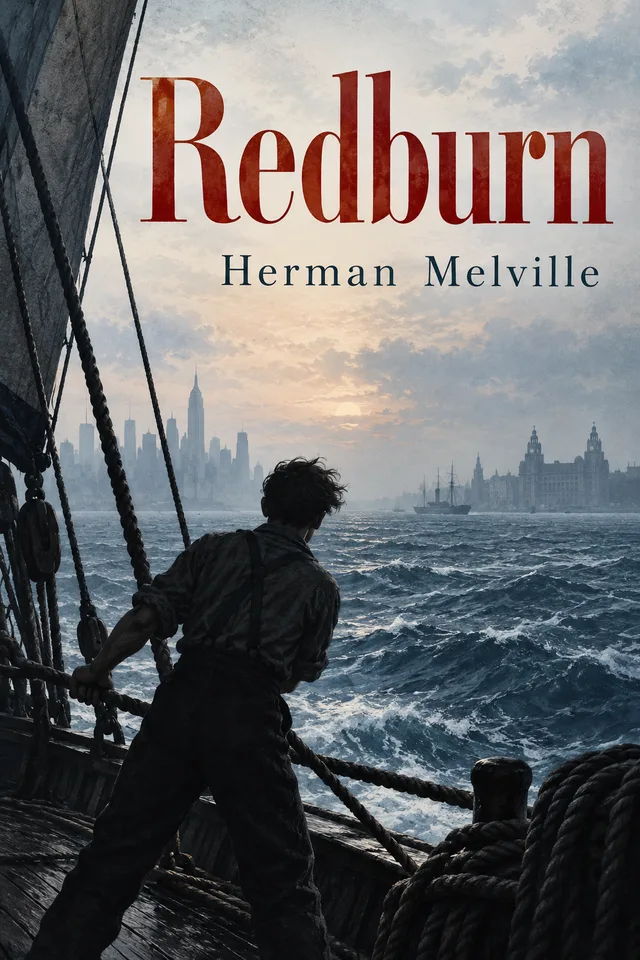
A young sailor’s first voyage from New York to Liverpool, told through shipboard labor, hunger, class, and uneasy encounters abroad.
- プレビュー
- 準備済みテキストからの抜粋
- 形式
- オンラインリーダー, EPUB, PDF
- アクセス
- ライブラリ claim
本の紹介
Redburn
Wellingborough Redburn leaves home with romantic ideas of the sea and meets the hard realities of maritime work, poverty, immigration, and empire. Melville combines coming-of-age adventure with a searching portrait of the Atlantic world.
BooksWhale エディション
このエディションの準備
このエディションはパブリックドメイン本文に基づき、BooksWhale がデジタル読書向けに準備しました。
パブリックドメイン根拠
このエディションを共有できる理由
Published in 1849; Melville died in 1891. The original English text is public domain under the United States term and life-plus-70 rules.
プレビューを読む
準備済みテキストからの抜粋
準備済み読書テキストから選んだプレビューです。
プレビュー章Full textプレビューを読む
Redburn
Herman Melville
Redburn: His First Voyage
Being the Sailor Boy Confessions and Reminiscences Of the Son-Of-A-Gentleman In the Merchant Navy
プレビュー章CHAPTER I. HOW WELLINGBOROUGH REDBURN’S TASTE FOR THE SEA WAS BORN AND BRED IN HIMプレビュー
“Wellingborough, as you are going to sea, suppose you take this shooting-jacket of mine along; it’s just the thing—take it, it will save the expense of another. You see, it’s quite warm; fine long skirts, stout horn buttons, and plenty of pockets.”
Out of the goodness and simplicity of his heart, thus spoke my elder brother to me, upon the eve of my departure for the seaport.
“And, Wellingborough,” he added, “since we are both short of money, and you want an outfit, and I Have none to give, you may as well take my fowling-piece along, and sell it in New York for what you can get.—Nay, take it; it’s of no use to me now; I can’t find it in powder any more.”
I was then but a boy. Some time previous my mother had removed from New York to a pleasant village on the Hudson River, where we lived in a small house, in a quiet way. Sad disappointments in several plans which I had sketched for my future life; the necessity of doing something for myself, united to a naturally roving disposition, had now conspired within me, to send me to sea as a sailor.
For months previous I had been poring over old New York papers, delightedly perusing the long columns of ship advertisements, all of which possessed a strange, romantic charm to me. Over and over again I devoured such announcements as the following:
FOR BREMEN. The coppered and copper-fastened brig Leda, having nearly completed her cargo, will sail for the above port on Tuesday the twentieth of May. For freight or passage apply on board at Coenties Slip.
To my young inland imagination every word in an advertisement like this, suggested volumes of thought.
A brig! The very word summoned up the idea of a black, sea-worn craft, with high, cozy bulwarks, and rakish masts and yards.
Coppered and copper-fastened! That fairly smelt of the salt water! How different such vessels must be from the wooden, one-masted, green-and-white-painted sloops, that glided up and down the river before our house on the bank.
Nearly completed her cargo! How momentous the announcement; suggesting ideas, too, of musty bales, and cases of silks and satins, and filling me with contempt for the vile deck-loads of hay and lumber, with which my river experience was familiar.
Will sail on Tuesday the 20th of May-and the newspaper bore date the fifth of the month! Fifteen whole days beforehand; think of that; what an important voyage it must be, that the time of sailing was fixed upon so long beforehand; the river sloops were not used to make such prospective announcements.
For freight or passage apply on board! Think of going on board a coppered and copper-fastened brig, and taking passage for Bremen! And who could be going to Bremen? No one but foreigners, doubtless; men of dark complexions and jet-black whiskers, who talked French.
Coenties Slip. Plenty more brigs and any quantity of ships must be lying there. Coenties Slip must be somewhere near ranges of grim-looking warehouses, with rusty iron doors and shutters, and tiled roofs; and old anchors and chain-cable piled on the walk. Old-fashioned coffeehouses, also, much abound in that neighborhood, with sunburnt sea-captains going in and out, smoking cigars, and talking about Havanna, London, and Calcutta.
All these my imaginations were wonderfully assisted by certain shadowy reminiscences of wharves, and warehouses, and shipping, with which a residence in a seaport during early childhood had supplied me.
Particularly, I remembered standing with my father on the wharf when a large ship was getting under way, and rounding the head of the pier. I remembered the yo heave ho! of the sailors, as they just showed their woolen caps above the high bulwarks. I remembered how I thought of their crossing the great ocean; and that that very ship, and those very sailors, so near to me then, would after a time be actually in Europe.
プレビュー章CHAPTER II. REDBURN’S DEPARTURE FROM HOMEプレビュー
It was with a heavy heart and full eyes, that my poor mother parted with me; perhaps she thought me an erring and a willful boy, and perhaps I was; but if I was, it had been a hardhearted world, and hard times that had made me so. I had learned to think much and bitterly before my time; all my young mounting dreams of glory had left me; and at that early age, I was as unambitious as a man of sixty.
Yes, I will go to sea; cut my kind uncles and aunts, and sympathizing patrons, and leave no heavy hearts but those in my own home, and take none along but the one which aches in my bosom. Cold, bitter cold as December, and bleak as its blasts, seemed the world then to me; there is no misanthrope like a boy disappointed; and such was I, with the warmth of me flogged out by adversity. But these thoughts are bitter enough even now, for they have not yet gone quite away; and they must be uncongenial enough to the reader; so no more of that, and let me go on with my story.
“Yes, I will write you, dear mother, as soon as I can,” murmured I, as she charged me for the hundredth time, not fail to inform her of my safe arrival in New York.
“And now Mary, Martha, and Jane, kiss me all round, dear sisters, and then I am off. I’ll be back in four months—it will be autumn then, and we’ll go into the woods after nuts, an I’ll tell you all about Europe. Good-by! good-by!”
So I broke loose from their arms, and not daring to look behind, ran away as fast as I could, till I got to the corner where my brother was waiting. He accompanied me part of the way to the place, where the steamboat was to leave for New York; instilling into me much sage advice above his age, for he was but eight years my senior, and warning me again and again to take care of myself; and I solemnly promised I would; for what cast-away will not promise to take of care himself, when he sees that unless he himself does, no one else will.
We walked on in silence till I saw that his strength was giving out,—he was in ill health then,—and with a mute grasp of the hand, and a loud thump at the heart, we parted.
It was early on a raw, cold, damp morning toward the end of spring, and the world was before me; stretching away a long muddy road, lined with comfortable houses, whose inmates were taking their sunrise naps, heedless of the wayfarer passing. The cold drops of drizzle trickled down my leather cap, and mingled with a few hot tears on my cheeks.
I had the whole road to myself, for no one was yet stirring, and I walked on, with a slouching, dogged gait. The gray shooting-jacket was on my back, and from the end of my brother’s rifle hung a small bundle of my clothes. My fingers worked moodily at the stock and trigger, and I thought that this indeed was the way to begin life, with a gun in your hand!
Talk not of the bitterness of middle-age and after life; a boy can feel all that, and much more, when upon his young soul the mildew has fallen; and the fruit, which with others is only blasted after ripeness, with him is nipped in the first blossom and bud. And never again can such blights be made good; they strike in too deep, and leave such a scar that the air of Paradise might not erase it. And it is a hard and cruel thing thus in early youth to taste beforehand the pangs which should be reserved for the stout time of manhood, when the gristle has become bone, and we stand up and fight out our lives, as a thing tried before and foreseen; for then we are veterans used to sieges and battles, and not green recruits, recoiling at the first shock of the encounter.
目次
このエディションの内容
- 01Full text
- 02CHAPTER I. HOW WELLINGBOROUGH REDBURN’S TASTE FOR THE SEA WAS BORN AND BRED IN HIM
- 03CHAPTER II. REDBURN’S DEPARTURE FROM HOME
- 04CHAPTER III. HE ARRIVES IN TOWN
- 05CHAPTER IV. HOW HE DISPOSED OF HIS FOWLING-PIECE
- 06CHAPTER V. HE PURCHASES HIS SEA-WARDROBE, AND ON A DISMAL RAINY DAY PICKS UP HIS BOARD AND LODGING ALONG THE WHARVES
- 07I answered that I was going as a “boy;” for so I was technically put down on the articles.
- 08I told him I didn’t know there were any rats in the ship, and hadn’t brought any “trap.”
- 09CHAPTER VI. HE IS INITIATED IN THE BUSINESS OF CLEANING OUT THE PIG-PEN, AND SLUSHING DOWN THE TOP-MAST
- 10CHAPTER VII. HE GETS TO SEA AND FEELS VERY BAD
- 11CHAPTER VIII. HE IS PUT INTO THE LARBOARD WATCH; GETS SEA-SICK; AND RELATES SOME OTHER OF HIS EXPERIENCES
- 12CHAPTER IX. THE SAILORS BECOMING A LITTLE SOCIAL, REDBURN CONVERSES WITH THEM
- 13CHAPTER X. HE IS VERY MUCH FRIGHTENED; THE SAILORS ABUSE HIM; AND HE BECOMES MISERABLE AND FORLORN
- 14CHAPTER XI. HE HELPS WASH THE DECKS, AND THEN GOES TO BREAKFAST
- 15CHAPTER XII. HE GIVES SOME ACCOUNT OF ONE OF HIS SHIPMATES CALLED JACKSON
- 16CHAPTER XIII. HE HAS A FINE DAY AT SEA, BEGINS TO LIKE IT; BUT CHANGES HIS MIND
- 17CHAPTER XIV. HE CONTEMPLATES MAKING A SOCIAL CALL ON THE CAPTAIN IN HIS CABIN
- 18CHAPTER XV. THE MELANCHOLY STATE OF HIS WARDROBE
- 19CHAPTER XVI. AT DEAD OF NIGHT HE IS SENT UP TO LOOSE THE MAIN-SKYSAIL
- 20CHAPTER XVII. THE COOK AND STEWARD
- 21CHAPTER XVIII. HE ENDEAVORS TO IMPROVE HIS MIND; AND TELLS OF ONE BLUNT AND HIS DREAM BOOK
- 22CHAPTER XIX. A NARROW ESCAPE
- 23CHAPTER XX. IN A FOG HE IS SET TO WORK AS A BELL-TOLLER, AND BEHOLDS A HERD OF OCEAN-ELEPHANTS
- 24CHAPTER XXI. A WHALEMAN AND A MAN-OF-WAR’S-MAN
- 25CHAPTER XXII. THE HIGHLANDER PASSES A WRECK
- 26CHAPTER XXIII. AN UNACCOUNTABLE CABIN-PASSENGER, AND A MYSTERIOUS YOUNG LADY
- 27CHAPTER XXIV. HE BEGINS TO HOP ABOUT IN THE RIGGING LIKE A SAINT JAGO’S MONKEY
- 28CHAPTER XXV. QUARTER-DECK FURNITURE
- 29CHAPTER XXVI. A SAILOR A JACK OF ALL TRADES
- 30CHAPTER XXVII. HE GETS A PEEP AT IRELAND, AND AT LAST ARRIVES AT LIVERPOOL
- 31CHAPTER XXVIII. HE GOES TO SUPPER AT THE SIGN OF THE BALTIMORE CLIPPER
- 32CHAPTER XXIX. REDBURN DEFERENTIALLY DISCOURSES CONCERNING THE PROSPECTS OF SAILORS
- 33CHAPTER XXX. REDBURN GROWS INTOLERABLY FLAT AND STUPID OVER SOME OUTLANDISH OLD GUIDE-BOOKS
- 34WALTER REDBURN.
- 35CHAPTER XXXI. WITH HIS PROSY OLD GUIDE-BOOK, HE TAKES A PROSY STROLL THROUGH THE TOWN
- 36CHAPTER XXXII. THE DOCKS
- 37CHAPTER XXXIII. THE SALT-DROGHERS, AND GERMAN EMIGRANT SHIPS
- 38CHAPTER XXXIV. THE IRRAWADDY
- 39CHAPTER XXXV. GALLIOTS, COAST-OF-GUINEA-MAN, AND FLOATING CHAPEL
- 40CHAPTER XXXVI. THE OLD CHURCH OF ST. NICHOLAS, AND THE DEAD-HOUSE
- 41HERE LYETH YE BODY OF TOBIAS DRINKER.
- 42CHAPTER XXXVII. WHAT REDBURN SAW IN LAUNCELOTT’S-HEY
- 43CHAPTER XXXVIII. THE DOCK-WALL BEGGARS
- 44CHAPTER XXXIX. THE BOOBLE-ALLEYS OF THE TOWN
- 45CHAPTER XL. PLACARDS, BRASS-JEWELERS, TRUCK-HORSES, AND STEAMERS
- 46CHAPTER XLI. REDBURN ROVES ABOUT HITHER AND THITHER
- 47CHAPTER XLII. HIS ADVENTURE WITH THE CROSS OLD GENTLEMAN
- 48CHAPTER XLIII. HE TAKES A DELIGHTFUL RAMBLE INTO THE COUNTRY; AND MAKES THE ACQUAINTANCE OF THREE ADORABLE CHARMERS
- 49“MAN-TRAPS AND SPRING-GUNS!”
- 50CHAPTER XLIV. REDBURN INTRODUCES MASTER HARRY BOLTON TO THE FAVORABLE CONSIDERATION OF THE READER
- 51CHAPTER XLV. HARRY BOLTON KIDNAPS REDBURN, AND CARRIES HIM OFF TO LONDON
- 52I trembled with amazement and delight.
- 53CHAPTER XLVI. A MYSTERIOUS NIGHT IN LONDON
- 54I fumbled in my pockets, and handed them to him.
- 55CHAPTER XLVII. HOMEWARD BOUND
- 56CHAPTER XLVIII. A LIVING CORPSE
- 57CHAPTER XLIX. CARLO
- 58CHAPTER L. HARRY BOLTON AT SEA
- 59CHAPTER LI. THE EMIGRANTS
- 60CHAPTER LII. THE EMIGRANTS’ KITCHEN
- 61CHAPTER LIII. THE HORATII AND CURIATII
- 62CHAPTER LIV. SOME SUPERIOR OLD NAIL-ROD AND PIG-TAIL
- 63CHAPTER LV. DRAWING NIGH TO THE LAST SCENE IN JACKSON’S CAREER
- 64CHAPTER LVI. UNDER THE LEE OF THE LONG-BOAT, REDBURN AND HARRY HOLD CONFIDENTIAL COMMUNION
- 65CHAPTER LVII. ALMOST A FAMINE
- 66CHAPTER LVIII. THOUGH THE HIGHLANDER PUTS INTO NO HARBOR AS YET; SHE HERE AND THERE LEAVES MANY OF HER PASSENGERS BEHIND
- 67CHAPTER LIX. THE LAST END OF JACKSON
- 68CHAPTER LX. HOME AT LAST
- 69CHAPTER LXI. REDBURN AND HARRY, ARM IN ARM, IN HARBOR
- 70I looked at Harry, and he looked at me; and then we both looked at this incomprehensible captain.
- 71CHAPTER LXII. THE LAST THAT WAS EVER HEARD OF HARRY BOLTON
- 72I then wrote to young Goodwell, who returned me the following letter, now spread before me.