英語 エディション
文学
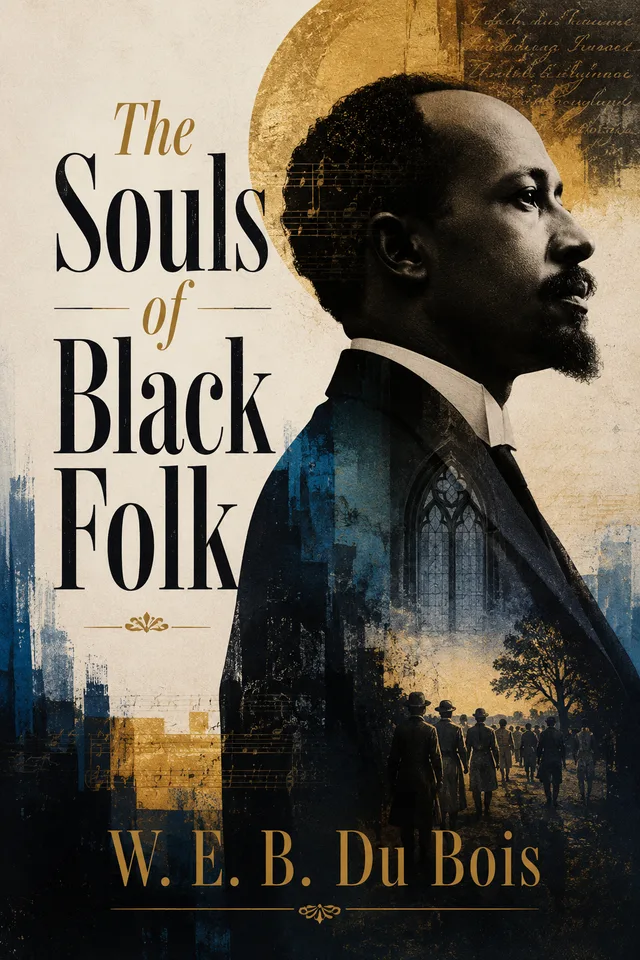
The Souls of Black Folk
英語 BooksWhale エディション · W. E. B. Du Bois
A landmark work on race, democracy, education, memory, music, and Black American life.
- プレビュー
- 準備済みテキストからの抜粋
- 形式
- オンラインリーダー, EPUB, PDF
- アクセス
- ライブラリ claim
本の紹介
The Souls of Black Folk
The Souls of Black Folk combines essays, history, autobiography, sociology, and spirituals to examine race, citizenship, education, and the color line in America. Du Bois’s English classic remains central to political thought, civil rights, and modern social criticism.
BooksWhale エディション
このエディションの準備
このエディションはパブリックドメイン本文に基づき、BooksWhale がデジタル読書向けに準備しました。
パブリックドメイン根拠
このエディションを共有できる理由
W. E. B. Du Bois died in 1963, and The Souls of Black Folk was first published in 1903. Its publication date supports the public-domain basis for this English edition.
プレビューを読む
準備済みテキストからの抜粋
準備済み読書テキストから選んだプレビューです。
プレビュー章Full textプレビューを読む
The Souls of Black Folk
W. E. B. Du Bois
プレビュー章The Forethoughtプレビュー
Herein lie buried many things which if read with patience may show the strange meaning of being black here at the dawning of the Twentieth Century. This meaning is not without interest to you, Gentle Reader; for the problem of the Twentieth Century is the problem of the color line.
I pray you, then, receive my little book in all charity, studying my words with me, forgiving mistake and foible for sake of the faith and passion that is in me, and seeking the grain of truth hidden there.
I have sought here to sketch, in vague, uncertain outline, the spiritual world in which ten thousand thousand Americans live and strive. First, in two chapters I have tried to show what Emancipation meant to them, and what was its aftermath. In a third chapter I have pointed out the slow rise of personal leadership, and criticized candidly the leader who bears the chief burden of his race to-day. Then, in two other chapters I have sketched in swift outline the two worlds within and without the Veil, and thus have come to the central problem of training men for life. Venturing now into deeper detail, I have in two chapters studied the struggles of the massed millions of the black peasantry, and in another have sought to make clear the present relations of the sons of master and man. Leaving, then, the white world, I have stepped within the Veil, raising it that you may view faintly its deeper recesses, - the meaning of its religion, the passion of its human sorrow, and the struggle of its greater souls. All this I have ended with a tale twice told but seldom written, and a chapter of song.
Some of these thoughts of mine have seen the light before in other guise. For kindly consenting to their republication here, in altered and extended form, I must thank the publishers of the Atlantic Monthly, The World's Work, the Dial, The New World, and the Annals of the American Academy of Political and Social Science. Before each chapter, as now printed, stands a bar of the Sorrow Songs, - some echo of haunting melody from the only American music which welled up from black souls in the dark past. And, finally, need I add that I who speak here am bone of the bone and flesh of the flesh of them that live within the Veil?
W.E.B. Du B.
Atlanta, Ga., Feb. 1, 1903.
プレビュー章I. Of Our Spiritual Strivingsプレビュー
O water, voice of my heart, crying in the sand, All night long crying with a mournful cry, As I lie and listen, and cannot understand The voice of my heart in my side or the voice of the sea, O water, crying for rest, is it I, is it I? All night long the water is crying to me.
Unresting water, there shall never be rest Till the last moon droop and the last tide fail, And the fire of the end begin to burn in the west; And the heart shall be weary and wonder and cry like the sea, All life long crying without avail, As the water all night long is crying to me.
ARTHUR SYMONS.
Between me and the other world there is ever an unasked question: unasked by some through feelings of delicacy; by others through the difficulty of rightly framing it. All, nevertheless, flutter round it. They approach me in a half-hesitant sort of way, eye me curiously or compassionately, and then, instead of saying directly, How does it feel to be a problem? they say, I know an excellent colored man in my town; or, I fought at Mechanicsville; or, Do not these Southern outrages make your blood boil? At these I smile, or am interested, or reduce the boiling to a simmer, as the occasion may require. To the real question, How does it feel to be a problem? I answer seldom a word.
And yet, being a problem is a strange experience, - peculiar even for one who has never been anything else, save perhaps in babyhood and in Europe. It is in the early days of rollicking boyhood that the revelation first bursts upon one, all in a day, as it were. I remember well when the shadow swept across me. I was a little thing, away up in the hills of New England, where the dark Housatonic winds between Hoosac and Taghkanic to the sea. In a wee wooden schoolhouse, something put it into the boys' and girls' heads to buy gorgeous visiting-cards - ten cents a package - and exchange. The exchange was merry, till one girl, a tall newcomer, refused my card, - refused it peremptorily, with a glance. Then it dawned upon me with a certain suddenness that I was different from the others; or like, mayhap, in heart and life and longing, but shut out from their world by a vast veil. I had thereafter no desire to tear down that veil, to creep through; I held all beyond it in common contempt, and lived above it in a region of blue sky and great wandering shadows. That sky was bluest when I could beat my mates at examination-time, or beat them at a foot-race, or even beat their stringy heads. Alas, with the years all this fine contempt began to fade; for the words I longed for, and all their dazzling opportunities, were theirs, not mine. But they should not keep these prizes, I said; some, all, I would wrest from them. Just how I would do it I could never decide: by reading law, by healing the sick, by telling the wonderful tales that swam in my head, - some way. With other black boys the strife was not so fiercely sunny: their youth shrunk into tasteless sycophancy, or into silent hatred of the pale world about them and mocking distrust of everything white; or wasted itself in a bitter cry, Why did God make me an outcast and a stranger in mine own house? The shades of the prison-house closed round about us all: walls strait and stubborn to the whitest, but relentlessly narrow, tall, and unscalable to sons of night who must plod darkly on in resignation, or beat unavailing palms against the stone, or steadily, half hopelessly, watch the streak of blue above.
After the Egyptian and Indian, the Greek and Roman, the Teuton and Mongolian, the Negro is a sort of seventh son, born with a veil, and gifted with second-sight in this American world, - a world which yields him no true self-consciousness, but only lets him see himself through the revelation of the other world. It is a peculiar sensation, this double-consciousness, this sense of always looking at one's self through the eyes of others, of measuring one's soul by the tape of a world that looks on in amused contempt and pity. One ever feels his twoness, - an American, a Negro; two souls, two thoughts, two unreconciled strivings; two warring ideals in one dark body, whose dogged strength alone keeps it from being torn asunder.
目次
このエディションの内容
- 01Full text
- 02The Forethought
- 03I. Of Our Spiritual Strivings
- 04II. Of the Dawn of Freedom
- 05III. Of Mr. Booker T. Washington and Others
- 06IV. Of the Meaning of Progress
- 07V. Of the Wings of Atalanta
- 08VI. Of the Training of Black Men
- 09VII. Of the Black Belt
- 10VIII. Of the Quest of the Golden Fleece
- 11IX. Of the Sons of Master and Man
- 12X. Of the Faith of the Fathers
- 13XI. Of the Passing of the First-Born
- 14XII. Of Alexander Crummell
- 15XIII. Of the Coming of John
- 16XIV. Of the Sorrow Songs
- 17The Afterthought