英語 エディション
文学
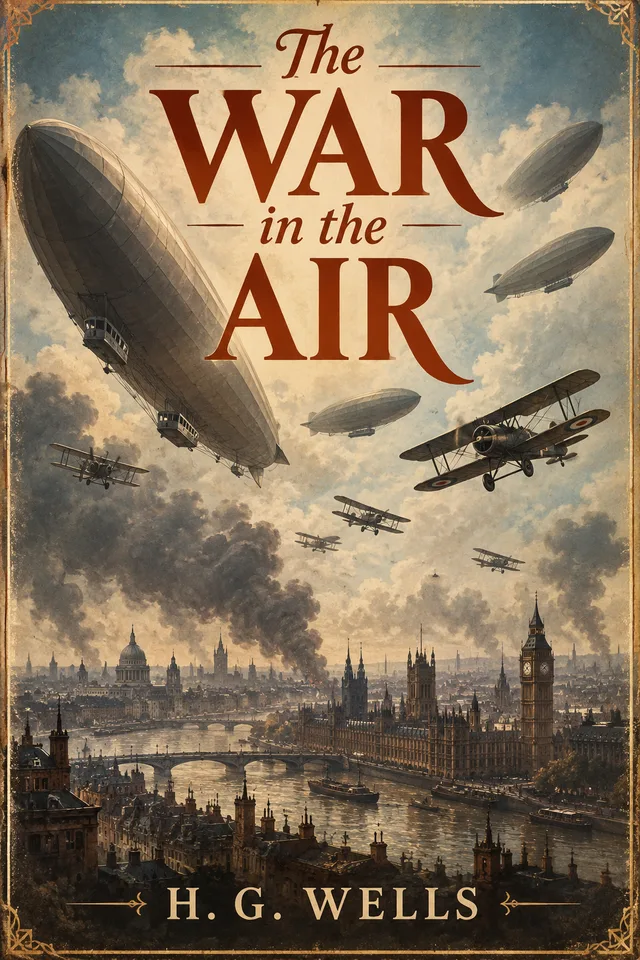
The War in the Air
英語 BooksWhale エディション · H. G. Wells
A speculative war novel that imagines aviation transforming modern conflict, cities, and political power.
- プレビュー
- 準備済みテキストからの抜粋
- 形式
- オンラインリーダー, EPUB, PDF
- アクセス
- ライブラリ claim
本の紹介
The War in the Air
H. G. Wells follows Bert Smallways from comic provincial adventure into a world where airships make old military assumptions obsolete. The novel mixes satire, technological imagination, and an unsettling forecast of industrialized war.
BooksWhale エディション
このエディションの準備
このエディションはパブリックドメイン本文に基づき、BooksWhale がデジタル読書向けに準備しました。
パブリックドメイン根拠
このエディションを共有できる理由
The author died before 1955 and the work was first published before 1931; the original English text is treated as public-domain source material for this edition.
プレビューを読む
準備済みテキストからの抜粋
準備済み読書テキストから選んだプレビューです。
プレビュー章Full textプレビューを読む
The War in the Air
H. G. Wells
プレビュー章PREFACE TO REPRINT EDITIONプレビュー
The reader should grasp clearly the date at which this book was written. It was done in 1907: it appeared in various magazines as a serial in 1908 and it was published in the Fall of that year. At that time the aeroplane was, for most people, merely a rumour and the “Sausage” held the air. The contemporary reader has all the advantage of ten years' experience since this story was imagined. He can correct his author at a dozen points and estimate the value of these warnings by the standard of a decade of realities. The book is weak on anti-aircraft guns, for example, and still more negligent of submarines. Much, no doubt, will strike the reader as quaint and limited but upon much the writer may not unreasonably plume himself. The interpretation of the German spirit must have read as a caricature in 1908. Was it a caricature? Prince Karl seemed a fantasy then. Reality has since copied Prince Carl with an astonishing faithfulness. Is it too much to hope that some democratic “Bert” may not ultimately get even with his Highness? Our author tells us in this book, as he has told us in others, more especially in The World Set Free, and as he has been telling us this year in his War and the Future, that if mankind goes on with war, the smash-up of civilization is inevitable. It is chaos or the United States of the World for mankind. There is no other choice. Ten years have but added an enormous conviction to the message of this book. It remains essentially right, a pamphlet story—in support of the League to Enforce Peace. K.
プレビュー章CHAPTER I. OF PROGRESS AND THE SMALLWAYS FAMILYプレビュー
“This here Progress,” said Mr. Tom Smallways, “it keeps on.”
“You'd hardly think it could keep on,” said Mr. Tom Smallways.
It was long before the War in the Air began that Mr. Smallways made this remark. He was sitting on the fence at the end of his garden and surveying the great Bun Hill gas-works with an eye that neither praised nor blamed. Above the clustering gasometers three unfamiliar shapes appeared, thin, wallowing bladders that flapped and rolled about, and grew bigger and bigger and rounder and rounder—balloons in course of inflation for the South of England Aero Club's Saturday-afternoon ascent.
“They goes up every Saturday,” said his neighbour, Mr. Stringer, the milkman. “It's only yestiday, so to speak, when all London turned out to see a balloon go over, and now every little place in the country has its weekly-outings—uppings, rather. It's been the salvation of them gas companies.”
“Larst Satiday I got three barrer-loads of gravel off my petaters,” said Mr. Tom Smallways. “Three barrer-loads! What they dropped as ballase. Some of the plants was broke, and some was buried.”
“Ladies, they say, goes up!”
“I suppose we got to call 'em ladies,” said Mr. Tom Smallways.
“Still, it ain't hardly my idea of a lady—flying about in the air, and throwing gravel at people. It ain't what I been accustomed to consider ladylike, whether or no.”
Mr. Stringer nodded his head approvingly, and for a time they continued to regard the swelling bulks with expressions that had changed from indifference to disapproval.
Mr. Tom Smallways was a green-grocer by trade and a gardener by disposition; his little wife Jessica saw to the shop, and Heaven had planned him for a peaceful world. Unfortunately Heaven had not planned a peaceful world for him. He lived in a world of obstinate and incessant change, and in parts where its operations were unsparingly conspicuous. Vicissitude was in the very soil he tilled; even his garden was upon a yearly tenancy, and overshadowed by a huge board that proclaimed it not so much a garden as an eligible building site. He was horticulture under notice to quit, the last patch of country in a district flooded by new and (other) things. He did his best to console himself, to imagine matters near the turn of the tide.
“You'd hardly think it could keep on,” he said.
Mr. Smallways' aged father, could remember Bun Hill as an idyllic Kentish village. He had driven Sir Peter Bone until he was fifty and then he took to drink a little, and driving the station bus, which lasted him until he was seventy-eight. Then he retired. He sat by the fireside, a shrivelled, very, very old coachman, full charged with reminiscences, and ready for any careless stranger. He could tell you of the vanished estate of Sir Peter Bone, long since cut up for building, and how that magnate ruled the country-side when it was country-side, of shooting and hunting, and of caches along the high road, of how “where the gas-works is” was a cricket-field, and of the coming of the Crystal Palace. The Crystal Palace was six miles away from Bun Hill, a great facade that glittered in the morning, and was a clear blue outline against the sky in the afternoon, and of a night, a source of gratuitous fireworks for all the population of Bun Hill. And then had come the railway, and then villas and villas, and then the gas-works and the water-works, and a great, ugly sea of workmen's houses, and then drainage, and the water vanished out of the Otterbourne and left it a dreadful ditch, and then a second railway station, Bun Hill South, and more houses and more, more shops, more competition, plate-glass shops, a school-board, rates, omnibuses, tramcars—going right away into London itself—bicycles, motor-cars and then more motor-cars, a Carnegie library.
目次
このエディションの内容
- 01Full text
- 02PREFACE TO REPRINT EDITION
- 03CHAPTER I. OF PROGRESS AND THE SMALLWAYS FAMILY
- 04It was there the difficulty began.
- 05CHAPTER II. HOW BERT SMALLWAYS GOT INTO DIFFICULTIES
- 06Its possibilities had come to them first with a humorous flavour.
- 07Much they cared!
- 08MR. BUTTERIDGE'S INVENTION FOR AMERICA.———————————————————-
- 09CHAPTER III. THE BALLOON
- 10I
- 11CHAPTER IV. THE GERMAN AIR-FLEET
- 12Memories swamped his scheming.
- 13Von Winterfeld made some explanation.
- 14CHAPTER V. THE BATTLE OF THE NORTH ATLANTIC
- 15CHAPTER VI. HOW WAR CAME TO NEW YORK
- 16CHAPTER VII. THE “VATERLAND” IS DISABLED
- 17Like a picture Bert saw these things, a picture a little blurred by a thin veil of wind-torn mist.
- 18CHAPTER VIII. A WORLD AT WAR
- 19CHAPTER IX. ON GOAT ISLAND
- 20If one was very hungry would one eat rats?
- 21CHAPTER X. THE WORLD UNDER THE WAR
- 22Could he get it? He gave himself to the steering. Round to the right—left!
- 23CHAPTER XI. THE GREAT COLLAPSE
- 24Could mankind have prevented this disaster of the War in the Air?
- 25THE EPILOGUE