英語 エディション
文学
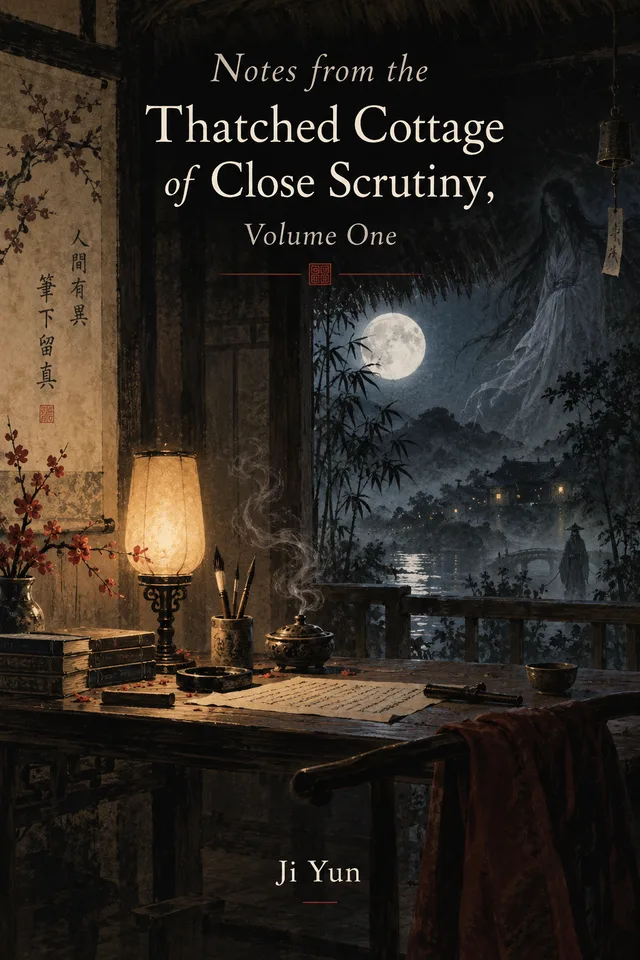
Notes from the Thatched Cottage of Close Scrutiny, Volume One
英語 BooksWhale エディション · Ji Yun
原題: 阅微草堂笔记
Ghost stories, strange encounters, moral anecdotes, and observations of late imperial society.
- プレビュー
- 準備済みテキストからの抜粋
- 形式
- オンラインリーダー, EPUB, PDF
- アクセス
- ライブラリ claim
本の紹介
Notes from the Thatched Cottage of Close Scrutiny, Volume One
Volume One gathers tales of spirits, omens, strange deaths, local customs, and moral reversals. Ji Yun uses the supernatural to examine character, justice, desire, and the limits of knowledge.
BooksWhale エディション
このエディションの準備
このエディションはパブリックドメイン本文に基づき、BooksWhale がデジタル読書向けに準備しました。
パブリックドメイン根拠
このエディションを共有できる理由
Ji Yun died in 1805; the Chinese source text is public domain. This edition is an authorized AI-assisted translation.
プレビューを読む
準備済みテキストからの抜粋
準備済み読書テキストから選んだプレビューです。
プレビュー章Full textプレビューを読む
Notes from the Thatched Cottage of Close Scrutiny, Volume One
Ji Yun
プレビュー章Original Preface to Jottings from the Thatched Cottage of Close Scrutinyプレビュー
Writing is meant to elucidate principles, and all scholars can do this through writing. Then is the so-called Great Way really so profound and unfathomable, so secret and incommunicable, like the mind-seal of Buddhism or the oral formulas of Daoism?
The essential principles inherent in all things and affairs are what we call the Way. Thus the Way exists between Heaven and Earth like mercury spilled upon the ground, every drop perfectly round; like the moon reflected upon water, visible everywhere. From governing a state and bringing peace to the world down to a single affair, object, word, or deed, traces of the Way are present everywhere. Writing is merely one of its manifestations.
At the highest level of writing are the Book of Songs, the Book of Documents, the Book of Rites, the Book of Music, the Book of Changes, and the Spring and Autumn Annals; these are where the Way finds its lodgment. Below them are the histories of successive dynasties; below those, the writings of worthy men; below those, the collected works of the various schools. These too form one branch of literature, and their words are sufficient to illuminate principle.
Still lower are unofficial histories, anecdotal records, romances, and tales. At first glance they may seem to have nothing to do with the Way, yet the “Treatise on Literature” in the Book of Han classified such writings as a school of their own, and bibliographies throughout the ages have continued to record them. Can they all be dismissed merely because some of their contents are strange or fantastic? Their words too can illuminate principles. Although they cannot be ranked among the higher forms of writing, their underlying purpose may still approach the proper Way and may not be without benefit to social morals and the hearts of men.
プレビュー章Zheng’s Preface to Jottings from the Thatched Cottage of Close Scrutinyプレビュー
Ji Yun, Duke Wenda of Hejian, spent many years serving in the imperial academies and secretariats. His writings are grand in spirit and may rightly be called the work of one of the great pens of his age. Some say that Duke Wenda delighted in humor and wit, and that whether joking, laughing, praising, or scolding, whatever came to his hand naturally became splendid prose.
Now that I have read his Jottings from the Thatched Cottage of Close Scrutiny, I find its contents plain and substantial, its form orderly and rigorous, and its central purpose consistently directed toward encouraging goodness and punishing evil. Is this not what people mean when they say that “the sage excels at distinguishing right from wrong”? Though its literary form is fiction, it reads almost like official history.
Duke Wenda himself said:
“It does not overturn right and wrong as does Biyun; it does not conceal private grudges as does The Journey of Zhou and Qin; it does not depict talented young men and beautiful women as does The Story of Yingying; and it does not dwell upon obscenity as does Secret Anecdotes of the Han. I hope upright gentlemen will not disdain it.”
Surely these are merely Duke Wenda’s modest words.
Duke Wenda’s grandson, Ji Shufu, came south to Lingnan to serve as an official. Many people asked him for copies of this book, so he decided to have it reengraved and reprinted. Shufu is sincere, cautious, and learned; diligent in administration and caring toward the people. He is an excellent official and has not disgraced the family tradition of his grandfather.
Written and respectfully examined by Zheng Kaixi of Longxi, in the spring of the yiwei year, the fifteenth year of the Daoguang reign.
目次
このエディションの内容
- 01Full text
- 02Original Preface to Jottings from the Thatched Cottage of Close Scrutiny
- 03Zheng’s Preface to Jottings from the Thatched Cottage of Close Scrutiny
- 04Volume One
- 05Summer Records from Luanyang, Part One
- 06Volume Two
- 07Summer Records from Luanyang, Part Two
- 08Volume Three
- 09Summer Records from Luanyang, Part Three
- 10Volume Four
- 11Summer Records from Luanyang, Part Four
- 12Volume Five
- 13Summer Records from Luanyang, Part Five
- 14Volume Six
- 15Summer Records from Luanyang, Part Six
- 16Volume Six was half written at Rehe and completed only after I returned to the capital.
言語の提供状況
他の言語
中国語
中国語 エディション
阅微草堂笔记
Ji Yun · 文学
清代笔记小说经典,记录狐鬼、因果、奇闻、世情、官场经验与士人判断。
フランス語
フランス語 エディション
Notes de la chaumière de Yuewei, Tome I
Ji Yun · 文学
Le premier tome d’un recueil chinois de fantômes, prodiges, anecdotes lettrées et jugements moraux.
スペイン語
スペイン語 エディション
Notas de la cabaña de Yuewei, volumen I
Ji Yun · 文学
Fantasma, zorro y prodigio aparecen en relatos breves donde el erudito Ji Yun mezcla asombro sobrenatural y observación moral.