inglês Edição
Literatura
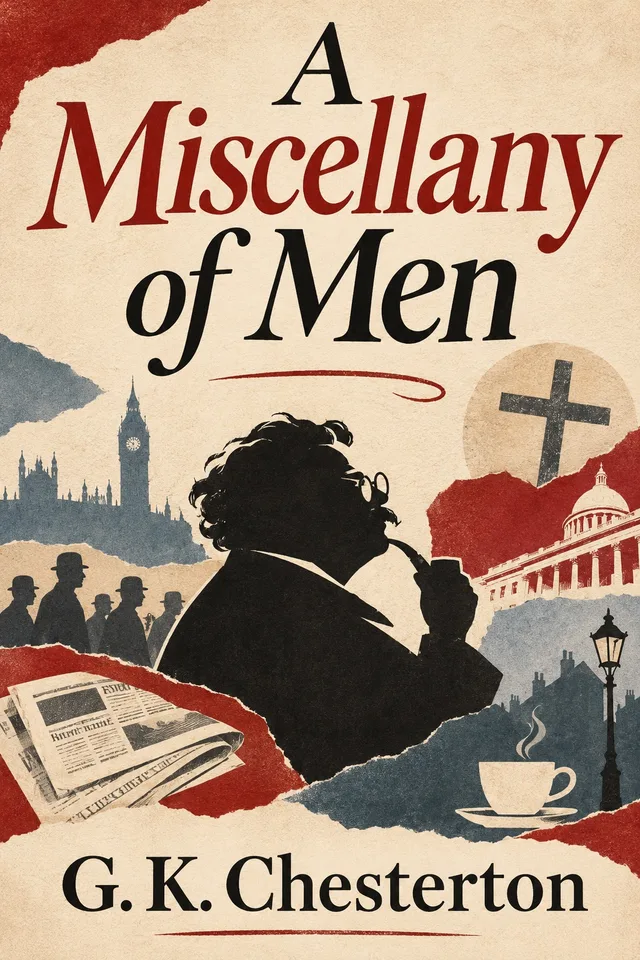
A Miscellany of Men
Edição BooksWhale em inglês por G. K. Chesterton
Chesterton turns recognizable social types into witty essays on politics, journalism, belief, freedom, and everyday habits of thought.
- Prévia
- Amostra do texto preparado
- Formatos
- Leitor online, EPUB, PDF
- Acesso
- Claim da Biblioteca
Introdução do livro
A Miscellany of Men
G. K. Chesterton builds this essay collection around figures such as the suffragist, the journalist, the miser, and the man who thinks backwards. Their familiar habits become starting points for arguments about public language, political assumptions, social convention, and individual liberty. Paradox and humor connect ordinary observations with larger disputes. The original English essays retain the variety of voices and subjects suggested by the title.
Edição BooksWhale
Como esta edição foi preparada
Esta edição se baseia em um texto em domínio público e foi preparada pela BooksWhale para leitura digital.
Base de domínio público
Por que pode ser compartilhada
G. K. Chesterton died in 1936, and this work was first published in 1912. This edition uses the public-domain original English text from Project Gutenberg, without later editorial notes or illustrations.
Ler prévia
Amostra do texto preparado
Prévia selecionada do texto preparado.
Capítulo de préviaFull textLer prévia
A Miscellany of Men
G. K. Chesterton
Capítulo de préviaTHE SUFFRAGISTPrévia
Rightly or wrongly, it is certain that a man both liberal and chivalric, can and very often does feel a dis-ease and distrust touching those political women we call Suffragettes. Like most other popular sentiments, it is generally wrongly stated even when it is rightly felt. One part of it can be put most shortly thus: that when a woman puts up her fists to a man she is putting herself in the only posture in which he is not afraid of her. He can be afraid of her speech and still more of her silence; but force reminds him of a rusted but very real weapon of which he has grown ashamed. But these crude summaries are never quite accurate in any matter of the instincts. For the things which are the simplest so long as they are undisputed invariably become the subtlest when once they are disputed: which was what Joubert meant, I suppose, when he said, “It is not hard to believe in God if one does not define Him.” When the evil instincts of old Foulon made him say of the poor, “Let them eat grass,” the good and Christian instincts of the poor made them hang him on a lamppost with his mouth stuffed full of that vegetation. But if a modern vegetarian aristocrat were to say to the poor, “But why don't you like grass?” their intelligences would be much more taxed to find such an appropriate repartee. And this matter of the functions of the sexes is primarily a matter of the instincts; sex and breathing are about the only two things that generally work best when they are least worried about. That, I suppose, is why the same sophisticated age that has poisoned the world with Feminism is also polluting it with Breathing Exercises. We plunge at once into a forest of false analogies and bad blundering history; while almost any man or woman left to themselves would know at least that sex is quite different from anything else in the world.
There is no kind of comparison possible between a quarrel of man and woman (however right the woman may be) and the other quarrels of slave and master, of rich and poor, or of patriot and invader, with which the Suffragists deluge us every day. The difference is as plain as noon; these other alien groups never came into contact until they came into collision. Races and ranks began with battle, even if they afterwards melted into amity. But the very first fact about the sexes is that they like each other. They seek each other: and awful as are the sins and sorrows that often come of their mating, it was not such things that made them meet. It is utterly astounding to note the way in which modern writers and talkers miss this plain, wide, and overwhelming fact: one would suppose woman a victim and nothing else. By this account ideal, emancipated woman has, age after age, been knocked silly with a stone axe. But really there is no fact to show that ideal, emancipated woman was ever knocked silly; except the fact that she is silly. And that might have arisen in so many other ways. Real responsible woman has never been silly; and any one wishing to knock her would be wise (like the streetboys) to knock and run away. It is ultimately idiotic to compare this prehistoric participation with any royalties or rebellions. Genuine royalties wish to crush rebellions. Genuine rebels wish to destroy kings. The sexes cannot wish to abolish each other; and if we allow them any sort of permanent opposition it will sink into something as base as a party system.
As marriage, therefore, is rooted in an aboriginal unity of instincts, you cannot compare it, even in its quarrels, with any of the mere collisions of separate institutions. You could compare it with the emancipation of negroes from planters—if it were true that a white man in early youth always dreamed of the abstract beauty of a black man. You could compare it with the revolt of tenants against a landlord—if it were true that young landlords wrote sonnets to invisible tenants. You could compare it to the fighting policy of the Fenians—if it were true that every normal Irishman wanted an Englishman to come and live with him. But as we know there are no instincts in any of these directions, these analogies are not only false but false on the cardinal fact. I do not speak of the comparative comfort or merit of these different things: I say they are different. It may be that love turned to hate is terribly common in sexual matters: it may be that hate turned to love is not uncommon in the rivalries of race or class. But any philosophy about the sexes that begins with anything but the mutual attraction of the sexes, begins with a fallacy; and all its historical comparisons are as irrelevant and impertinent as puns.
Capítulo de préviaTHE POET AND THE CHEESEPrévia
There is something creepy in the flat Eastern Counties; a brush of the white feather. There is a stillness, which is rather of the mind than of the bodily senses. Rapid changes and sudden revelations of scenery, even when they are soundless, have something in them analogous to a movement of music, to a crash or a cry. Mountain hamlets spring out on us with a shout like mountain brigands. Comfortable valleys accept us with open arms and warm words, like comfortable innkeepers. But travelling in the great level lands has a curiously still and lonely quality; lonely even when there are plenty of people on the road and in the market-place. One's voice seems to break an almost elvish silence, and something unreasonably weird in the phrase of the nursery tales, “And he went a little farther and came to another place,” comes back into the mind.
In some such mood I came along a lean, pale road south of the fens, and found myself in a large, quiet, and seemingly forgotten village. It was one of those places that instantly produce a frame of mind which, it may be, one afterwards decks out with unreal details. I dare say that grass did not really grow in the streets, but I came away with a curious impression that it did. I dare say the marketplace was not literally lonely and without sign of life, but it left the vague impression of being so. The place was large and even loose in design, yet it had the air of something hidden away and always overlooked. It seemed shy, like a big yokel; the low roofs seemed to be ducking behind the hedges and railings; and the chimneys holding their breath. I came into it in that dead hour of the afternoon which is neither after lunch nor before tea, nor anything else even on a half-holiday; and I had a fantastic feeling that I had strayed into a lost and extra hour that is not numbered in the twenty-four.
I entered an inn which stood openly in the market-place yet was almost as private as a private house. Those who talk of “public-houses” as if they were all one problem would have been both puzzled and pleased with such a place. In the front window a stout old lady in black with an elaborate cap sat doing a large piece of needlework. She had a kind of comfortable Puritanism about her; and might have been (perhaps she was) the original Mrs. Grundy. A little more withdrawn into the parlour sat a tall, strong, and serious girl, with a face of beautiful honesty and a pair of scissors stuck in her belt, doing a small piece of needlework. Two feet behind them sat a hulking labourer with a humorous face like wood painted scarlet, with a huge mug of mild beer which he had not touched, and probably would not touch for hours. On the hearthrug there was an equally motionless cat; and on the table a copy of 'Household Words'.
I was conscious of some atmosphere, still and yet bracing, that I had met somewhere in literature. There was poetry in it as well as piety; and yet it was not poetry after my particular taste. It was somehow at once solid and airy. Then I remembered that it was the atmosphere in some of Wordsworth's rural poems; which are full of genuine freshness and wonder, and yet are in some incurable way commonplace. This was curious; for Wordsworth's men were of the rocks and fells, and not of the fenlands or flats. But perhaps it is the clearness of still water and the mirrored skies of meres and pools that produces this crystalline virtue. Perhaps that is why Wordsworth is called a Lake Poet instead of a mountain poet. Perhaps it is the water that does it. Certainly the whole of that town was like a cup of water given at morning.
Sumário
Nesta edição
- 01Full text
- 02THE SUFFRAGIST
- 03THE POET AND THE CHEESE
- 04THE THING
- 05THE MAN WHO THINKS BACKWARDS
- 06THE NAMELESS MAN
- 07THE GARDENER AND THE GUINEA
- 08THE VOTER AND THE TWO VOICES
- 09THE MAD OFFICIAL
- 10THE ENCHANTED MAN
- 11THE SUN WORSHIPPER
- 12THE WRONG INCENDIARY
- 13THE FREE MAN
- 14THE HYPOTHETICAL HOUSEHOLDER
- 15THE PRIEST OF SPRING
- 16THE REAL JOURNALIST
- 17THE SENTIMENTAL SCOT
- 18THE SECTARIAN OF SOCIETY
- 19THE FOOL
- 20THE CONSCRIPT AND THE CRISIS
- 21THE MISER AND HIS FRIENDS
- 22THE MYSTAGOGUE
- 23THE RED REACTIONARY
- 24THE SEPARATIST AND SACRED THINGS
- 25THE MUMMER
- 26THE ARISTOCRATIC 'ARRY
- 27THE NEW THEOLOGIAN
- 28THE ROMANTIC IN THE RAIN
- 29THE FALSE PHOTOGRAPHER
- 30THE SULTAN
- 31THE ARCHITECT OF SPEARS
- 32THE MAN ON TOP
- 33THE OTHER KIND OF MAN
- 34THE MEDIÆVAL VILLAIN
- 35THE DIVINE DETECTIVE
- 36THE ELF OF JAPAN
- 37THE CHARTERED LIBERTINE
- 38THE CONTENTED MAN
- 39THE ANGRY AUTHOR: HIS FAREWELL
Disponibilidade de idiomas
Outros idiomas
Outras edições de idioma ainda não foram publicadas. Elas aparecerão aqui quando disponíveis.
Solicitar outro idioma