inglês Edição
Filosofia
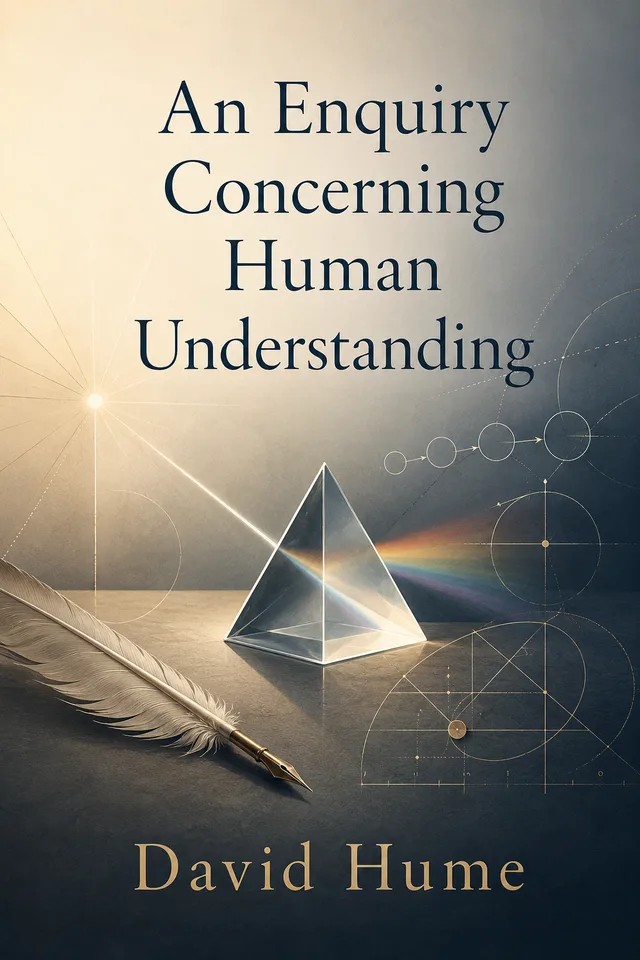
An Enquiry Concerning Human Understanding
Edição BooksWhale em inglês por David Hume
A lucid philosophical inquiry into knowledge, causation, probability, miracles, and human understanding.
- Prévia
- Amostra do texto preparado
- Formatos
- Leitor online, EPUB, PDF
- Acesso
- Claim da Biblioteca
Introdução do livro
An Enquiry Concerning Human Understanding
An Enquiry Concerning Human Understanding presents David Hume’s central arguments on experience, causation, belief, skepticism, probability, and miracles in a concise English philosophical classic.
Edição BooksWhale
Como esta edição foi preparada
Esta edição se baseia em um texto em domínio público e foi preparada pela BooksWhale para leitura digital.
Base de domínio público
Por que pode ser compartilhada
David Hume died in 1776, and An Enquiry Concerning Human Understanding was first published in 1748. These dates support the public-domain basis for this English original-language edition.
Ler prévia
Amostra do texto preparado
Prévia selecionada do texto preparado.
Capítulo de préviaFull textLer prévia
An Enquiry Concerning Human Understanding
BY DAVID HUME
Capítulo de préviaSECTION I.Prévia
OF THE DIFFERENT SPECIES OF PHILOSOPHY.
1. Moral philosophy, or the science of human nature, may be treated after two different manners; each of which has its peculiar merit, and may contribute to the entertainment, instruction, and reformation of mankind. The one considers man chiefly as born for action; and as influenced in his measures by taste and sentiment; pursuing one object, and avoiding another, according to the value which these objects seem to possess, and according to the light in which they present themselves. As virtue, of all objects, is allowed to be the most valuable, this species of philosophers paint her in the most amiable colours; borrowing all helps from poetry and eloquence, and treating their subject in an easy and obvious manner, and such as is best fitted to please the imagination, and engage the affections. They select the most striking observations and instances from common life; place opposite characters in a proper contrast; and alluring us into the paths of virtue by the views of glory and happiness, direct our steps in these paths by the soundest precepts and most illustrious examples. They make us _feel_ the difference between vice and virtue; they excite and regulate our sentiments; and so they can but bend our hearts to the love of probity and true honour, they think, that they have fully attained the end of all their labours.
2. The other species of philosophers consider man in the light of a reasonable rather than an active being, and endeavour to form his understanding more than cultivate his manners. They regard human nature as a subject of speculation; and with a narrow scrutiny examine it, in order to find those principles, which regulate our understanding, excite our sentiments, and make us approve or blame any particular object, action, or behaviour. They think it a reproach to all literature, that philosophy should not yet have fixed, beyond controversy, the foundation of morals, reasoning, and criticism; and should for ever talk of truth and falsehood, vice and virtue, beauty and deformity, without being able to determine the source of these distinctions. While they attempt this arduous task, they are deterred by no difficulties; but proceeding from particular instances to general principles, they still push on their enquiries to principles more general, and rest not satisfied till they arrive at those original principles, by which, in every science, all human curiosity must be bounded. Though their speculations seem abstract, and even unintelligible to common readers, they aim at the approbation of the learned and the wise; and think themselves sufficiently compensated for the labour of their whole lives, if they can discover some hidden truths, which may contribute to the instruction of posterity.
3. It is certain that the easy and obvious philosophy will always, with the generality of mankind, have the preference above the accurate and abstruse; and by many will be recommended, not only as more agreeable, but more useful than the other. It enters more into common life; moulds the heart and affections; and, by touching those principles which actuate men, reforms their conduct, and brings them nearer to that model of perfection which it describes. On the contrary, the abstruse philosophy, being founded on a turn of mind, which cannot enter into business and action, vanishes when the philosopher leaves the shade, and comes into open day; nor can its principles easily retain any influence over our conduct and behaviour. The feelings of our heart, the agitation of our passions, the vehemence of our affections, dissipate all its conclusions, and reduce the profound philosopher to a mere plebeian.
4. This also must be confessed, that the most durable, as well as justest fame, has been acquired by the easy philosophy, and that abstract reasoners seem hitherto to have enjoyed only a momentary reputation, from the caprice or ignorance of their own age, but have not been able to support their renown with more equitable posterity. It is easy for a profound philosopher to commit a mistake in his subtile reasonings; and one mistake is the necessary parent of another, while he pushes on his consequences, and is not deterred from embracing any conclusion, by its unusual appearance, or its contradiction to popular opinion. But a philosopher, who purposes only to represent the common sense of mankind in more beautiful and more engaging colours, if by accident he falls into error, goes no farther; but renewing his appeal to common sense, and the natural sentiments of the mind, returns into the right path, and secures himself from any dangerous illusions. The fame of Cicero flourishes at present; but that of Aristotle is utterly decayed. La Bruyere passes the seas, and still maintains his reputation: But the glory of Malebranche is confined to his own nation, and to his own age. And Addison, perhaps, will be read with pleasure, when Locke shall be entirely forgotten.
Capítulo de préviaSECTION II.Prévia
OF THE ORIGIN OF IDEAS.
11. Every one will readily allow, that there is a considerable difference between the perceptions of the mind, when a man feels the pain of excessive heat, or the pleasure of moderate warmth, and when he afterwards recalls to his memory this sensation, or anticipates it by his imagination. These faculties may mimic or copy the perceptions of the senses; but they never can entirely reach the force and vivacity of the original sentiment. The utmost we say of them, even when they operate with greatest vigour, is, that they represent their object in so lively a manner, that we could _almost_ say we feel or see it: But, except the mind be disordered by disease or madness, they never can arrive at such a pitch of vivacity, as to render these perceptions altogether undistinguishable. All the colours of poetry, however splendid, can never paint natural objects in such a manner as to make the description be taken for a real landskip. The most lively thought is still inferior to the dullest sensation.
We may observe a like distinction to run through all the other perceptions of the mind. A man in a fit of anger, is actuated in a very different manner from one who only thinks of that emotion. If you tell me, that any person is in love, I easily understand your meaning, and form a just conception of his situation; but never can mistake that conception for the real disorders and agitations of the passion. When we reflect on our past sentiments and affections, our thought is a faithful mirror, and copies its objects truly; but the colours which it employs are faint and dull, in comparison of those in which our original perceptions were clothed. It requires no nice discernment or metaphysical head to mark the distinction between them.
12. Here therefore we may divide all the perceptions of the mind into two classes or species, which are distinguished by their different degrees of force and vivacity. The less forcible and lively are commonly denominated _Thoughts_ or _Ideas_. The other species want a name in our language, and in most others; I suppose, because it was not requisite for any, but philosophical purposes, to rank them under a general term or appellation. Let us, therefore, use a little freedom, and call them _Impressions_; employing that word in a sense somewhat different from the usual. By the term _impression_, then, I mean all our more lively perceptions, when we hear, or see, or feel, or love, or hate, or desire, or will. And impressions are distinguished from ideas, which are the less lively perceptions, of which we are conscious, when we reflect on any of those sensations or movements above mentioned.
13. Nothing, at first view, may seem more unbounded than the thought of man, which not only escapes all human power and authority, but is not even restrained within the limits of nature and reality. To form monsters, and join incongruous shapes and appearances, costs the imagination no more trouble than to conceive the most natural and familiar objects. And while the body is confined to one planet, along which it creeps with pain and difficulty; the thought can in an instant transport us into the most distant regions of the universe; or even beyond the universe, into the unbounded chaos, where nature is supposed to lie in total confusion. What never was seen, or heard of, may yet be conceived; nor is any thing beyond the power of thought, except what implies an absolute contradiction.
But though our thought seems to possess this unbounded liberty, we shall find, upon a nearer examination, that it is really confined within very narrow limits, and that all this creative power of the mind amounts to no more than the faculty of compounding, transposing, augmenting, or diminishing the materials afforded us by the senses and experience. When we think of a golden mountain, we only join two consistent ideas, _gold_, and _mountain_, with which we were formerly acquainted. A virtuous horse we can conceive; because, from our own feeling, we can conceive virtue; and this we may unite to the figure and shape of a horse, which is an animal familiar to us. In short, all the materials of thinking are derived either from our outward or inward sentiment: the mixture and composition of these belongs alone to the mind and will. Or, to express myself in philosophical language, all our ideas or more feeble perceptions are copies of our impressions or more lively ones.
Sumário
Nesta edição
- 01Full text
- 02SECTION I.
- 03SECTION II.
- 04SECTION III.
- 05SECTION IV.
- 06PART I.
- 07PART II.
- 08SECTION V.
- 09PART I.
- 10PART II.
- 11SECTION VI.
- 12SECTION VII.
- 13PART I.
- 14PART II.
- 15SECTION VIII.
- 16PART I.
- 17PART II.
- 18SECTION IX.
- 19SECTION X.
- 20PART I.
- 21PART II.
- 22SECTION XI.
- 23SECTION XII.
- 24PART I.
- 25PART II.
- 26PART III.
Disponibilidade de idiomas
Outros idiomas
Outras edições de idioma ainda não foram publicadas. Elas aparecerão aqui quando disponíveis.
Solicitar outro idioma