inglês Edição
Literatura
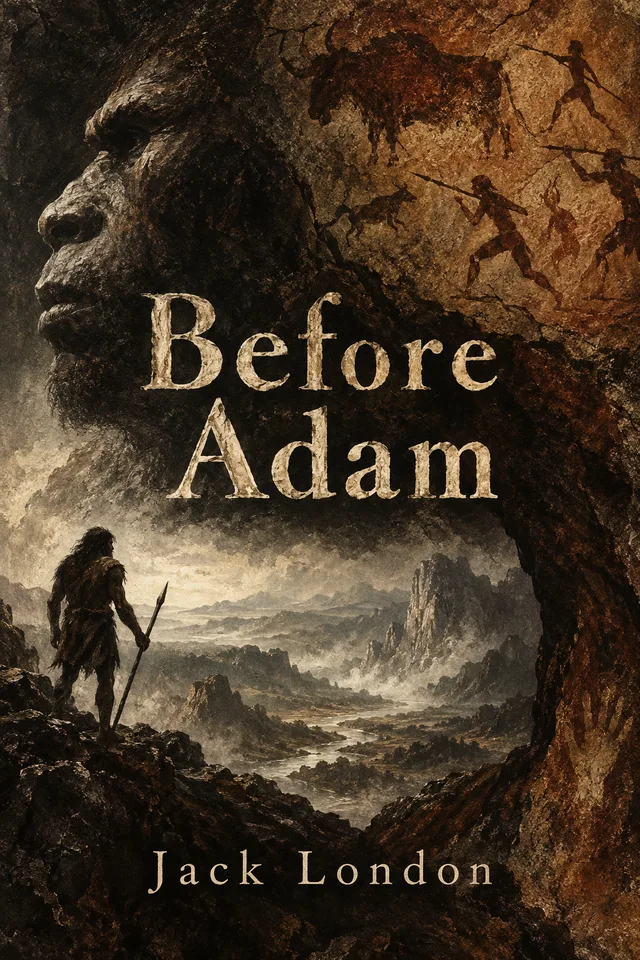
Before Adam
Edição BooksWhale em inglês por Jack London
A modern dreamer remembers a brutal prehistoric world of early humans and survival.
- Prévia
- Amostra do texto preparado
- Formatos
- Leitor online, EPUB, PDF
- Acesso
- Claim da Biblioteca
Introdução do livro
Before Adam
London imagines ancestral memory as vivid visions of a dangerous prehistoric society, combining evolutionary speculation and adventure.
Edição BooksWhale
Como esta edição foi preparada
Esta edição se baseia em um texto em domínio público e foi preparada pela BooksWhale para leitura digital.
Base de domínio público
Por que pode ser compartilhada
The source text is public domain; Jack London died in 1916 and the work dates from 1906.
Ler prévia
Amostra do texto preparado
Prévia selecionada do texto preparado.
Capítulo de préviaFull textLer prévia
Before Adam
Jack London
“These are our ancestors, and their history is our history. Remember that as surely as we one day swung down out of the trees and walked upright, just as surely, on a far earlier day, did we crawl up out of the sea and achieve our first adventure on land.”
Capítulo de préviaCHAPTER IPrévia
Pictures! Pictures! Pictures! Often, before I learned, did I wonder whence came the multitudes of pictures that thronged my dreams; for they were pictures the like of which I had never seen in real wake-a-day life. They tormented my childhood, making of my dreams a procession of nightmares and a little later convincing me that I was different from my kind, a creature unnatural and accursed.
In my days only did I attain any measure of happiness. My nights marked the reign of fear—and such fear! I make bold to state that no man of all the men who walk the earth with me ever suffer fear of like kind and degree. For my fear is the fear of long ago, the fear that was rampant in the Younger World, and in the youth of the Younger World. In short, the fear that reigned supreme in that period known as the Mid-Pleistocene.
What do I mean? I see explanation is necessary before I can tell you of the substance of my dreams. Otherwise, little could you know of the meaning of the things I know so well. As I write this, all the beings and happenings of that other world rise up before me in vast phantasmagoria, and I know that to you they would be rhymeless and reasonless.
What to you the friendship of Lop-Ear, the warm lure of the Swift One, the lust and the atavism of Red-Eye? A screaming incoherence and no more. And a screaming incoherence, likewise, the doings of the Fire People and the Tree People, and the gibbering councils of the horde. For you know not the peace of the cool caves in the cliffs, the circus of the drinking-places at the end of the day. You have never felt the bite of the morning wind in the tree-tops, nor is the taste of young bark sweet in your mouth.
It would be better, I dare say, for you to make your approach, as I made mine, through my childhood. As a boy I was very like other boys—in my waking hours. It was in my sleep that I was different. From my earliest recollection my sleep was a period of terror. Rarely were my dreams tinctured with happiness. As a rule, they were stuffed with fear—and with a fear so strange and alien that it had no ponderable quality. No fear that I experienced in my waking life resembled the fear that possessed me in my sleep. It was of a quality and kind that transcended all my experiences.
For instance, I was a city boy, a city child, rather, to whom the country was an unexplored domain. Yet I never dreamed of cities; nor did a house ever occur in any of my dreams. Nor, for that matter, did any of my human kind ever break through the wall of my sleep. I, who had seen trees only in parks and illustrated books, wandered in my sleep through interminable forests. And further, these dream trees were not a mere blur on my vision. They were sharp and distinct. I was on terms of practised intimacy with them. I saw every branch and twig; I saw and knew every different leaf.
Well do I remember the first time in my waking life that I saw an oak tree. As I looked at the leaves and branches and gnarls, it came to me with distressing vividness that I had seen that same kind of tree many and countless times in my sleep. So I was not surprised, still later on in my life, to recognize instantly, the first time I saw them, trees such as the spruce, the yew, the birch, and the laurel. I had seen them all before, and was seeing them even then, every night, in my sleep.
This, as you have already discerned, violates the first law of dreaming, namely, that in one’s dreams one sees only what he has seen in his waking life, or combinations of the things he has seen in his waking life. But all my dreams violated this law. In my dreams I never saw anything of which I had knowledge in my waking life. My dream life and my waking life were lives apart, with not one thing in common save myself. I was the connecting link that somehow lived both lives.
Capítulo de préviaCHAPTER IIPrévia
I have said that in my dreams I never saw a human being. Of this fact I became aware very early, and felt poignantly the lack of my own kind. As a very little child, even, I had a feeling, in the midst of the horror of my dreaming, that if I could find but one man, only one human, I should be saved from my dreaming, that I should be surrounded no more by haunting terrors. This thought obsessed me every night of my life for years—if only I could find that one human and be saved!
I must iterate that I had this thought in the midst of my dreaming, and I take it as an evidence of the merging of my two personalities, as evidence of a point of contact between the two disassociated parts of me. My dream personality lived in the long ago, before ever man, as we know him, came to be; and my other and wake-a-day personality projected itself, to the extent of the knowledge of man’s existence, into the substance of my dreams.
Perhaps the psychologists of the book will find fault with my way of using the phrase, “disassociation of personality.” I know their use of it, yet am compelled to use it in my own way in default of a better phrase. I take shelter behind the inadequacy of the English language. And now to the explanation of my use, or misuse, of the phrase.
It was not till I was a young man, at college, that I got any clew to the significance of my dreams, and to the cause of them. Up to that time they had been meaningless and without apparent causation. But at college I discovered evolution and psychology, and learned the explanation of various strange mental states and experiences. For instance, there was the falling-through-space dream—the commonest dream experience, one practically known, by first-hand experience, to all men.
This, my professor told me, was a racial memory. It dated back to our remote ancestors who lived in trees. With them, being tree-dwellers, the liability of falling was an ever-present menace. Many lost their lives that way; all of them experienced terrible falls, saving themselves by clutching branches as they fell toward the ground.
Now a terrible fall, averted in such fashion, was productive of shock. Such shock was productive of molecular changes in the cerebral cells. These molecular changes were transmitted to the cerebral cells of progeny, became, in short, racial memories. Thus, when you and I, asleep or dozing off to sleep, fall through space and awake to sickening consciousness just before we strike, we are merely remembering what happened to our arboreal ancestors, and which has been stamped by cerebral changes into the heredity of the race.
There is nothing strange in this, any more than there is anything strange in an instinct. An instinct is merely a habit that is stamped into the stuff of our heredity, that is all. It will be noted, in passing, that in this falling dream which is so familiar to you and me and all of us, we never strike bottom. To strike bottom would be destruction. Those of our arboreal ancestors who struck bottom died forthwith. True, the shock of their fall was communicated to the cerebral cells, but they died immediately, before they could have progeny. You and I are descended from those that did not strike bottom; that is why you and I, in our dreams, never strike bottom.
And now we come to disassociation of personality. We never have this sense of falling when we are wide awake. Our wake-a-day personality has no experience of it. Then—and here the argument is irresistible—it must be another and distinct personality that falls when we are asleep, and that has had experience of such falling—that has, in short, a memory of past-day race experiences, just as our wake-a-day personality has a memory of our wake-a-day experiences.
Sumário
Nesta edição
- 01Full text
- 02CHAPTER I
- 03CHAPTER II
- 04CHAPTER III
- 05CHAPTER IV
- 06CHAPTER V
- 07CHAPTER VI
- 08CHAPTER VII
- 09CHAPTER VIII
- 10CHAPTER IX
- 11CHAPTER X
- 12CHAPTER XI
- 13CHAPTER XII
- 14CHAPTER XIII
- 15CHAPTER XIV
- 16CHAPTER XV
- 17CHAPTER XVI
- 18CHAPTER XVII
- 19CHAPTER XVIII
Disponibilidade de idiomas
Outros idiomas
Outras edições de idioma ainda não foram publicadas. Elas aparecerão aqui quando disponíveis.
Solicitar outro idioma