inglês Edição
Literatura
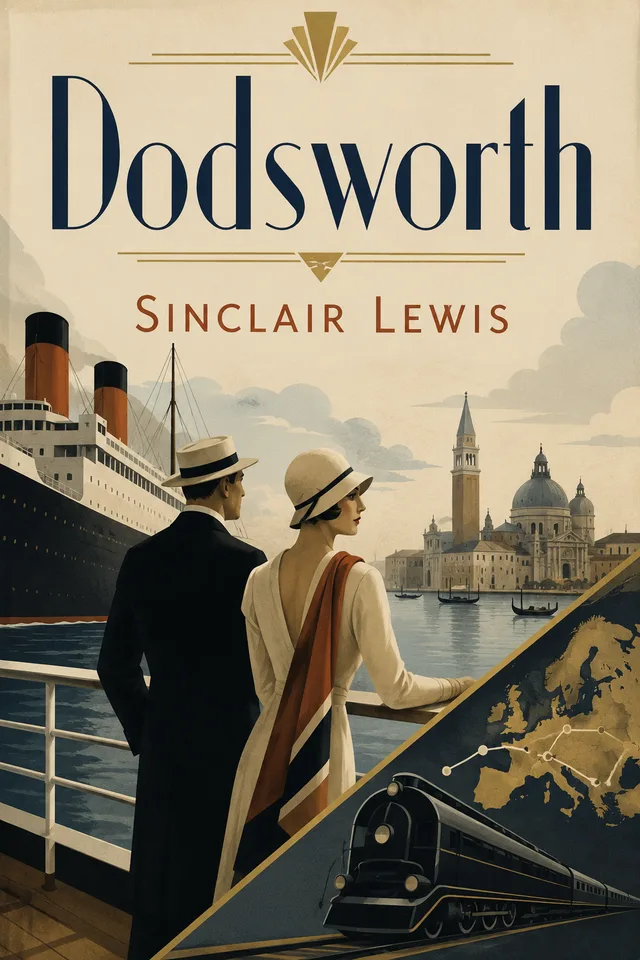
Dodsworth
Edição BooksWhale em inglês por Sinclair Lewis
A transatlantic novel about marriage, wealth, travel, American identity, and emotional reinvention.
- Prévia
- Amostra do texto preparado
- Formatos
- Leitor online, EPUB, PDF
- Acesso
- Claim da Biblioteca
Introdução do livro
Dodsworth
Dodsworth follows a retired automobile manufacturer and his wife through Europe as success, marriage, age, and cultural aspiration come under pressure. Lewis studies American business confidence, social performance, and personal honesty with the sharp observation that made him a Nobel laureate.
Edição BooksWhale
Como esta edição foi preparada
Esta edição se baseia em um texto em domínio público e foi preparada pela BooksWhale para leitura digital.
Base de domínio público
Por que pode ser compartilhada
Dodsworth is a public-domain work: the author died in 1951, and the text was first published in 1929. This edition uses the original English text.
Ler prévia
Amostra do texto preparado
Prévia selecionada do texto preparado.
Capítulo de préviaDodsworthLer prévia
DODSW ORTH
COLLIER
DODSWORTH
SINCLAIR LEWIS
DODSW ORTH
P. F. COLLIER & SON COMPANY
NEW YORK
HARCOURT, BRACE AND COMPANY, INC.
PRINTED IN THE UNITED STATES OF AMERICA
428)
DOROTHY
Capítulo de préviaCHAPTER 1Prévia
Tue aristocracy of Zenith were dancing at the Kennepoose
Canoe Club. They two-stepped on the wide porch, with its
pillars of pine trunks, its bobbing Japanese lanterns; and
never were there dance-frocks with wider sleeves nor hair
more sensuously piled on little smiling heads, never an August
evening more moon-washed and spacious and proper for re-
spectable romance.
Three guests had come in these new-fangled automobiles,
for it was now 1903, the climax of civilization. A fourth auto-
mobile was approaching, driven by Samuel Dodsworth.
The scene was a sentimental chromo—crisping lake, lovers
. in canoes singing “Nelly Was a Lady,” all very lugubrious and
happy; and Sam Dodsworth enjoyed it. He was a large and
formidable young man, with a healthy brown mustache and a
chaos of brown hair on a massive head. He was, at twenty-
eight, assistant superintendent of that most noisy and unsen-
timental institution, the Zenith Locomotive Works, and in
Yale (class of 1896) he had played better than average foot-
ball, but he thought well of the most sentimental sorts of
moonlight.
Tonight he was particularly uplifted because he was driving
his first car. And it was none of your old-fashioned “gasoline
buggies,” with the engine under the seat. The engine bulked
in front, under a proud hood over two feet long, and the steer-
ing column was not straight but rakishly tilted. The car was
sporting and rather dangerous, and the lights were powerful
affairs fed by acetylene gas. Sam sped on, with a feeling of
power, of dominating the universe, at twelve dizzy miles an
hour.
At the Canoe Club he was greeted by Tub Pearson, admi-
rable in white kid gloves. Tub—Thomas J. Pearson—round
and short and jolly, class-jester and class-dandy at Yale, had
been Sam Dodsworth’s roommate and chief admirer through-
out college, but now Tub had begun to take on an irritable
1
ee eS ee
2 DODSWORTH
dignity as teller and future president of his father’s bank in
Zenith.
“Tt runs!” Tub marveled, as Sam stepped in triumph from
the car. “I’ve got a horse all ready to tow you back!”
Tub had to be witty, whatever happened.
“Certainly it runs! I’ll bet I was up to eighteen miles an
hour!”
“Yeh! Dll bet that some day automobiles’ll run forty!”
Tub jeered. “Sure! Why, they'll just about drive the poor old
horse right off the highway!”
“They will! And I’m thinking of tying up with this new
Revelation Company to manufacture ’em.”
“Not seriously, you poor chump?”
“Ves,”
“Oh, my Lord!” Tub wailed affectionately. “Don’t be crazy,
Sambo! My dad says automobiles are nothing but a fad. Cost
too much to run. In five years, he says, they’ll disappear.”
Sam’s answer was not very logical:
“Who’s the young angel on the porch?”
If she was an angel, the girl at whom Sam was pointing, she
was an angel of ice; slim, shining, ash-blonde, her self-pos-
sessed voice very cool as she parried the complimentary teas-
ing of half a dozen admirers; a crystal candle-stick of a girl
among black-and-white lumps of males.
“You remember her—Frances Voelker—Fran Voelker—old
Herman’s kid. She’s been abroad for a year, and she was East,
in finishing-school, before that. Just a brat—isn’t over nine-
teen or twenty, I guess. Golly, they say she speaks German
and French and Italian and Woof-woof and all known lan-
guages.”
Herman Voelker had brewed his way into millions and
respectability. His house was almost the largest in Zenith—
certainly it had the greatest amount of turrets, colored glass
windows, and lace curtains—and he was leader among the
German-Americans who were supplanting the New Englanders
throughout the state as controllers of finance and merchan-
dising. He entertained German professors when they came lec-
turing and looking, and it was asserted that one of the genu-
Capítulo de préviaCHAPTER 2Prévia
SAMUEL DopswortH discovered that there was a snowstorm,
neatly a blizzard, whirling about the house. He closed the
windows with a bang and plumped back into bed till the room
should be warm. He did not move so swiftly as he once had,
and above the frogged silk pajamas which Fran insisted on
buying for him, his hair was gray. He was healthy enough, and
serene, but he was tired, and he seemed far older than his
fifty years.
Fran was asleep in the farther of the twin beds, vast walnut
structures with yellow silk draping. Sam looked about the
bedroom. He had sometimes caught himself wondering if it
wasn’t too elaborate, but usually its floridness pleased him,
not only as a sign of success but because it suited the luxurious
Fran. Now he noted contentedly the chaise longue, with a
green and silver robe across it; the desk, with monogrammed
stationery very severe and near-English and snobbish; Fran’s
bedside table, with jeweled traveling-clock, cigarettes, and the
new novels; the bathroom with its purple tiles.
Fran stirred, sighed and, while he chuckled at her resem-
blance to a child trying to slip back into dreams, she furiously
burrowed her eyes into the little lacy pillow, which was crum-
pled with her determined sleeping.
“No use,” he said. His rather heavy voice caressed her.
“You know you’re awake! Rise and shine! Face the problems
of humanity and the grape fruit!”
She sat up, looking at him with the astonishment she had
never quite lost at being married, breaking a yawn with a
smile, tousling her bobbed hair that was still ash-blond, without
gray. If Sam seemed older than his age, she was far younger.
She was forty-one now, in 1925, but, rosy with sleeping, she
seemed thirty-one.
“T’m going to have breakfast in bed you’re smoking before
breakfast again I haven’t had breakfast in bed since yester-
day,” she yawned amiably, ee he swung his thick legs over
DODSWORTH 9
the edge of his lilac satin comforter and lighted a cigarette.
“Ves. Stay in bed. Like to, myself. Devil of a snowstorm,”
he said, paddling round to stroke her hair, to nuzzle his
ruddy cheek against her soft fairness. “By the way, did I
ever remember to tell you that I adore you?”
“Why—let me see—no, I don’t believe so.’
“Golly, ?m getting absent- minded! Tl have my secretary
remind me to do it tomorrow.” Seriously: “Realize that we
finally wind up the old Revelation Company today? Sort of
sorry.”
“No! I’m not a bit sorry! I’m delighted. You'll be free for
the first time in all these years. Let’s run off some place. Oh,
don’t let yourself get tied up with anything new! So silly. We
have enough money, and you go on stewing—‘must change the
design of the carburetor float—simply must sell more cars in
the territory between Medicine Hat and Woolawoola.’ So
silly! What does it matter! Do ring for the maid, darling.”
“Well, no, maybe it doesn’t matter, but fellow likes to do
his job. Tt’ s kind of a battle; fun to beat the other fellow and
put over a thundering big sale. But I am rather tired. Wouldn’t
mind skipping off to Florida or some place.”
‘“hetsl?”
He had dutifully brought her heavy silver mirror, her brush
and comb, her powder, her too-gorgeous lounging robe of
Chinese brocade. When she had made herself a bit older by
making herself youthful, she sat up in bed to read the Zenith
Advocate-Times. If she looked fluffy and agreeably useless,
there was nothing fluffy in her sharp comments on the news.
She sounded like a woman of many affairs, many committees.
“Humph! That idiot-boy alderman, Klingenger, is going to
oppose our playground bill. Ill wring his neck! ... The
D.A.R. are going to do another pageant. I will mot be Martha
Sumário
Nesta edição
- 01Dodsworth
- 02CHAPTER 1
- 03CHAPTER 2
- 04CHAPTER 3
- 05CHAPTER 4
- 06CHAPTER 5
- 07CHAPTER 6
- 08CHAPTER 7
- 09CHAPTER 8
- 10CHAPTER 9
- 11CHAPTER 10
- 12CHAPTER 11
- 13CHAPTER 12
- 14CHAPTER 13
- 15CHAPTER 14
- 16CHAPTER 15
- 17CHAPTER 16
- 18CHAPTER 17
- 19CHAPTER 18
- 20book-shelves were covered with sheets, and the deep chairs,
- 21CHAPTER 19
- 22CHAPTER 20
- 23CHAPTER 21
- 24CHAPTER 22
- 25CHAPTER 23
- 26CHAPTER 24
- 27CHAPTER 25
- 28CHAPTER 26
- 29CHAPTER 27
- 30CHAPTER 28
- 31CHAPTER 29
- 32CHAPTER 30
- 33CHAPTER 31
- 34CHAPTER 32
- 35CHAPTER 33
- 36CHAPTER 34
- 37CHAPTER 35
- 38scene—me sitting there smoking in Kurt’s flat and trying to
- 39CHAPTER 36
Disponibilidade de idiomas
Outros idiomas
Outras edições de idioma ainda não foram publicadas. Elas aparecerão aqui quando disponíveis.
Solicitar outro idioma