inglês Edição
Literatura
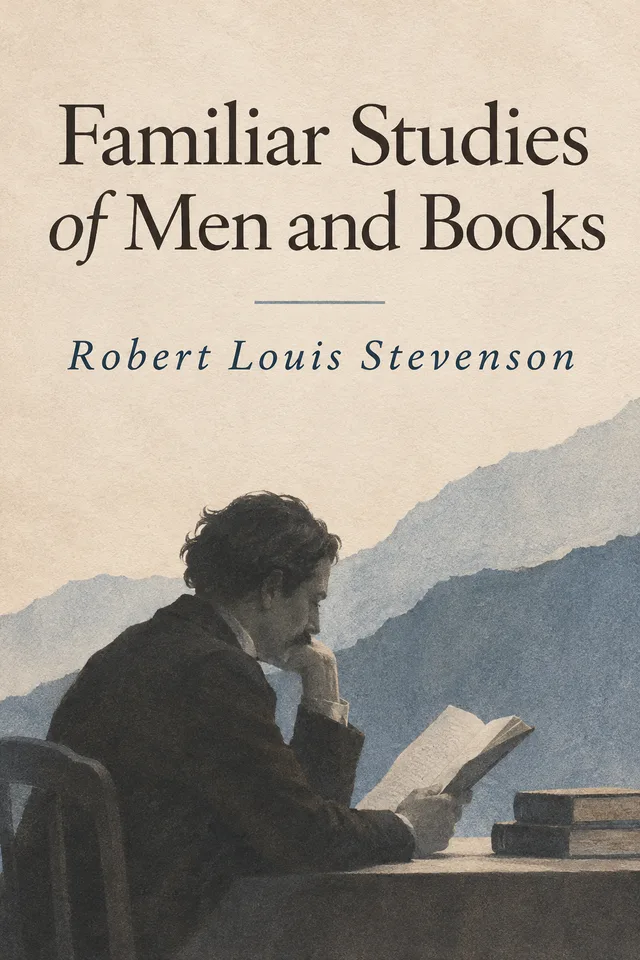
Familiar Studies of Men and Books
Edição BooksWhale em inglês por Robert Louis Stevenson
Stevenson explores the lives, books, ambitions, and contradictions of nine writers and historical figures with wit and sympathy.
- Prévia
- Amostra do texto preparado
- Formatos
- Leitor online, EPUB, PDF
- Acesso
- Claim da Biblioteca
Introdução do livro
Familiar Studies of Men and Books
Robert Louis Stevenson brings biography and literary criticism together in nine studies of figures including Victor Hugo, Robert Burns, Walt Whitman, Henry David Thoreau, and Samuel Pepys. His portraits follow the tensions between public reputation and private character, asking how experience becomes literature. The collection also includes his introductory reflections on the essays.
Edição BooksWhale
Como esta edição foi preparada
Esta edição se baseia em um texto em domínio público e foi preparada pela BooksWhale para leitura digital.
Base de domínio público
Por que pode ser compartilhada
Robert Louis Stevenson died in 1894. This edition uses the original English text supplied by Project Gutenberg, identified there as public domain in the United States, without added illustrations or editorial notes.
Ler prévia
Amostra do texto preparado
Prévia selecionada do texto preparado.
Capítulo de préviaFull textLer prévia
Familiar Studies of Men and Books
Robert Louis Stevenson
Capítulo de préviaPREFACE BY WAY OF CRITICISM.Prévia
These studies are collected from the monthly press. One appeared in the New Quarterly, one in Macmillan’s, and the rest in the Cornhill Magazine. To the Cornhill I owe a double debt of thanks; first, that I was received there in the very best society, and under the eye of the very best of editors; and second, that the proprietors have allowed me to republish so considerable an amount of copy.
These nine worthies have been brought together from many different ages and countries. Not the most erudite of men could be perfectly prepared to deal with so many and such various sides of human life and manners. To pass a true judgment upon Knox and Burns implies a grasp upon the very deepest strain of thought in Scotland,—a country far more essentially different from England than many parts of America; for, in a sense, the first of these men re-created Scotland, and the second is its most essentially national production. To treat fitly of Hugo and Villon would involve yet wider knowledge, not only of a country foreign to the author by race, history, and religion, but of the growth and liberties of art. Of the two Americans, Whitman and Thoreau, each is the type of something not so much realised as widely sought after among the late generations of their countrymen; and to see them clearly in a nice relation to the society that brought them forth, an author would require a large habit of life among modern Americans. As for Yoshida, I have already disclaimed responsibility; it was but my hand that held the pen.
In truth, these are but the readings of a literary vagrant. One book led to another, one study to another. The first was published with trepidation. Since no bones were broken, the second was launched with greater confidence. So, by insensible degrees, a young man of our generation acquires, in his own eyes, a kind of roving judicial commission through the ages; and, having once escaped the perils of the Freemans and the Furnivalls, sets himself up to right the wrongs of universal history and criticism. Now, it is one thing to write with enjoyment on a subject while the story is hot in your mind from recent reading, coloured with recent prejudice; and it is quite another business to put these writings coldly forth again in a bound volume. We are most of us attached to our opinions; that is one of the “natural affections” of which we hear so much in youth; but few of us are altogether free from paralysing doubts and scruples. For my part, I have a small idea of the degree of accuracy possible to man, and I feel sure these studies teem with error. One and all were written with genuine interest in the subject; many, however, have been conceived and finished with imperfect knowledge; and all have lain, from beginning to end, under the disadvantages inherent in this style of writing.
Of these disadvantages a word must here be said. The writer of short studies, having to condense in a few pages the events of a whole lifetime, and the effect on his own mind of many various volumes, is bound, above all things, to make that condensation logical and striking. For the only justification of his writing at all is that he shall present a brief, reasoned, and memorable view. By the necessity of the case, all the more neutral circumstances are omitted from his narrative; and that of itself, by the negative exaggeration of which I have spoken in the text, lends to the matter in hand a certain false and specious glitter. By the necessity of the case, again, he is forced to view his subject throughout in a particular illumination, like a studio artifice. Like Hales with Pepys, he must nearly break his sitter’s neck to get the proper shadows on the portrait. It is from one side only that he has time to represent his subject. The side selected will either be the one most striking to himself, or the one most obscured by controversy; and in both cases that will be the one most liable to strained and sophisticated reading. In a biography, this and that is displayed; the hero is seen at home, playing the flute; the different tendencies of his work come, one after another, into notice; and thus something like a true, general impression of the subject may at last be struck. But in the short study, the writer, having seized his “point of view,” must keep his eye steadily to that. He seeks, perhaps, rather to differentiate than truly to characterise. The proportions of the sitter must be sacrificed to the proportions of the portrait; the lights are heightened, the shadows overcharged; the chosen expression, continually forced, may degenerate at length into a grimace; and we have at best something of a caricature, at worst a calumny. Hence, if they be readable at all, and hang together by their own ends, the peculiar convincing force of these brief representations. They take so little a while to read, and yet in that little while the subject is so repeatedly introduced in the same light and with the same expression, that, by sheer force of repetition, that view is imposed upon the reader. The two English masters of the style, Macaulay and Carlyle, largely exemplify its dangers. Carlyle, indeed, had so much more depth and knowledge of the heart, his portraits of mankind are felt and rendered with so much more poetic comprehension, and he, like his favourite Ram Dass, had a fire in his belly so much more hotly burning than the patent reading lamp by which Macaulay studied, that it seems at first sight hardly fair to bracket them together. But the “point of view” was imposed by Carlyle on the men he judged of in his writings with an austerity not only cruel but almost stupid. They are too often broken outright on the Procrustean bed; they are probably always disfigured. The rhetorical artifice of Macaulay is easily spied; it will take longer to appreciate the moral bias of Carlyle. So with all writers who insist on forcing some significance from all that comes before them; and the writer of short studies is bound, by the necessity of the case, to write entirely in that spirit. What he cannot vivify he should omit.
Capítulo de préviaVICTOR HUGO’S ROMANCES.Prévia
Après le roman pittoresque mais prosaïque de Walter Scott il restera un autre roman à créer, plus beau et plus complet encore selon nous. C’est le roman, à la fois drame et épopée, pittoresque mais poétique, réel mais idéal, vrai mais grand, qui enchâssera Walter Scott dans Homère.—Victor Hugo on Quentin Durward.
Victor Hugo’s romances occupy an important position in the history of literature; many innovations, timidly made elsewhere, have in them been carried boldly out to their last consequences; much that was indefinite in literary tendencies has attained to definite maturity; many things have come to a point and been distinguished one from the other; and it is only in the last romance of all, Quatre Vingt Treize, that this culmination is most perfect. This is in the nature of things. Men who are in any way typical of a stage of progress may be compared more justly to the hand upon the dial of the clock, which continues to advance as it indicates, than to the stationary milestone, which is only the measure of what is past. The movement is not arrested. That significant something by which the work of such a man differs from that of his predecessors, goes on disengaging itself and becoming more and more articulate and cognisable. The same principle of growth that carried his first book beyond the books of previous writers, carries his last book beyond his first. And just as the most imbecile production of any literary age gives us sometimes the very clue to comprehension we have sought long and vainly in contemporary masterpieces, so it may be the very weakest of an author’s books that, coming in the sequel of many others, enables us at last to get hold of what underlies the whole of them—of that spinal marrow of significance that unites the work of his life into something organic and rational. This is what has been done by Quatre Vingt Treize for the earlier romances of Victor Hugo, and, through them, for a whole division of modern literature. We have here the legitimate continuation of a long and living literary tradition; and hence, so far, its explanation. When many lines diverge from each other in direction so slightly as to confuse the eye, we know that we have only to produce them to make the chaos plain: this is continually so in literary history; and we shall best understand the importance of Victor Hugo’s romances if we think of them as some such prolongation of one of the main lines of literary tendency.
When we compare the novels of Walter Scott with those of the man of genius who preceded him, and whom he delighted to honour as a master in the art—I mean Henry Fielding—we shall be somewhat puzzled, at the first moment, to state the difference that there is between these two. Fielding has as much human science; has a far firmer hold upon the tiller of his story; has a keen sense of character, which he draws (and Scott often does so too) in a rather abstract and academical manner; and finally, is quite as humorous and quite as good-humoured as the great Scotchman. With all these points of resemblance between the men, it is astonishing that their work should be so different. The fact is, that the English novel was looking one way and seeking one set of effects in the hands of Fielding; and in the hands of Scott it was looking eagerly in all ways and searching for all the effects that by any possibility it could utilise. The difference between these two men marks a great enfranchisement. With Scott the Romantic movement, the movement of an extended curiosity and an enfranchised imagination, has begun. This is a trite thing to say; but trite things are often very indefinitely comprehended: and this enfranchisement, in as far as it regards the technical change that came over modern prose romance, has never perhaps been explained with any clearness.
Sumário
Nesta edição
- 01Full text
- 02PREFACE BY WAY OF CRITICISM.
- 03VICTOR HUGO’S ROMANCES.
- 04SOME ASPECTS OF ROBERT BURNS
- 05Youth.
- 06The Love Stories.
- 07Downward Course.
- 08Works.
- 09WALT WHITMAN.
- 10I.
- 11II.
- 12III.
- 13IV.
- 14V.
- 15VI.
- 16HENRY DAVID THOREAU: HIS CHARACTER AND OPINIONS.
- 17I.
- 18II.
- 19III.
- 20IV.
- 21V.
- 22YOSHIDA-TORAJIRO
- 23FRANÇOIS VILLON, STUDENT, POET, AND HOUSEBREAKER.
- 24A Wild Youth.
- 25A Gang of Thieves.
- 26Villon and the Gallows.
- 27The Large Testament.
- 28CHARLES OF ORLEANS.
- 29I.
- 30II.
- 31III.
- 32IV.
- 33V.
- 34SAMUEL PEPYS.
- 35The Diary.
- 36A Liberal Genius.
- 37Respectability.
- 38JOHN KNOX AND HIS RELATIONS TO WOMEN.
- 39I.—The Controversy about Female Rule.
- 40II.—Private Life.
Disponibilidade de idiomas
Outros idiomas
Outras edições de idioma ainda não foram publicadas. Elas aparecerão aqui quando disponíveis.
Solicitar outro idioma