inglês Edição
Literatura
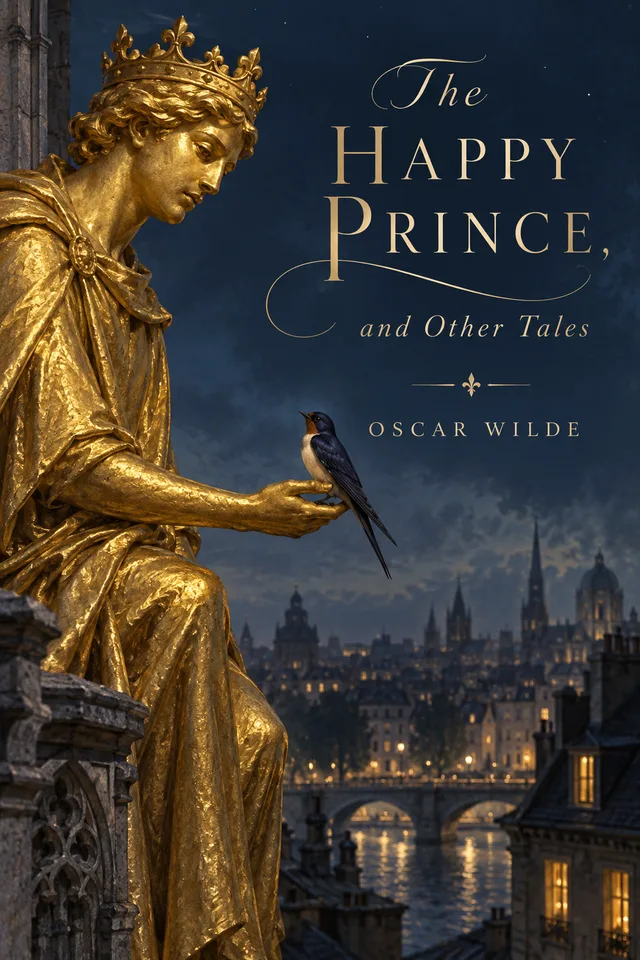
The Happy Prince, and Other Tales
Edição BooksWhale em inglês por Oscar Wilde
Wilde’s fairy tales pair luminous, playful storytelling with sharp questions about poverty, kindness, beauty, and sacrifice.
- Prévia
- Amostra do texto preparado
- Formatos
- Leitor online, EPUB, PDF
- Acesso
- Claim da Biblioteca
Introdução do livro
The Happy Prince, and Other Tales
The title story follows a gilded statue and a migrating swallow whose acts of generosity expose the city’s indifference. Wilde’s collection moves between tenderness, satire, and moral fable, making these stories rewarding for younger readers and adults attentive to their social edge.
Edição BooksWhale
Como esta edição foi preparada
Esta edição se baseia em um texto em domínio público e foi preparada pela BooksWhale para leitura digital.
Base de domínio público
Por que pode ser compartilhada
First published in 1888. Oscar Wilde died in 1900; the original English stories are public domain under the selected-market term screens. Use a historical text and verify any added illustrations independently.
Ler prévia
Amostra do texto preparado
Prévia selecionada do texto preparado.
Capítulo de préviaFull textLer prévia
The Happy Prince, and Other Tales
Capítulo de préviaThe Happy Prince.Prévia
HIGH above the city, on a tall column, stood the statue of the Happy
Prince. He was gilded all over with thin leaves of fine gold, for eyes
he had two bright sapphires, and a large red ruby glowed on his
sword-hilt.
He was very much admired indeed. “He is as beautiful as a weathercock,”
remarked one of the Town Councillors who wished to gain a reputation for
having artistic tastes; “only not quite so useful,” he added, fearing
lest people should think him unpractical, which he really was not.
“Why can’t you be like the Happy Prince?” asked a sensible mother of her
little boy who was crying for the moon. “The Happy Prince never dreams
of crying for anything.”
“I am glad there is some one in the world who is quite happy,” muttered a
disappointed man as he gazed at the wonderful statue.
“He looks just like an angel,” said the Charity Children as they came out
of the cathedral in their bright scarlet cloaks and their clean white
pinafores.
“How do you know?” said the Mathematical Master, “you have never seen
one.”
“Ah! but we have, in our dreams,” answered the children; and the
Mathematical Master frowned and looked very severe, for he did not
approve of children dreaming.
One night there flew over the city a little Swallow. His friends had
gone away to Egypt six weeks before, but he had stayed behind, for he was
in love with the most beautiful Reed. He had met her early in the spring
as he was flying down the river after a big yellow moth, and had been so
attracted by her slender waist that he had stopped to talk to her.
“Shall I love you?” said the Swallow, who liked to come to the point at
once, and the Reed made him a low bow. So he flew round and round her,
touching the water with his wings, and making silver ripples. This was
his courtship, and it lasted all through the summer.
“It is a ridiculous attachment,” twittered the other Swallows; “she has
no money, and far too many relations”; and indeed the river was quite
full of Reeds. Then, when the autumn came they all flew away.
After they had gone he felt lonely, and began to tire of his lady-love.
“She has no conversation,” he said, “and I am afraid that she is a
coquette, for she is always flirting with the wind.” And certainly,
whenever the wind blew, the Reed made the most graceful curtseys. “I
admit that she is domestic,” he continued, “but I love travelling, and my
wife, consequently, should love travelling also.”
“Will you come away with me?” he said finally to her; but the Reed shook
her head, she was so attached to her home.
“You have been trifling with me,” he cried. “I am off to the Pyramids.
Good-bye!” and he flew away.
All day long he flew, and at night-time he arrived at the city. “Where
shall I put up?” he said; “I hope the town has made preparations.”
Then he saw the statue on the tall column.
“I will put up there,” he cried; “it is a fine position, with plenty of
fresh air.” So he alighted just between the feet of the Happy Prince.
“I have a golden bedroom,” he said softly to himself as he looked round,
and he prepared to go to sleep; but just as he was putting his head under
his wing a large drop of water fell on him. “What a curious thing!” he
cried; “there is not a single cloud in the sky, the stars are quite clear
and bright, and yet it is raining. The climate in the north of Europe is
really dreadful. The Reed used to like the rain, but that was merely her
selfishness.”
Then another drop fell.
“What is the use of a statue if it cannot keep the rain off?” he said; “I
Capítulo de préviaThe Nightingale and the Rose.Prévia
“SHE said that she would dance with me if I brought her red roses,” cried
the young Student; “but in all my garden there is no red rose.”
From her nest in the holm-oak tree the Nightingale heard him, and she
looked out through the leaves, and wondered.
“No red rose in all my garden!” he cried, and his beautiful eyes filled
with tears. “Ah, on what little things does happiness depend! I have
read all that the wise men have written, and all the secrets of
philosophy are mine, yet for want of a red rose is my life made
wretched.”
“Here at last is a true lover,” said the Nightingale. “Night after night
have I sung of him, though I knew him not: night after night have I told
his story to the stars, and now I see him. His hair is dark as the
hyacinth-blossom, and his lips are red as the rose of his desire; but
passion has made his face like pale ivory, and sorrow has set her seal
upon his brow.”
“The Prince gives a ball to-morrow night,” murmured the young Student,
“and my love will be of the company. If I bring her a red rose she will
dance with me till dawn. If I bring her a red rose, I shall hold her in
my arms, and she will lean her head upon my shoulder, and her hand will
be clasped in mine. But there is no red rose in my garden, so I shall
sit lonely, and she will pass me by. She will have no heed of me, and my
heart will break.”
“Here indeed is the true lover,” said the Nightingale. “What I sing of,
he suffers—what is joy to me, to him is pain. Surely Love is a wonderful
thing. It is more precious than emeralds, and dearer than fine opals.
Pearls and pomegranates cannot buy it, nor is it set forth in the
marketplace. It may not be purchased of the merchants, nor can it be
weighed out in the balance for gold.”
“The musicians will sit in their gallery,” said the young Student, “and
play upon their stringed instruments, and my love will dance to the sound
of the harp and the violin. She will dance so lightly that her feet will
not touch the floor, and the courtiers in their gay dresses will throng
round her. But with me she will not dance, for I have no red rose to
give her”; and he flung himself down on the grass, and buried his face in
his hands, and wept.
“Why is he weeping?” asked a little Green Lizard, as he ran past him with
his tail in the air.
“Why, indeed?” said a Butterfly, who was fluttering about after a
sunbeam.
“Why, indeed?” whispered a Daisy to his neighbour, in a soft, low voice.
“He is weeping for a red rose,” said the Nightingale.
“For a red rose?” they cried; “how very ridiculous!” and the little
Lizard, who was something of a cynic, laughed outright.
But the Nightingale understood the secret of the Student’s sorrow, and
she sat silent in the oak-tree, and thought about the mystery of Love.
Suddenly she spread her brown wings for flight, and soared into the air.
She passed through the grove like a shadow, and like a shadow she sailed
across the garden.
In the centre of the grass-plot was standing a beautiful Rose-tree, and
when she saw it she flew over to it, and lit upon a spray.
“Give me a red rose,” she cried, “and I will sing you my sweetest song.”
But the Tree shook its head.
“My roses are white,” it answered; “as white as the foam of the sea, and
whiter than the snow upon the mountain. But go to my brother who grows
round the old sun-dial, and perhaps he will give you what you want.”
Sumário
Nesta edição
- 01Full text
- 02The Happy Prince.
- 03The Nightingale and the Rose.
- 04The Selfish Giant.
- 05The Devoted Friend.
- 06The Remarkable Rocket.
Disponibilidade de idiomas
Outros idiomas
Outras edições de idioma ainda não foram publicadas. Elas aparecerão aqui quando disponíveis.
Solicitar outro idioma