inglês Edição
História
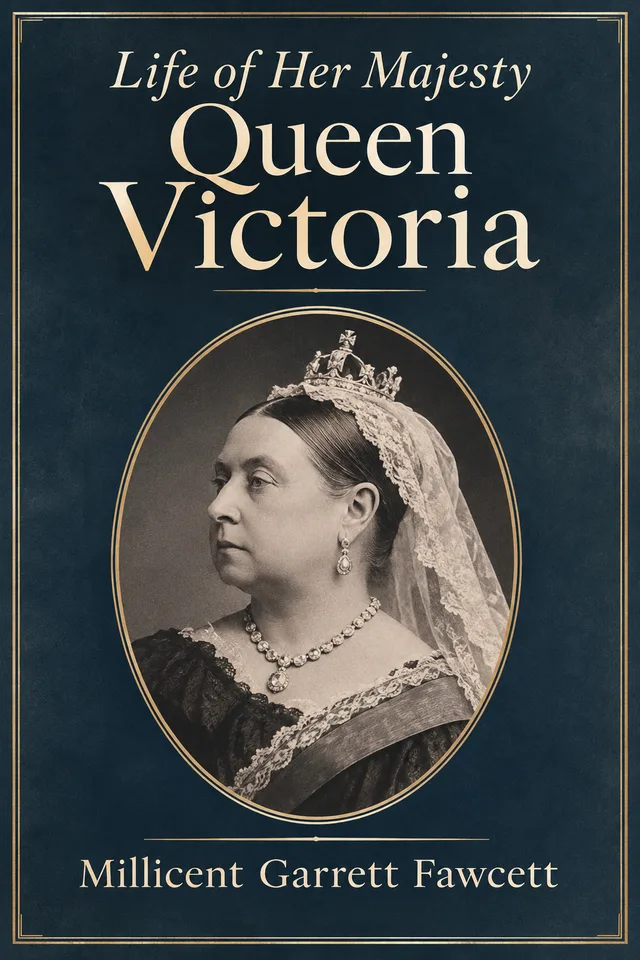
Life of Her Majesty Queen Victoria
Edição BooksWhale em inglês por Millicent Garrett Fawcett
Millicent Garrett Fawcett examines Queen Victoria’s upbringing, family life, political relationships, and influence on the British monarchy.
- Prévia
- Amostra do texto preparado
- Formatos
- Leitor online, EPUB, PDF
- Acesso
- Claim da Biblioteca
Introdução do livro
Life of Her Majesty Queen Victoria
This biography follows Victoria from her education and accession to her marriage with Prince Albert, her dealings with ministers, and her public life after Albert’s death. Its eighteen chapters connect the habits of the royal household with the political events and responsibilities that shaped her reign through 1895.
Edição BooksWhale
Como esta edição foi preparada
Esta edição se baseia em um texto em domínio público e foi preparada pela BooksWhale para leitura digital.
Base de domínio público
Por que pode ser compartilhada
Millicent Garrett Fawcett died in 1929. This is the English text of the 1895 biography.
Ler prévia
Amostra do texto preparado
Prévia selecionada do texto preparado.
Capítulo de préviaPREFACE.Ler prévia
It would have been impossible, within the limits of this little book, to narrate, even in barest outline, all the events of the Queen’s long life and reign. In attempting to deal with so large a subject in so short a space, I have therefore thought it best to dwell on what may be considered the formative influences on the Queen’s character in her early life, and in later years to refer only to political and personal events, in so far as they illustrate her character and her conception of her political functions. Even with this limitation, I am fully aware how far short I have come of being able to produce a worthy record of a noble life. I will only add that I begun this little book with a feeling towards Her Majesty of sincere veneration and gratitude, and that this feeling has been deepened by studying more closely than I had done before the ideal place of the Crown in the English Constitution, as a power above party, and the important part the Queen has taken now for nearly sixty years in making this ideal a reality. It is not too much to say that, by her sagacity and persistent devotion to duty, she has created modern constitutionalism, and more than any other single person has made England and the English monarchy what they now are.
A list of the books referred to will be found after the chronological table. Among them it is almost unnecessary to say that I am especially indebted to “The Early Years of the Prince Consort,” by General Grey, and to “The Life of the Prince Consort,” by Sir Theodore Martin. I also desire to express my respectful thanks to H. R. H. Princess Christian, for help very graciously and kindly given in the selection of a portrait for this little volume.
MILLICENT GARRETT FAWCETT.
April, 1895.
Capítulo de préviaCHAPTER I. THE QUEEN’S IMMEDIATE PREDECESSORS.Prévia
Every now and then, on the birth of a male heir to any of the great historic kingdoms of Europe, the newspapers and the makers of public speeches break forth into rejoicing and thanksgiving that the country in question is secured from all the perils and evils supposed to be associated with the reign of a female Sovereign. It is of little importance, perhaps, that this attitude of mind conveys but a poor compliment to our Queen and other living Queens and Queen Regents; but it is not a little curious that the popular opinion to which these articles and speeches give expression, namely, that the chances are that any man will make a better Sovereign than any woman, is wholly contrary to experience; it is hardly going too far to say that in every country in which the succession to the Crown has been open to women, some of the greatest, most capable, and most patriotic Sovereigns have been queens. The names of Isabella of Spain, of Maria Theresa of Austria, will rise in this connection to every mind; and, little as she is to be admired as a woman, Catherine II. of Russia showed that she thoroughly understood the art of reigning. Her vices would have excited little remark had she been a king instead of a queen. It is an unconscious tribute to the higher standard of conduct queens have taught the world to expect from them, that while the historic muse stands aghast at the private life of the Russian Empress, she is only very mildly scandalized by a Charles V. or a Henry IV., thinking, with much justice, that their great qualities as rulers serve to cover their multitude of sins as private individuals. The brief which history could produce on behalf of Queens, as successful rulers, can be argued also from the negative side. The Salic law did not, to say the least, save the French monarchy from ruin. How far the overthrow of that monarchy was due to a combination of incompetence and depravity in various proportions in the descendants of the Capets from the Regent Orleans onwards towards the Revolution, is a question which must be decided by others. Carlyle’s view of the cause of the Revolution was that it was due to “every scoundrel that had lived, and, quack-like, pretended to be doing, and had only been eating and misdoing, in all provinces of life, as shoeblack or as sovereign lord, each in his degree, from the time of Charlemagne and earlier.” Women no doubt produced their share of quacks and charlatans in the humble ranks of this long procession of misdoers, but not as sovereigns, because, with the superior logic of the Gallic mind, the French people not only believed the accession of a woman to the throne to be a misfortune, but guarded themselves against the calamity by the Salic law. The fact affords a fresh proof that logic is a poor thing to be ruled by, because of the liability, which cannot be eliminated from human affairs, of making a mistake in the premises. The English plan, though less logical, is more practically successful. We speak and write as if a nation could not suffer a greater misfortune than to have a woman at the head of the State; but we do nothing to bar the female succession, with the result that out of our five Queens Regnant we have had three of eminent distinction as compared with any other Sovereign; and of these three, one ranks with the very greatest of the statesmen who deserve to be remembered as the Makers of England.
Something more can be claimed than that the Salic law did not prevent the overthrow of the French monarchy. It is probable that the female succession to the throne did save the English monarchy in 1837. Failing the Queen, the next heir would have been the Duke of Cumberland, and from all the records of the time, it does not suffice to say that he was unpopular, he was simply hated,—and with justice. He appears to have conceived it to be his function in Hanover “to cut the wings of the democracy;” if he had succeeded to the English throne and adopted the same policy here, he would have brought the whole fabric of the monarchy about his ears. He was equally without private and public virtues. The Duke of Wellington once asked George IV. why the Duke of Cumberland was so unpopular. The King replied, “Because there never was a father well with his son, or husband with his wife, or lover with his mistress, or friend with his friend, that he did not try to make mischief between them.”
Capítulo de préviaCHAPTER II. CHILDHOOD AND EDUCATION.Prévia
The previous chapter dwelt upon some serious drawbacks to the Queen’s happiness as a child. But if she was unfortunate in living in an atmosphere too highly charged with contention, her childhood was in another respect remarkably fortunate. Very few heirs to the throne have been brought up from infancy with an education carefully designed as a preparation for their future exalted station, combined with almost all the simplicity and domesticity of private life. But this unusual combination was secured for the Queen by the circumstances of her childhood. At the time of her birth the chances were decidedly against her succession. Even down to the last few months of his life, William IV. continued to speak of her as “Heiress Presumptive,” not as “Heiress Apparent” to the throne. He never probably completely relinquished the hope of having a child of his own to succeed him. In 1835 there had been rumors, which seemed well authenticated, that Queen Adelaide was about to give birth to a child. The absence of absolute certainty in the Princess Victoria’s prospects of the succession, the reluctance of her uncles and of Parliament to establish her and her mother with an income suitable to their rank and her future position, all worked together, in combination with the good sense of her mother, to secure for the little Princess a childhood free from much of the pomp, formality, and flattery from which an heir to the throne seldom even partially escapes.
While she was thus protected from many of the disadvantages associated with her rank, its advantages were not neglected. The Duchess of Kent gathered about her at Kensington Palace a great many of the representatives of the foremost minds of the day in literature, science, and in social reform. Nearly all the memoirs of distinguished men and women of that period contain some mention of their gracious reception at Kensington Palace by the Duchess, and the interest they had felt in seeing the little Princess. Among those who were received in this way may be mentioned Sir Walter Scott, Wilberforce, and Mrs. Somerville.
The Duchess of Kent made the suitable education of her child the one absorbing object of her life; and she seems to have realized that education does not consist in merely learning facts or acquiring accomplishments, but should also aim at forming the character and disciplining the whole nature, so that it may acquire conscientiousness and the strength which comes from self-government. Keeping this end ever in view, and aided, no doubt, by a responsiveness in the child’s own nature, the little Princess was trained in those habits of strict personal integrity which are the only unfailing safeguard for truthfulness and fundamental honesty in regard to money and other possessions. All observers who have been brought into personal relationship with the Queen speak of her as possessing one of the most transparently truthful natures they have ever known. The Right Hon. John Bright, with his Quaker-bred traditions as to literal exactitude in word and deed, said that this was the trait in her character of which he carried away the most vivid impression. An anecdote is given in “The Life of Bishop Wilberforce,” illustrative of the Queen’s truthfulness as a child. Dr. Davys, Bishop of Peterborough, formerly preceptor to Princess Victoria, told Dr. Wilberforce that when he was teaching her, one day the little Princess was very anxious that the lesson should be over, and was rather troublesome. The Duchess of Kent came in and asked how she had behaved. Baroness Lehzen, the governess, replied that once she had been rather naughty. The Princess touched her and said, “No, Lehzen, twice; don’t you remember?”
The financial side of truthfulness is honesty; and here again the Queen has instituted a new order of things in English royalty. We are so accustomed to the sway of a Sovereign who regards it as dishonest to owe more than she is ready and willing to pay, that we have almost forgotten that this was very far from being the case with her predecessors. Even the highly respectable Prince Leopold could not live within his income of £50,000 a year, and was £83,000 in debt when he became King of the Belgians in 1831.
Sumário
Nesta edição
- 01PREFACE.
- 02CHAPTER I. THE QUEEN’S IMMEDIATE PREDECESSORS.
- 03CHAPTER II. CHILDHOOD AND EDUCATION.
- 04CHAPTER III. ACCESSION TO THE THRONE.
- 05CHAPTER IV. LOVE AND POLITICS.
- 06CHAPTER V. ROCKS AHEAD.
- 07CHAPTER VI. THE PRINCE.
- 08CHAPTER VII. THE QUEEN AND PEEL.
- 09CHAPTER VIII. STOCKMAR.
- 10CHAPTER IX. THE NURSERY.
- 11CHAPTER X. HOME LIFE.—OSBORNE AND BALMORAL.
- 12CHAPTER XI. FORTY-THREE TO FORTY-EIGHT.
- 13CHAPTER XII. PALMERSTON.
- 14CHAPTER XIII. PEACE AND WAR.
- 15CHAPTER XIV. A NATION OF SHOPKEEPERS.
- 16CHAPTER XV. THE VALLEY OF THE SHADOW OF DEATH.
- 17CHAPTER XVI. DOMESTIC LIFE AFTER 1861.
- 18CHAPTER XVII. THE WARP AND WOOF OF HOME AND POLITICS.
- 19CHAPTER XVIII. THE QUEEN AND THE EMPIRE.
Disponibilidade de idiomas
Outros idiomas
Outras edições de idioma ainda não foram publicadas. Elas aparecerão aqui quando disponíveis.
Solicitar outro idioma