inglês Edição
Economia
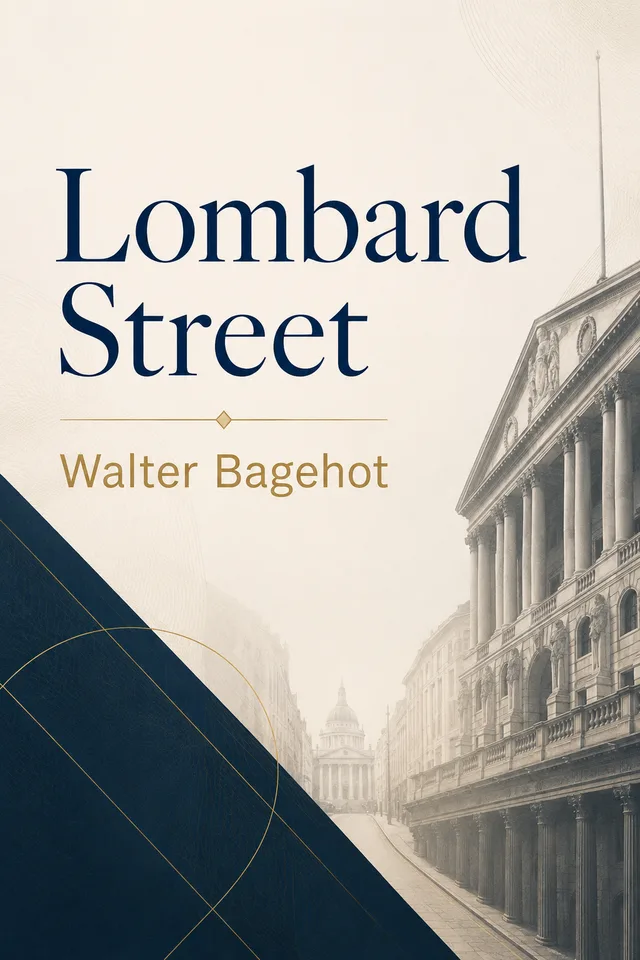
Lombard Street
Edição BooksWhale em inglês por Walter Bagehot
A classic explanation of banking, credit, central banks, money markets, and financial confidence.
- Prévia
- Amostra do texto preparado
- Formatos
- Leitor online, EPUB, PDF
- Acesso
- Claim da Biblioteca
Introdução do livro
Lombard Street
Lombard Street analyzes the City of London, the Bank of England, credit discipline, reserves, panic, and the practical mechanics of modern finance. This English original edition remains essential for readers of economics and banking history.
Edição BooksWhale
Como esta edição foi preparada
Esta edição se baseia em um texto em domínio público e foi preparada pela BooksWhale para leitura digital.
Base de domínio público
Por que pode ser compartilhada
Walter Bagehot died in 1877, and Lombard Street was first published in 1873, supporting the public-domain basis for this English original edition.
Ler prévia
Amostra do texto preparado
Prévia selecionada do texto preparado.
Capítulo de préviaFull textLer prévia
Lombard Street
Walter Bagehot
A Description of the Money Market.
By WALTER BAGEHOT
Capítulo de préviaCHAPTER I.Prévia
Introductory.
I venture to call this Essay 'Lombard Street,' and not the 'Money Market,' or any such phrase, because I wish to deal, and to show that I mean to deal, with concrete realities. A notion prevails that the Money Market is something so impalpable that it can only be spoken of in very abstract words, and that therefore books on it must always be exceedingly difficult. But I maintain that the Money Market is as concrete and real as anything else; that it can be described in as plain words; that it is the writer's fault if what he says is not clear. In one respect, however, I admit that I am about to take perhaps an unfair advantage. Half, and more than half, of the supposed 'difficulty' of the Money Market has arisen out of the controversies as to 'Peel's Act,' and the abstract discussions on the theory on which that act is based, or supposed to be based.
But in the ensuing pages I mean to speak as little as I can of the Act of 1844; and when I do speak of it, I shall deal nearly exclusively with its experienced effects, and scarcely at all, if at all, with its refined basis.
For this I have several reasons,--one, that if you say anything about the Act of 1844, it is little matter what else you say, for few will attend to it. Most critics will seize on the passage as to the Act, either to attack it or defend it, as if it were the main point.
There has been so much fierce controversy as to this Act of Parliament--and there is still so much animosity--that a single sentence respecting it is far more interesting to very many than a whole book on any other part of the subject. Two hosts of eager disputants on this subject ask of every new writer the one question--Are you with us or against us? and they care for little else. Of course if the Act of 1844 really were, as is commonly thought, the _primum mobile_ of the English Money Market, the source of all good according to some, and the source of all harm according to others, the extreme irritation excited by an opinion on it would be no reason for not giving a free opinion. A writer on any subject must not neglect its cardinal fact, for fear that others may abuse him. But, in my judgment, the Act of 1844 is only a subordinate matter in the Money Market; what has to be said on it has been said at disproportionate length; the phenomena connected with it have been magnified into greater relative importance than they at all deserve. We must never forget that a quarter of a century has passed since 1844, a period singularly remarkable for its material progress, and almost marvellous in its banking development. Even, therefore, if the facts so much referred to in 1844 had the importance then ascribed to them, and I believe that in some respects they were even then overstated, there would be nothing surprising in finding that in a new world new phenomena had arisen which now are larger and stronger. In my opinion this is the truth: since 1844, Lombard Street is so changed that we cannot judge of it without describing and discussing a most vigorous adult world which then was small and weak. On this account I wish to say as little as is fairly possible of the Act of 1844, and, as far as I can, to isolate and dwell exclusively on the 'Post-Peel' agencies, so that those who have had enough of that well-worn theme (and they are very many) may not be wearied, and that the new and neglected parts of the subject may be seen as they really are.
The briefest and truest way of describing Lombard Street is to say that it is by far the greatest combination of economical power and economical delicacy that the world has even seen. Of the greatness of the power there will be no doubt. Money is economical power.
Capítulo de préviaCHAPTER II.Prévia
A General View of Lombard Street.
Sumário
Nesta edição
- 01Full text
- 02CHAPTER I.
- 03CHAPTER II.
- 04I.
- 05ISSUE DEPARTMENT.
- 0633,288,640| 33,288,640 L
- 07BANKING DEPARTMENT.
- 0844,891,613 L| 44,891,613 L
- 091857 " " L 1,462,000
- 101866 " " L 3,000,000
- 11II.
- 12CHAPTER III.
- 13II.
- 14CHAPTER IV.
- 15CHAPTER V.
- 16CHAPTER VI.
- 17'THE GREAT RISE IN THE PRICE OF COMMODITIES.
- 18GAZETTE AVERAGE PRICE OF WHEAT.
- 19CHAPTER VII.
- 20'THE GREAT IMPORTANCE OF THE LATE MEETING
- 21OF THE PROPRIETORS OF THE BANK OF ENGLAND.
- 22" 17 3,217,000 L
- 23" 24 3,485,000 L
- 24" 31 2,258,000 L
- 25" 13 957,000 L
- 26II.
- 27CHAPTER VIII.
- 28CHAPTER IX.
- 29CHAPTER X.
- 30CHAPTER XI.
- 31CHAPTER XII.
- 32CHAPTER XIII.
- 33APPENDIX.
- 34(1) ENGLISH BANKING.
- 35(3) BANKS OF GERMANY (JANUARY, 1873).
- 36(4) NATIONAL BANKS OF UNITED STATES (OCTOBER 3, 1872).
- 37SUMMARY
- 38L L L L L
- 39L L
Disponibilidade de idiomas
Outros idiomas
Outras edições de idioma ainda não foram publicadas. Elas aparecerão aqui quando disponíveis.
Solicitar outro idioma