inglês Edição
Ciência
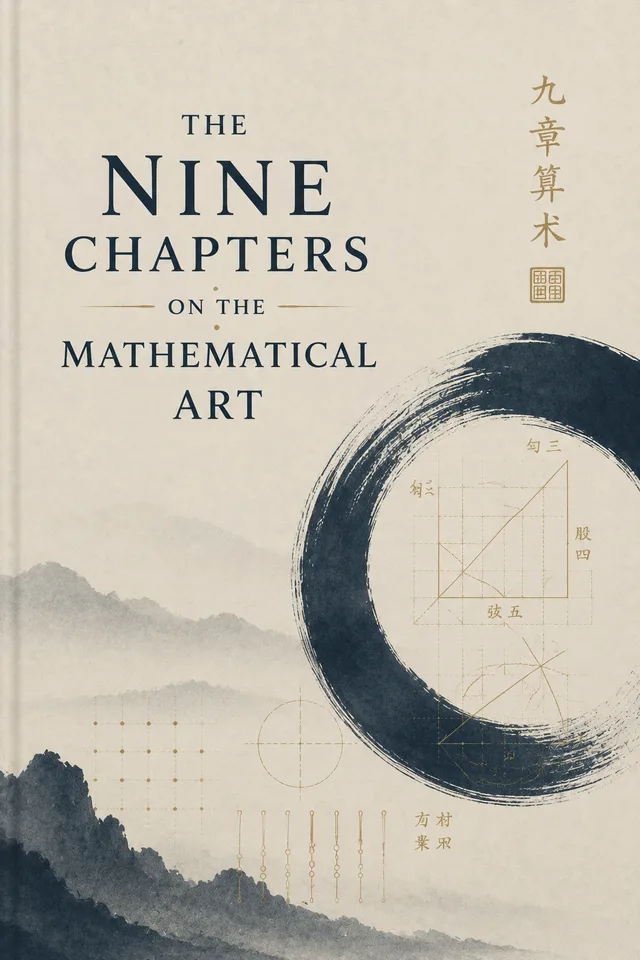
The Nine Chapters on the Mathematical Art
Edição BooksWhale em inglês por Texto tradicional
Título original: 九章算术
An ancient Chinese mathematics classic of algorithms, measurement, equations, proportions, and practical problems.
- Prévia
- Amostra do texto preparado
- Formatos
- Leitor online, EPUB, PDF
- Acesso
- Claim da Biblioteca
Introdução do livro
The Nine Chapters on the Mathematical Art
The Nine Chapters on the Mathematical Art presents mathematics through worked problems involving fields, grain, engineering, proportional exchange, excess and deficiency, equations, and right triangles. It reveals a practical algorithmic tradition central to Chinese mathematical history.
Edição BooksWhale
Como esta edição foi preparada
Esta edição é uma tradução assistida por IA e revisada por pessoas, preparada pela BooksWhale para legibilidade, formatação e consistência.
Base de domínio público
Por que pode ser compartilhada
The public-domain original text serves as the base. This BooksWhale English edition is an AI-assisted, human-reviewed translation prepared from the public-domain source text.
Ler prévia
Amostra do texto preparado
Prévia selecionada do texto preparado.
Capítulo de préviaFull textLer prévia
The Nine Chapters on the Mathematical Art
Jiu Zhang Suan Shu
Zhang Cang
Geng Shouchang
Capítulo de préviaPreface to the Annotations on the Nine Chapters on the Mathematical ArtPrévia
Liu Hui
In ancient times, Paoxi first drew the Eight Trigrams to penetrate and obtain the excellent qualities of heaven, earth, and the spirits, and to imitate the forms of all things in the world. Later he also devised the technique of nines and nines to complement the changes of the six lines. The Yellow Emperor then wondrously extended these transformations, establishing the framework of the calendar and correcting the pitch-pipes, in order to investigate the origins of the Way — and so the essence of the Two Modes and Four Images could be grasped and followed. It has been recorded that "Lishou established arithmetic," but I have not heard the details of this account. Note: the Duke of Zhou established the rites and music, which included the Nine Numbers; the Nine Numbers later developed into the Nine Chapters on the Mathematical Art. In the past, the tyrannical Qin Shi Huang burned books, causing the classical arts to be scattered and lost. Later, Zhang Cang, Marquis of Beiping of the Han dynasty, and Geng Shouchang, Deputy Director of Agriculture, were both renowned for their mastery of mathematics. Zhang Cang and others gathered the surviving remnants of ancient texts and made deletions and additions. Thus the table of contents differs somewhat from the ancient version, and the exposition largely employs the language of more recent times.
I studied the Nine Chapters in my youth, and examined it in greater depth as I grew older. Observing the distinctions between the obverse and reverse of things, I traced the roots of arithmetic, and while exploring these profound and subtle principles, gradually came to comprehend the ideas within. So I have ventured to exhaust my humble capacities, gathering what materials I have encountered, to compose annotations for it. Things can be inferred from one another by analogy, each belonging to its proper category. Thus the branches, though separate, share a single trunk, because they spring from the same origin. Furthermore, by analyzing numerical principles through written argument and explaining solid figures through diagrams, the work is made concise and thorough, clear and unencumbered, so that readers may understand more than half of the content. Mathematics is one of the Six Arts; in antiquity it was used to promote worthy men and to educate the sons of the nobility. Though it is called the Nine Numbers, it can reach to the extremely small and infinitesimal, and probe the inexhaustible. As for the methods handed down — they exist like compass, set-square, and measures, with universal applicability, and so learning them is not a particularly difficult matter. Those who love mathematics are few today, and thus although there are many learned people in the world, they are not necessarily well-versed in it.
The Rites of Zhou stipulates that one of the duties of the Director of Instruction is to erect a gnomon eight chi tall at noon on the summer solstice, and to designate the place where the shadow measures one chi five cun as the center of the earth. The commentary on the Rites of Zhou states that at that moment the sun is 15,000 li to the south. This result can be derived by calculation. Note: the Nine Chapters contains methods for using four gnomons to find distances, and for using trees to find the height of a mountain — in both cases a nearby reference object is used as a correspondent, and distances as great as this are not involved. It appears, then, that the methods of Zhang Cang and others are insufficient to encompass all mathematical methods. I find that among the Nine Numbers there is a category called "double differences," whose original purpose was to answer precisely these kinds of questions. Whenever one measures extreme heights or depths and also seeks the distances to them, it is necessary to use double differences and right triangles. Because one takes the difference between two corresponding legs as the ratio, it is called "double difference."
Capítulo de préviaChapter One: Rectangular FieldsPrévia
Chapter One: Rectangular Fields
Sumário
Nesta edição
- 01Full text
- 02Preface to the Annotations on the Nine Chapters on the Mathematical Art
- 03Chapter One: Rectangular Fields
- 04Annotated by Liu Hui of Wei Further annotated by imperial decree by Li Chunfeng and colleagues, Court Deliberation Grandee, Director of the Imperial Astronomical Bureau, and Knight of the Light Chariot, of the Tang dynasty
- 05Rule for the area of a rectangular field: Multiply the number of bu in the width by the number of bu in the length to obtain the product in bu. (Liu Hui's note: This product is called the "power" of the field. Whenever length and width are multiplied together, the result is called the "power." Li Chunfeng's note: The Nine Chapters says "multiply width by length to get the product in bu," and Liu Hui's note says "multiplying length and width together is called the power." Examining the sense of the annotation, it seems that "product" and "power" are treated as having the same meaning. But reasoning carefully, this should not be so. Why? "Power" is the figure obtained by extending a rectangle in a single direction; "product" is the result of accumulating numbers. Considered by name, the two are entirely different. To take them as the same, I believe, is inadmissible. When we speak of "power," we mean a rectangle with a width and a length; when we speak of "product," we mean the total count of bu. The Nine Chapters says "multiply to obtain the product in bu," clearly indicating the accumulation of a number. Liu Hui's note says "multiplying is called the power," which contradicts the original meaning of a product of bu-counts. The first half of the note — "this product is called the power of the field" — is broadly acceptable; the second half — "whenever length and width are multiplied it is called the power" — is both redundant and improper. In composing these annotations, one should retain what is correct and discard what is wrong, making a careful selection for the reference of later students.) Divide the product in bu by the conversion factor of 240 square bu per mu to obtain the number of mu. 100 mu makes one qing. (Li Chunfeng's note: This is the opening of the book, so the conversion rules for mu and qing are stated explicitly here. They will not be repeated in what follows. For one mu of field, 15 bu wide: divide it lengthwise into 15 strips each 1 bu wide and 16 bu long. Then cut it crosswise into 16 strips each 1 bu wide and 15 bu long. After these lengthwise and crosswise divisions, each section forms a square, giving 240 square bu in total. For one mu of land, the number of square bu equals the number of unit squares. Thus multiplying the width-bu by the length-bu to obtain the product in bu is verified. 240 square bu is the conversion unit for mu; 100 mu is the conversion unit for qing. Dividing the product by these gives the result.)
- 06Rule for rectangular fields (with li as unit of area): Multiply the number of li in the width by the number of li in the length to obtain the product in square li. Multiply this by 375 to obtain the number of mu. (Liu Hui's note: Multiplying width-li by length-li gives the area in square li. One square li contains 3 qing 75 mu; multiply this by the area in square li to obtain the number of mu.)
- 07Rule for triangular fields: Take half the base and multiply by the height. (Liu Hui's note: Taking half the base is done to use the surplus to fill the deficit, converting the triangular field into a rectangular one. One may also use half the height multiplied by the base. According to "half the base multiplied by the height," one is taking the average of the base. So the base and height multiplied give the product in bu; dividing by the mu conversion factor gives the number of mu.)
- 08Rule for right-trapezoid fields: Add the upper and lower bases, halve the sum, and multiply by the height. Alternatively, use half the height multiplied by the sum of the upper and lower bases. Convert using the mu method. (Liu Hui's note: Taking half the sum of the upper and lower bases is done to use the surplus to fill the deficit.)
- 09Rule for trapezoidal fields: Add upper and lower bases, halve the sum, multiply by the height; convert using the mu method. (Liu Hui's note: Dividing the trapezoid in the middle into two right-trapezoid fields, so the rule is similar to the above. One may also use the sum of upper and lower bases multiplied by half the height.)
- 10Rule for circular fields: Multiply half the circumference by the radius to obtain the area in square bu. (Liu Hui's note: Half the circumference serves as length, the radius as width; therefore width multiplied by length gives the area in bu. Suppose the diameter of a circle is 2 chi; inscribe a regular hexagon, whose six sides are each equal to the radius, in accordance with the ratio of circumference 3 to diameter 1.)
- 11Rule for domed fields: Multiply the lower circumference by the dome-diameter; divide by 4. (Liu Hui's note: This rule is not correct. I will now derive the surface area of a square pyramid to demonstrate. Suppose a square pyramid has a base side of 6 chi and a height of 4 chi. Taking 4 chi as the base of the right triangle and half the base side (3 chi) as the other leg, the slant height is the hypotenuse, giving 5 chi. Multiply leg by hypotenuse, then multiply by 4, giving 60 square chi — the total lateral surface area of the four faces of the square pyramid. If there is an inscribed cone inside, the ratio of the cone's lateral area to the pyramid's lateral area is the same as the ratio of the inscribed circle's area to the square's area. Note: the base perimeter of the square pyramid is 24 chi; multiplying by the slant height of 5 chi and halving gives the lateral area of the pyramid. Therefore, to find the lateral area of the cone, take half the dome-diameter multiplied by half the lower circumference — that is the area of the cone. But in the present "domed field," the diameter is an arc on the surface of a spherical cap, yet the same rule is used as for the cone, giving a value that will be too small. However, this method is simpler to apply, so it is here briefly noted as an approximation suitable for fields of considerable extent. Finding the lateral area of a cone is analogous to finding the area of a circle. Since the full circumference and full diameter are used here, division by 4 is needed, by the same reasoning as for the circular field. The rule for opening cubic spheres (kai li yuan) discusses the rates for circle and square in detail, and can be used to verify what is described here.)
- 12Rule for bow-shaped fields: Multiply the chord by the sagitta; add the sagitta squared; divide the sum by 2. (Liu Hui's note: In a square with an inscribed circle, the area of the inscribed regular 12-gon is three-quarters of the circumscribed square. The inscribed square's area is half the circumscribed square, so the "red-and-cyan" figure has area equal to one-quarter of the circumscribed square. The bow-shaped field is a semi-circle, so we compute by the half-circle formula. "Chord times sagitta, halved" gives the area of the yellow figure; "sagitta squared, halved" gives the combined area of the two cyan figures. The cyan and yellow figures together form the arc-body. The arc-body should follow the same reasoning as the circular arc. But now the polygon's sides cannot reach the outer boundary, so the value obtained is slightly too small. The circular field rule uses the ratio 3:1, computing the area of the inscribed regular 12-gon, also slightly too small. The present rule is similar, and has only been verified for a semicircular arc field. For arcs less than a semicircle, the approximation is even less accurate.)
- 13Rule for ring-shaped fields: Add the inner and outer circumferences, halve the sum, and multiply by the ring-width to obtain the area in square bu. (Liu Hui's note: The average of the inner and outer circumferences of the field gives the mean circumference, which serves as the length. Halving and adding is to use the surplus to fill the deficit. Alternatively, treat the inner and outer circumferences as separate circular fields; subtract the area of the inner circle from the area of the outer circle — the remainder is the area of the ring.)
- 14Chapter Two: Millet and Grain
- 15Chapter Three: Proportional Distribution
- 16Chapter Four: Minor Breadth
- 17Rule for extracting the circular root: Take the area in square bu; multiply by 12; extract the square root of the result to obtain the circumference. (Liu Hui's note: This rule uses the ratio of circumference 3 to diameter 1 and is the inverse of the old circular field rule. Using the Hui ratio: multiply the area by 314, divide by 25, and extract the square root to obtain the circumference. Extracting the square root gives the diameter. Therefore, computing the circumference from the area involves a slight loss. If the area is multiplied by 200 and divided by 157, extracting the square root gives the diameter — but this is slightly too large. Li Chunfeng's note: Liu Hui's annotation for finding the circumference lacks the phrase "extract the square root to obtain the diameter" — the phrase appearing in current editions is a later interpolation. Using the precise ratio: multiply the area by 88 and divide by 7. With the ratio 3:1, suppose circumference 6 and diameter 2: half the circumference times the radius gives area 3. Circumference 6 squared gives 36; dividing both by the common factor: area becomes 1, the circumference-square-rate is 12. So: circumference squared times 1, divided by 12, gives area 3. In the present rule, multiplying by 1 does not increase the value — so dividing by 12 gives the area. Reversing this: list the area 3, multiply by 12, and the result is the circumference squared. Since squaring followed by square-root extraction returns the original number, extracting the square root gives the circumference.)
- 18Rule for extracting the spherical root: Take the volume of the sphere in cubic chi; multiply by 16; divide by 9; extract the cube root of the result to obtain the diameter. (Liu Hui's note: A sphere (li yuan) is a ball. This rule follows the ratio of circumference 3 to diameter 1 throughout. Let the circular area be 3/4 of its circumscribed square's area. The cylinder's volume is likewise 3/4 of the cube's volume. Setting the cylinder's square rate as 12 and the circle rate as 9, the sphere's volume is 3/4 of the cylinder's. 4 squared is 16, 3 squared is 9, so the sphere's volume is 9/16 of the cube. Therefore multiply the sphere's volume by 16 and divide by 9 to obtain the cube's volume. The sphere's diameter equals the cube's side length, so extracting the cube root gives the sphere's diameter. However, this derivation is incorrect. How to verify? Take 8 cubic counting-pieces, each with side 1 cun; stack them to form a cube of side 2 cun. Make a horizontal inscribed cylinder of diameter 2 cun and height 2 cun. Then make a vertical inscribed cylinder perpendicular to it; the region common to both cylinders is shaped like two square umbrella-caps joined together (mouhe fang gai). Each of the 8 pieces is like a yangma, but with rounded edges. The rate of the joined caps is the square rate, and the inscribed sphere is the circle rate. By this reasoning, the cylinder would be the square rate — is this not an error? Using circumference 3 to diameter 1 as the circle rate makes the circular area slightly too small. If the cylinder is taken as the square rate, the sphere's volume would be slightly too large. These two errors compensate each other, making the ratio 9:16 approximately correct by coincidence — the sphere's volume is slightly too large. Looking inside the cube at the part outside the joined caps: although it gradually diminishes, the exact amount is unclear. In sum, that cube is a mixture of square and circular cross-sections — irregular and not a uniform shape. To distort the shape and misinterpret it would, I fear, violate the correct principles. I will leave this question for one who can resolve it.)
- 19Chapter Five: Assessment of Works
- 20Rule for piling grain: Multiply the base circumference by itself; multiply by the height; divide by 36. (Liu Hui's note: Same as the circular cone rule. Using the Hui ratio, also multiply the base circumference by itself, multiply by the height, then multiply by 25 and divide by 942.) For grain piled against a wall (Liu Hui's note: occupying half the circular cone's volume), divide by 18. (Liu Hui's note: Using the Hui ratio, multiply the base circumference by itself, multiply by the height, then multiply by 25 and divide by 471. For the against-a-wall case, the circumference is half the full circumference. Squaring it gives one-quarter of the full circumference squared — so take half the divisor for the full circumference.) For grain piled in a corner (Liu Hui's note: a corner is a jiao — occupying one-quarter of the circular cone's volume), divide by 9. (Liu Hui's note: Using the Hui ratio, double the base circumference squared, multiply by the height, multiply by 25, and divide by 471. For the corner case, the circumference is half of the against-a-wall circumference. Squaring gives one-quarter of the against-a-wall squared — so take half the against-a-wall divisor. Since the divisor cannot be halved, double the dividend instead. This rule also uses the 3:1 ratio. Suppose dividing the circumference by 3 gives the diameter; if inexact, convert to a common denominator, combining with the numerator to give the diameter as an accumulated product. The diameter squared, multiplied by the height, gives 3 times the circumscribed square pyramid's volume as an accumulated product. The denominator squared is 9, serving as divisor; dividing again by 3 gives one square pyramid's volume. To find the circular cone from the square pyramid, as for inscribed circle from square, multiply by 3 and divide by 4. Finding the square pyramid used a divisor of 3; finding the circular cone requires multiplying by 3 — these cancel, leaving denominator 9 multiplied by 4 to give 36 as the combined divisor. The circular cone and level-ground pile computation are the same, hence divide by 36. Li Chunfeng's note: Using the precise ratio, multiply by 7; for level-ground piling, divide by 264; against-a-wall, divide by 132; in-a-corner, divide by 66.)
- 21Chapter Six: Equitable Transport
- 22Chapter Seven: Excess and Deficit
- 23Chapter Eight: The Method of Equations
- 24Chapter Nine: Right Triangles
Disponibilidade de idiomas
Outros idiomas
chinês
chinês Edição
九章算术
Texto tradicional · Ciência
中国古代数学经典,涵盖方田、粟米、比例、方程、勾股等实用问题。
italiano
italiano Edição
I nove capitoli dell’arte matematica
Texto tradicional · Ciência
Un classico matematico cinese in italiano, con problemi su campi, cereali, proporzioni, misure e procedure algoritmiche.
português
português Edição
Os Nove Capítulos da Arte Matemática
Texto tradicional · Ciência
Clássico matemático chinês em português, com problemas de campos, grãos, proporções, medidas e cálculo algorítmico.