inglês Edição
História
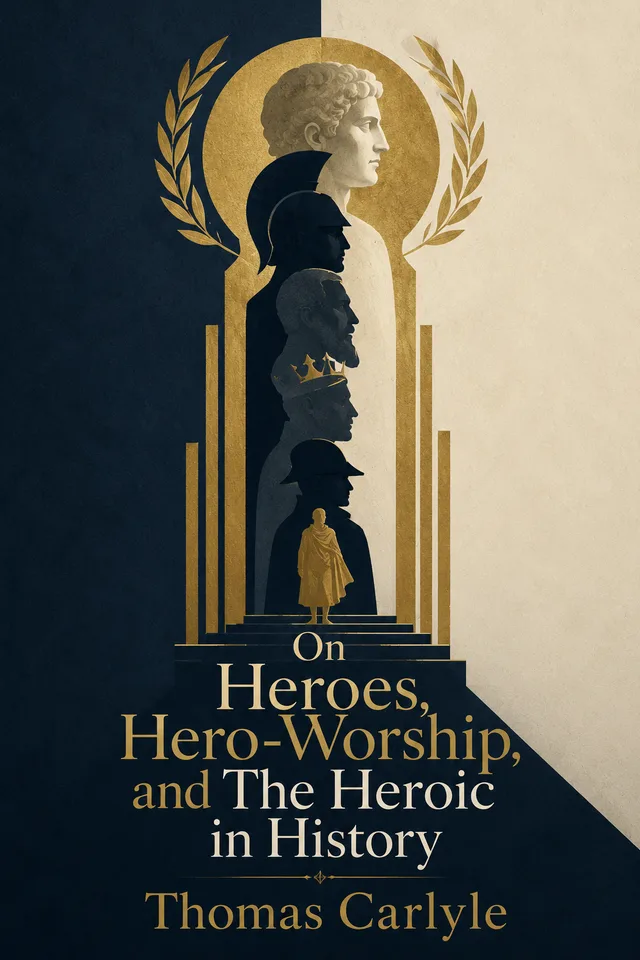
On Heroes, Hero-Worship, and The Heroic in History
Edição BooksWhale em inglês por Thomas Carlyle
Carlyle’s influential lectures on prophets, poets, priests, writers, rulers, and historical greatness.
- Prévia
- Amostra do texto preparado
- Formatos
- Leitor online, EPUB, PDF
- Acesso
- Claim da Biblioteca
Introdução do livro
On Heroes, Hero-Worship, and The Heroic in History
In “On Heroes,” Carlyle interprets history through figures such as Odin, Muhammad, Dante, Shakespeare, Luther, Johnson, Rousseau, Burns, Cromwell, and Napoleon. The lectures reveal a major Victorian theory of authority, charisma, and cultural memory.
Edição BooksWhale
Como esta edição foi preparada
Esta edição se baseia em um texto em domínio público e foi preparada pela BooksWhale para leitura digital.
Base de domínio público
Por que pode ser compartilhada
On Heroes, Hero-Worship, and The Heroic in History is a public-domain work: the author died in 1881, and the text was first published in 1841. This edition uses the original English text.
Ler prévia
Amostra do texto preparado
Prévia selecionada do texto preparado.
Capítulo de préviaFull textLer prévia
On Heroes, Hero-Worship, and The Heroic in History
By Thomas Carlyle
Capítulo de préviaLECTURES ON HEROES.Prévia
LECTURES ON HEROES.
Capítulo de préviaLECTURE I. THE HERO AS DIVINITY. ODIN. PAGANISM: SCANDINAVIAN MYTHOLOGY.Prévia
[May 5, 1840.]
We have undertaken to discourse here for a little on Great Men, their manner of appearance in our world's business, how they have shaped themselves in the world's history, what ideas men formed of them, what work they did;--on Heroes, namely, and on their reception and performance; what I call Hero-worship and the Heroic in human affairs. Too evidently this is a large topic; deserving quite other treatment than we can expect to give it at present. A large topic; indeed, an illimitable one; wide as Universal History itself. For, as I take it, Universal History, the history of what man has accomplished in this world, is at bottom the History of the Great Men who have worked here. They were the leaders of men, these great ones; the modellers, patterns, and in a wide sense creators, of whatsoever the general mass of men contrived to do or to attain; all things that we see standing accomplished in the world are properly the outer material result, the practical realization and embodiment, of Thoughts that dwelt in the Great Men sent into the world: the soul of the whole world's history, it may justly be considered, were the history of these. Too clearly it is a topic we shall do no justice to in this place!
One comfort is, that Great Men, taken up in any way, are profitable company. We cannot look, however imperfectly, upon a great man, without gaining something by him. He is the living light-fountain, which it is good and pleasant to be near. The light which enlightens, which has enlightened the darkness of the world; and this not as a kindled lamp only, but rather as a natural luminary shining by the gift of Heaven; a flowing light-fountain, as I say, of native original insight, of manhood and heroic nobleness;--in whose radiance all souls feel that it is well with them. On any terms whatsoever, you will not grudge to wander in such neighborhood for a while. These Six classes of Heroes, chosen out of widely distant countries and epochs, and in mere external figure differing altogether, ought, if we look faithfully at them, to illustrate several things for us. Could we see them well, we should get some glimpses into the very marrow of the world's history. How happy, could I but, in any measure, in such times as these, make manifest to you the meanings of Heroism; the divine relation (for I may well call it such) which in all times unites a Great Man to other men; and thus, as it were, not exhaust my subject, but so much as break ground on it! At all events, I must make the attempt.
It is well said, in every sense, that a man's religion is the chief fact with regard to him. A man's, or a nation of men's. By religion I do not mean here the church-creed which he professes, the articles of faith which he will sign and, in words or otherwise, assert; not this wholly, in many cases not this at all. We see men of all kinds of professed creeds attain to almost all degrees of worth or worthlessness under each or any of them. This is not what I call religion, this profession and assertion; which is often only a profession and assertion from the outworks of the man, from the mere argumentative region of him, if even so deep as that. But the thing a man does practically believe (and this is often enough _without_ asserting it even to himself, much less to others); the thing a man does practically lay to heart, and know for certain, concerning his vital relations to this mysterious Universe, and his duty and destiny there, that is in all cases the primary thing for him, and creatively determines all the rest. That is his _religion_; or, it may be, his mere scepticism and _no-religion_: the manner it is in which he feels himself to be spiritually related to the Unseen World or No-World; and I say, if you tell me what that is, you tell me to a very great extent what the man is, what the kind of things he will do is. Of a man or of a nation we inquire, therefore, first of all, What religion they had? Was it Heathenism,--plurality of gods, mere sensuous representation of this Mystery of Life, and for chief recognized element therein Physical Force? Was it Christianism; faith in an Invisible, not as real only, but as the only reality; Time, through every meanest moment of it, resting on Eternity; Pagan empire of Force displaced by a nobler supremacy, that of Holiness? Was it Scepticism, uncertainty and inquiry whether there was an Unseen World, any Mystery of Life except a mad one;--doubt as to all this, or perhaps unbelief and flat denial? Answering of this question is giving us the soul of the history of the man or nation. The thoughts they had were the parents of the actions they did; their feelings were parents of their thoughts: it was the unseen and spiritual in them that determined the outward and actual;--their religion, as I say, was the great fact about them. In these Discourses, limited as we are, it will be good to direct our survey chiefly to that religious phasis of the matter. That once known well, all is known. We have chosen as the first Hero in our series Odin the central figure of Scandinavian Paganism; an emblem to us of a most extensive province of things. Let us look for a little at the Hero as Divinity, the oldest primary form of Heroism.
Sumário
Nesta edição
- 01Full text
- 02LECTURES ON HEROES.
- 03LECTURE I. THE HERO AS DIVINITY. ODIN. PAGANISM: SCANDINAVIAN MYTHOLOGY.
- 04LECTURE II. THE HERO AS PROPHET. MAHOMET: ISLAM.
- 05LECTURE III. THE HERO AS POET. DANTE: SHAKSPEARE.
- 06LECTURE IV. THE HERO AS PRIEST. LUTHER; REFORMATION: KNOX; PURITANISM.
- 07LECTURE V. THE HERO AS MAN OF LETTERS. JOHNSON, ROUSSEAU, BURNS.
- 08LECTURE VI. THE HERO AS KING. CROMWELL, NAPOLEON: MODERN REVOLUTIONISM.
Disponibilidade de idiomas
Outros idiomas
Outras edições de idioma ainda não foram publicadas. Elas aparecerão aqui quando disponíveis.
Solicitar outro idioma