inglês Edição
História
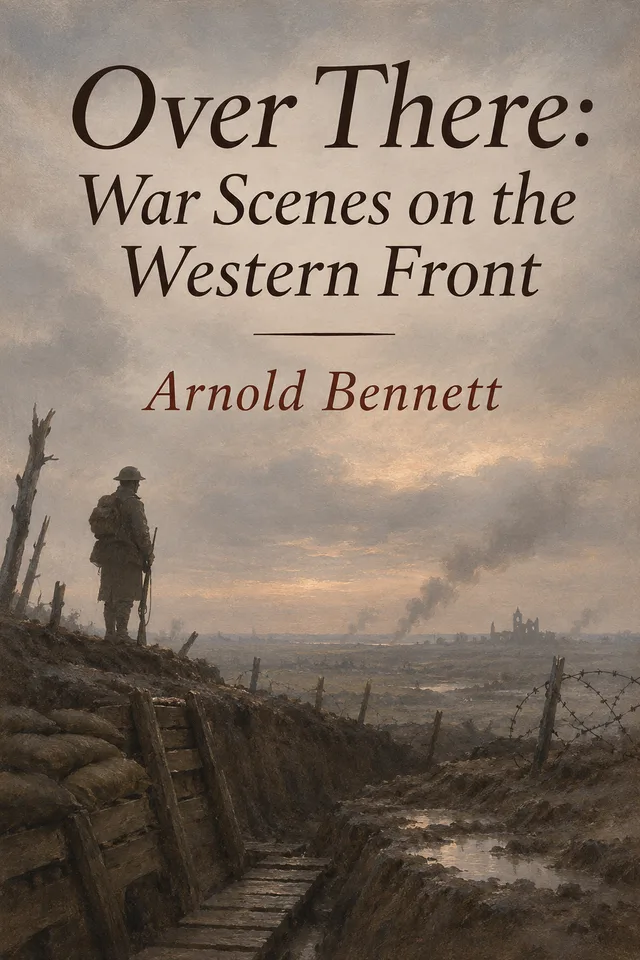
Over There: War Scenes on the Western Front
Edição BooksWhale em inglês por Arnold Bennett
Arnold Bennett records wartime Paris, the French and British lines, and the destruction he witnessed on the Western Front.
- Prévia
- Amostra do texto preparado
- Formatos
- Leitor online, EPUB, PDF
- Acesso
- Claim da Biblioteca
Introdução do livro
Over There: War Scenes on the Western Front
Bennett moves from the streets and rooftops of wartime Paris to the French front, the British lines and the ruins of Ypres. He records conversations, journeys and small changes in everyday habits alongside the evidence of battle. The book follows what he could see as a visitor travelling through communities and landscapes altered by war.
Edição BooksWhale
Como esta edição foi preparada
Esta edição se baseia em um texto em domínio público e foi preparada pela BooksWhale para leitura digital.
Base de domínio público
Por que pode ser compartilhada
The original text by Arnold Bennett is in the public domain in the United States. This edition uses the historical English text.
Ler prévia
Amostra do texto preparado
Prévia selecionada do texto preparado.
Capítulo de préviaI The Zone Of ParisLer prévia
From the balcony you look down upon massed and variegated tree- tops as though you were looking down upon a valley forest from a mountain height. Those trees, whose hidden trunks make alleys and squares, are rooted in the history of France. On the dusty gravel of the promenade which runs between the garden and the street a very young man and a girl, tiny figures, are playing with rackets at one of those second-rate ball games beloved by the French petite bourgeoisie. Their jackets and hats are hung on the corner of the fancy wooden case in which an orange-tree is planted. They are certainly perspiring in the heavy heat of the early morning. They are also certainly in love. This lively dalliance is the preliminary to a day’s desk-work. It seems ill-chosen, silly, futile. The couple have forgotten, if they ever knew, that they are playing at a terrific and long-drawn moment of crisis in a spot sacred to the finest civilisation.
From the balcony you can see, close by, the Louvre, with its sculptures extending from Jean Goujon to Carpeaux; the Church of St. Clotilde, where Cesar Franck for forty years hid his genius away from popularity; the railway station of the Quai d’Orsay, which first proved that a terminus may excite sensations as fine as those excited by a palace or a temple; the dome of the Invalides; the unique facades, equal to any architecture of modern times, to the north of the Place de la Concorde, where the Ministry of Marine has its home. Nobody who knows Paris, and understands what Paris has meant and still means to humanity, can regard the scene without the most exquisite sentiments of humility, affection, and gratitude. It is impossible to look at the plinths, the mouldings, the carving of the Ministry of Marine and not be thrilled by that supreme expression of national art.
And all this escaped! That is the feeling which one has. All this beauty was menaced with disaster at the hands of beings who comprehended it even less than the simple couple playing ball, beings who have scarcely reached the beginnings of comprehension, and who joined a barbaric ingenuousness to a savage cruelty. It was menaced, but it escaped. Perhaps no city was ever in acuter peril; it escaped by a miracle, but it did escape. It escaped because tens of thousands of soldiers in thousands of taxi- cabs advanced more rapidly than any soldiers could be expected to advance. “The population of Paris has revolted and is hurrying to ask mercy from us!” thought the reconnoitring simpletons in Taubes, when they noted beneath them the incredible processions of taxi- cabs going north. But what they saw was the Sixth Army, whose movement changed the campaign, and perhaps the whole course of history.
“A great misfortune has overtaken us,” said a German officer the next day. It was true. Greater than he suspected.
The horror of what might have happened, the splendour of what did happen, mingle in the awed mind as you look over the city from the balcony. The city escaped. And the event seems vaster and more sublime than the mind can bear.
The streets of Paris have now a perpetual aspect of Sunday morning; only the sound of church-bells is lacking. A few of the taxi- cabs have come back; but all the auto-buses without exception are away behind the front. So that the traffic is forced underground, where the railways are manned by women. A horse-bus, dug up out of the past, jogs along the most famous boulevard in the world like a country diligence, with a fat, laughing peasant-woman clinging to its back-step and collecting fare-moneys into the immense pocket of her black apron. Many of the most expensive and unnecessary shops are shut; the others wait with strange meekness for custom. But the provision shops and all the sturdy cheap shops of the poor go on naturally, without any self-consciousness, just as usual. The pavements show chiefly soldiers in a wild, new variety of uniforms, from pale blue to black, imitated and adapted from all sources, and especially from England—and widows and orphans. The number of young girls and women in mourning, in the heavy mourning affected by the Latin race, is enormous. This crape is the sole casualty list permitted by the French War Office. It suffices. Supreme grief is omnipresent; but it is calm, cheerful, smiling. Widows glance at each other with understanding, like initiates of a secret and powerful society.
Capítulo de préviaII On The French FrontPrévia
We were met at a poste de commandement by the officers in charge, who were waiting for us. And later we found that we were always thus met. The highest officer present—General, Colonel, or Commandant—was at every place at our disposition to explain things—and to explain them with that clarity of which the French alone have the secret and of which a superlative example exists in the official report of the earlier phases of the war, offered to the Anglo-Saxon public through Reuter. Automobiles and chauffeurs abounded for our small party of four. Never once at any moment of the day, whether driving furiously along somewhat deteriorated roads in the car, or walking about the land, did I lack a Staff officer who produced in me the illusion that he was living solely in order to be of use to me. All details of the excursions were elaborately organised; never once did the organisation break down. No pre- Lusitania American correspondent could have been more spoiled by Germans desperately anxious for his goodwill than I was spoiled by these French who could not gain my goodwill because they had the whole of it already. After the rites of greeting, we walked up to the high terrace of a considerable chateau close by, and France lay before us in a shimmering vast semicircle. In the distance, a low range of hills, irregularly wooded; then a river; then woods and spinneys; then vineyards—boundless vineyards which climbed in varying slopes out of the valley almost to our feet. Far to the left was a town with lofty factory chimneys, smokeless.
Peasant women were stooping in the vineyards; the whole of the earth seemed to be cultivated and to be yielding bounteously. It was a magnificent summer afternoon. The sun was high and a few huge purple shadows moved with august deliberation across the brilliant greens. An impression of peace, majesty, grandeur; and of the mild, splendid richness of the soil of France.
“You see that white line on the hills opposite,” said an officer, opening a large-scale map.
I guessed it was a level road.
“That is the German trenches,” said he. “They are five miles away. Their gun-positions are in the woods. Our own trenches are invisible from here.”
It constituted a great moment, this first vision of the German trenches. With the thrill came the lancinating thought: “All of France that lies beyond that line, land just like the land on which I am standing, inhabited by people just like the people who are talking to me, is under the insulting tyranny of the invader.” And I also thought, as the sense of distance quickened my imagination to realise that these trenches stretched from Ostend to Switzerland, and that the creators of them were prosecuting similar enterprises as far north- east as Riga, and as far southeast as the confines of Roumania: “The brigands are mad, but they are mad in the grand manner.”
We were at the front.
We had driven for twenty miles along a very busy road which was closed to civilians, and along which even Staff officers could not travel without murmuring the password to placate the hostile vigilance of sentries. The civil life of the district was in abeyance, proceeding precariously from meal to meal. Aeroplanes woke the sleep. No letter could leave a post office without a precautionary delay of three days.
Telegrams were suspect. To get into a railway station was almost as difficult as to get into paradise. A passport or a safe-conduct was the sine qua non of even the restricted liberty which had survived. And yet nowhere did I see a frown nor hear a complaint. Everybody comprehended that the exigencies of the terrific military machine were necessary exigencies. Everybody waited, waited, in confidence and with tranquil smiles. Also it is misleading to say that civil life was in abeyance. For the elemental basis of its prosperity and its amenities continued just as though the lunatic bullies of Potsdam had never dictated to Vienna the ultimatum for Serbia. The earth was yielding, fabulously. It was yielding up to within a mile and a half of the German wire entanglements. The peasants would not neglect the earth. Officers remonstrated with them upon their perilous rashness. They replied: “The land must be tilled.”
Capítulo de préviaIII RuinsPrévia
When you go into Rheims by the Epernay road, the life of the street seems to be proceeding as usual, except that octroi formalities have been abolished. Women, some young and beautiful, stare nonchalantly as the car passes. Children are playing and shrieking in the sunshine; the little cafes and shops keep open door; the baker is busy; middle-aged persons go their ways in meditation upon existence. It is true there are soldiers; but there are soldiers in every important French town at all seasons of the year in peace-time. In short, the spectacle is just that ordinarily presented to the poorer exterior thoroughfares leading towards the centre of a city.
And yet, in two minutes, in less than two minutes, you may be in a quarter where no life is left. This considerable quarter is not seriously damaged—it is destroyed. Not many houses, but every house in it will have to be rebuilt from the cellars. This quarter is desolation. Large shops, large houses, small shops, and small houses have all been treated alike. The facade may stand, the roof may have fallen in entirely or only partially, floors may have disappeared altogether or may still be clinging at odd angles to the walls—the middle of every building is the same: a vast heap of what once was the material of a home or a business, and what now is foul rubbish. In many instances the shells have revealed the functioning of the home at its most intimate, and that is seen which none should see. Indignation rises out of the heart. Amid stacks of refuse you may distinguish a bath, a magnificent fragment of mirror, a piece of tapestry, a saucepan. In a funeral shop wreaths still hang on their hooks for sale. Telephone and telegraph wires depend in a loose tangle from the poles. The clock of the Protestant church has stopped at a quarter to six. The shells have been freakish. In one building a shell harmlessly made a hole in the courtyard large enough to bury every commander of a German army; another shell—a 210 mm.—went through an inner wall and opened up the cellars by destroying 150 square feet of ground-floor: ten people were in the cellars, and none was hurt. Uninjured signs of cafes and shops, such as “The Good Hope,” “The Success of the Day,” meet your gaze with sardonic calm.
The inhabitants of this quarter, and of other quarters in Rheims, have gone. Some are dead. Others are picnicking in Epernay, Paris, elsewhere. They have left everything behind them, and yet they have left nothing. Each knows his lot in the immense tragedy. Nobody can realise the whole of the tragedy. It defies the mind; and, moreover, the horror of it is allayed somewhat by the beautiful forms which ruin—even the ruin of modern ugly architecture—occasionally takes. The effect of the pallor of a bedroom wall-paper against smoke-blackened masonry, where some corner of a house sticks up like a tall, serrated column out of the confusion, remains obstinately in the memory, symbolising, somehow, the grand German deed.
For do not forget that this quarter accurately represents what the Germans came out of Germany into France deliberately to do. This material devastation, this annihilation of effort, hope, and love, this substitution of sorrow for joy—is just what plans and guns were laid for, what the worshipped leaders of the Fatherland prepared with the most wanton and scientific solicitude. It is desperately cruel. But it is far worse than cruel—it is idiotic in its immense futility. The perfect idiocy of the thing overwhelms you. And to your reason it is monstrous that one population should overrun another with murder and destruction from political covetousness as that two populations should go to war concerning a religious creed. Indeed, it is more monstrous. It is an obscene survival, a phenomenon that has strayed through some negligence of fate, into the wrong century.
Sumário
Nesta edição
- 01I The Zone Of Paris
- 02II On The French Front
- 03III Ruins
- 04IV At Grips
- 05V The British Lines
- 06VI The Unique City
Disponibilidade de idiomas
Outros idiomas
Outras edições de idioma ainda não foram publicadas. Elas aparecerão aqui quando disponíveis.
Solicitar outro idioma