inglês Edição
Literatura
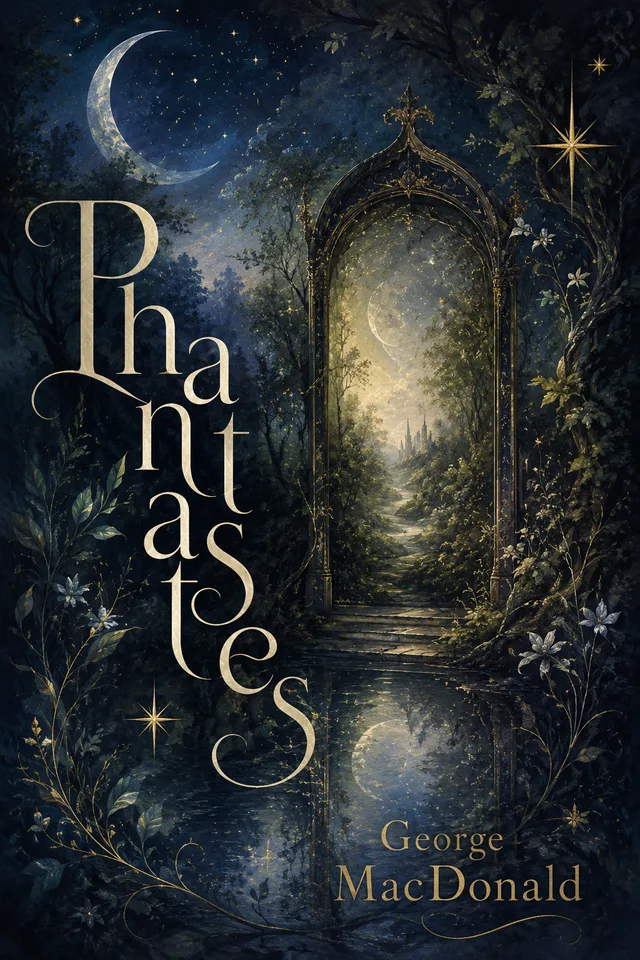
Phantastes
Edição BooksWhale em inglês por George MacDonald
A foundational fantasy romance of fairyland, dream logic, temptation, beauty, and spiritual quest.
- Prévia
- Amostra do texto preparado
- Formatos
- Leitor online, EPUB, PDF
- Acesso
- Claim da Biblioteca
Introdução do livro
Phantastes
Phantastes sends Anodos into a strange fairy realm where desire, shadow, beauty, and moral awakening unfold through dreamlike adventure. George MacDonald’s original English novel is a key early fantasy work for readers tracing the roots of modern imaginative literature.
Edição BooksWhale
Como esta edição foi preparada
Esta edição se baseia em um texto em domínio público e foi preparada pela BooksWhale para leitura digital.
Base de domínio público
Por que pode ser compartilhada
George MacDonald died in 1905, and Phantastes was first published in 1858; these dates support the public-domain basis for this original English fantasy novel.
Ler prévia
Amostra do texto preparado
Prévia selecionada do texto preparado.
Capítulo de préviaPart 1Ler prévia
Phantastes
George MacDonald
PHANTASTES
A FAERIE ROMANCE
“Phantastes from ‘their fount’ all shapes deriving, In new habiliments can quickly dight.”
FLETCHER’S _Purple Island_
Es lassen sich Erzählungen ohne Zusammenhang, jedoch mit Association, wie Träume, denken; Gedichte, die bloss wohlklingend und voll schöner Worte sind, aber auch ohne allen Sinn und Zusammenhang, höchstens einzelne Strophen verständlich, wie Bruchstücke aus den verschiedenartigsten Dingen. Diese wahre Poesie kann höchstens einen allegorischen Sinn in Grossen, und eine indirecte Wirkung, wie Musik, haben. Darum ist die Natur so rein poetisch, wie die Stube eines Zauberers, eines Physikers, eine Kinderstube, eine Polter- und Vorrathskammer.
Ein Märchen ist wie ein Traumbild ohne Zusammenhang. Ein Ensemble wunderbarer Dinge und Begebenheiten, z. B. eine musikalische Phantasie, die harmonischen Folgen einer Aeolsharfe, die Natur selbst...
In einem echten Märchen muss alles wunderbar, geheimnissvoll und zusammenhängend sein; alles belebt, jeder auf eine andere Art. Die ganze Natur muss wunderlich mit der ganzen Geisterwelt gemischt sein; hier tritt die Zeit der Anarchie, der Gesetzlosigkeit, Freiheit, der Naturstand der Natur, die Zeit von der Welt ein . . . Die Welt des Märchens ist die, der Welt der Wahrheit durchaus entgegengesetzte, und eben darum ihr so durchaus ähnlich, wie das Chaos der vollendeten Schöpfung ähnlich ist.--NOVALIS.
CHAPTER I
“A spirit . . .
The undulating woods, and silent well, And rippling rivulet, and evening gloom, Now deepening the dark shades, for speech assuming, Held commune with him; as if he and it Were all that was.”
SHELLEY’S _Alastor_.
I awoke one morning with the usual perplexity of mind which accompanies the return of consciousness. As I lay and looked through the eastern window of my room, a faint streak of peach-colour, dividing a cloud that just rose above the low swell of the horizon, announced the approach of the sun. As my thoughts, which a deep and apparently dreamless sleep had dissolved, began again to assume crystalline forms, the strange events of the foregoing night presented themselves anew to my wondering consciousness. The day before had been my one-and-twentieth birthday. Among other ceremonies investing me with my legal rights, the keys of an old secretary, in which my father had kept his private papers, had been delivered up to me. As soon as I was left alone, I ordered lights in the chamber where the secretary stood, the first lights that had been there for many a year; for, since my father’s death, the room had been left undisturbed. But, as if the darkness had been too long an inmate to be easily expelled, and had dyed with blackness the walls to which, bat-like, it had clung, these tapers served but ill to light up the gloomy hangings, and seemed to throw yet darker shadows into the hollows of the deep-wrought cornice.
All the further portions of the room lay shrouded in a mystery whose deepest folds were gathered around the dark oak cabinet which I now approached with a strange mingling of reverence and curiosity. Perhaps, like a geologist, I was about to turn up to the light some of the buried strata of the human world, with its fossil remains charred by passion and petrified by tears. Perhaps I was to learn how my father, whose personal history was unknown to me, had woven his web of story; how he had found the world, and how the world had left him. Perhaps I was to find only the records of lands and moneys, how gotten and how secured; coming down from strange men, and through troublous times, to me, who knew little or nothing of them all. To solve my speculations, and to dispel the awe which was fast gathering around me as if the dead were drawing near, I approached the secretary; and having found the key that fitted the upper portion, I opened it with some difficulty, drew near it a heavy high-backed chair, and sat down before a multitude of little drawers and slides and pigeon-holes. But the door of a little cupboard in the centre especially attracted my interest, as if there lay the secret of this long-hidden world. Its key I found.
Capítulo de préviaPart 2Prévia
Seeing no door, I went round to the other side, and there I found one, wide open. A woman sat beside it, preparing some vegetables for dinner.
This was homely and comforting. As I came near, she looked up, and seeing me, showed no surprise, but bent her head again over her work, and said in a low tone:
“Did you see my daughter?”
“I believe I did,” said I. “Can you give me something to eat, for I am very hungry?” “With pleasure,” she replied, in the same tone; “but do not say anything more, till you come into the house, for the Ash is watching us.”
Having said this, she rose and led the way into the cottage; which, I now saw, was built of the stems of small trees set closely together, and was furnished with rough chairs and tables, from which even the bark had not been removed. As soon as she had shut the door and set a chair—
“You have fairy blood in you,” said she, looking hard at me.
“How do you know that?”
“You could not have got so far into this wood if it were not so; and I am trying to find out some trace of it in your countenance. I think I see it.”
“What do you see?”
“Oh, never mind: I may be mistaken in that.”
“But how then do you come to live here?”
“Because I too have fairy blood in me.”
Here I, in my turn, looked hard at her, and thought I could perceive, notwithstanding the coarseness of her features, and especially the heaviness of her eyebrows, a something unusual—I could hardly call it grace, and yet it was an expression that strangely contrasted with the form of her features. I noticed too that her hands were delicately formed, though brown with work and exposure.
“I should be ill,” she continued, “if I did not live on the borders of the fairies’ country, and now and then eat of their food. And I see by your eyes that you are not quite free of the same need; though, from your education and the activity of your mind, you have felt it less than I. You may be further removed too from the fairy race.”
I remembered what the lady had said about my grandmothers.
Here she placed some bread and some milk before me, with a kindly apology for the homeliness of the fare, with which, however, I was in no humour to quarrel. I now thought it time to try to get some explanation of the strange words both of her daughter and herself.
“What did you mean by speaking so about the Ash?”
She rose and looked out of the little window. My eyes followed her; but as the window was too small to allow anything to be seen from where I was sitting, I rose and looked over her shoulder. I had just time to see, across the open space, on the edge of the denser forest, a single large ash-tree, whose foliage showed bluish, amidst the truer green of the other trees around it; when she pushed me back with an expression of impatience and terror, and then almost shut out the light from the window by setting up a large old book in it.
“In general,” said she, recovering her composure, “there is no danger in the daytime, for then he is sound asleep; but there is something unusual going on in the woods; there must be some solemnity among the fairies to-night, for all the trees are restless, and although they cannot come awake, they see and hear in their sleep.”
“But what danger is to be dreaded from him?”
Instead of answering the question, she went again to the window and looked out, saying she feared the fairies would be interrupted by foul weather, for a storm was brewing in the west.
Capítulo de préviaPart 3Prévia
“Now let us moan.” “And cover her o’er.” “Primrose is gone.” “All but the flower.” “Here is a leaf.” “Lay her upon it.” “Follow in grief.” “Pocket has done it.”
“Deeper, poor creature!
Winter may come.” “He cannot reach her— That is a hum.” “She is buried, the beauty!” “Now she is done.” “That was the duty.” “Now for the fun.”
And with a wild laugh they sprang away, most of them towards the cottage. During the latter part of the song-talk, they had formed themselves into a funeral procession, two of them bearing poor Primrose, whose death Pocket had hastened by biting her stalk, upon one of her own great leaves. They bore her solemnly along some distance, and then buried her under a tree. Although I say _her_ I saw nothing but the withered primrose-flower on its long stalk. Pocket, who had been expelled from the company by common consent, went sulkily away towards her hammock, for she was the fairy of the calceolaria, and looked rather wicked. When she reached its stem, she stopped and looked round. I could not help speaking to her, for I stood near her. I said, “Pocket, how could you be so naughty?”
“I am never naughty,” she said, half-crossly, half-defiantly; “only if you come near my hammock, I will bite you, and then you will go away.”
“Why did you bite poor Primrose?”
“Because she said we should never see Snowdrop; as if we were not good enough to look at her, and she was, the proud thing!—served her right!”
“Oh, Pocket, Pocket,” said I; but by this time the party which had gone towards the house, rushed out again, shouting and screaming with laughter. Half of them were on the cat’s back, and half held on by her fur and tail, or ran beside her; till, more coming to their help, the furious cat was held fast; and they proceeded to pick the sparks out of her with thorns and pins, which they handled like harpoons. Indeed, there were more instruments at work about her than there could have been sparks in her. One little fellow who held on hard by the tip of the tail, with his feet planted on the ground at an angle of forty-five degrees, helping to keep her fast, administered a continuous flow of admonitions to Pussy.
“Now, Pussy, be patient. You know quite well it is all for your good.
You cannot be comfortable with all those sparks in you; and, indeed, I am charitably disposed to believe” (here he became very pompous) “that they are the cause of all your bad temper; so we must have them all out, every one; else we shall be reduced to the painful necessity of cutting your claws, and pulling out your eye-teeth. Quiet! Pussy, quiet!”
But with a perfect hurricane of feline curses, the poor animal broke loose, and dashed across the garden and through the hedge, faster than even the fairies could follow. “Never mind, never mind, we shall find her again; and by that time she will have laid in a fresh stock of sparks. Hooray!” And off they set, after some new mischief.
But I will not linger to enlarge on the amusing display of these frolicsome creatures. Their manners and habits are now so well known to the world, having been so often described by eyewitnesses, that it would be only indulging self-conceit, to add my account in full to the rest. I cannot help wishing, however, that my readers could see them for themselves. Especially do I desire that they should see the fairy of the daisy; a little, chubby, round-eyed child, with such innocent trust in his look! Even the most mischievous of the fairies would not tease him, although he did not belong to their set at all, but was quite a little country bumpkin. He wandered about alone, and looked at everything, with his hands in his little pockets, and a white night-cap on, the darling! He was not so beautiful as many other wild flowers I saw afterwards, but so dear and loving in his looks and little confident ways.
Sumário
Nesta edição
- 01Part 1
- 02Part 2
- 03Part 3
- 04Part 4
- 05Part 5
- 06Part 6
- 07Part 7
- 08Part 8
- 09Part 9
- 10Part 10
- 11Part 11
- 12Part 12
- 13Part 13
- 14Part 14
- 15Part 15
- 16Part 16
- 17Part 17
- 18Part 18
- 19Part 19
- 20Part 20
- 21Part 21
- 22Part 22
- 23Part 23
Disponibilidade de idiomas
Outros idiomas
Outras edições de idioma ainda não foram publicadas. Elas aparecerão aqui quando disponíveis.
Solicitar outro idioma