inglês Edição
Literatura
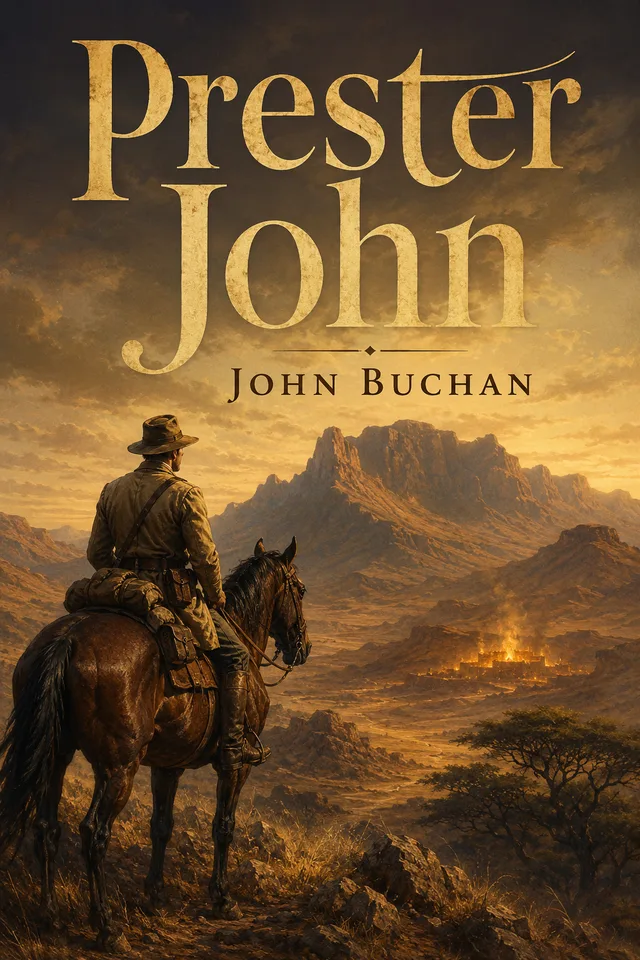
Prester John
Edição BooksWhale em inglês por John Buchan
A compact adventure novel of South African politics, treasure, danger, imperial imagination, and Buchan’s brisk thriller style.
- Prévia
- Amostra do texto preparado
- Formatos
- Leitor online, EPUB, PDF
- Acesso
- Claim da Biblioteca
Introdução do livro
Prester John
Prester John is a carefully selected public-domain literature work by John Buchan. A compact adventure novel of South African politics, treasure, danger, imperial imagination, and Buchan’s brisk thriller style. This BooksWhale edition is prepared for readers looking for classic works with clean metadata, searchable titles, and reliable publication context.
Edição BooksWhale
Como esta edição foi preparada
Esta edição se baseia em um texto em domínio público e foi preparada pela BooksWhale para leitura digital.
Base de domínio público
Por que pode ser compartilhada
Prester John was first published in 1910. The selected edition uses public-domain text suitable for BooksWhale publication, with any translation source limited to public-domain material.
Ler prévia
Amostra do texto preparado
Prévia selecionada do texto preparado.
Capítulo de préviaPart 1Ler prévia
Prester John
John Buchan
CHAPTER I THE MAN ON THE KIRKCAPLE SHORE
I mind as if it were yesterday my first sight of the man. Little I knew at the time how big the moment was with destiny, or how often that face seen in the fitful moonlight would haunt my sleep and disturb my waking hours. But I mind yet the cold grue of terror I got from it, a terror which was surely more than the due of a few truant lads breaking the Sabbath with their play.
The town of Kirkcaple, of which and its adjacent parish of Portincross my father was the minister, lies on a hillside above the little bay of Caple, and looks squarely out on the North Sea. Round the horns of land which enclose the bay the coast shows on either side a battlement of stark red cliffs through which a burn or two makes a pass to the water’s edge. The bay itself is ringed with fine clean sands, where we lads of the burgh school loved to bathe in the warm weather. But on long holidays the sport was to go farther afield among the cliffs; for there there were many deep caves and pools, where podleys might be caught with the line, and hid treasures sought for at the expense of the skin of the knees and the buttons of the trousers. Many a long Saturday I have passed in a crinkle of the cliffs, having lit a fire of driftwood, and made believe that I was a smuggler or a Jacobite new landed from France. There was a band of us in Kirkcaple, lads of my own age, including Archie Leslie, the son of my father’s session-clerk, and Tam Dyke, the provost’s nephew. We were sealed to silence by the blood oath, and we bore each the name of some historic pirate or sailorman. I was Paul Jones, Tam was Captain Kidd, and Archie, need I say it, was Morgan himself. Our tryst was a cave where a little water called the Dyve Burn had cut its way through the cliffs to the sea. There we forgathered in the summer evenings and of a Saturday afternoon in winter, and told mighty tales of our prowess and flattered our silly hearts. But the sober truth is that our deeds were of the humblest, and a dozen of fish or a handful of apples was all our booty, and our greatest exploit a fight with the roughs at the Dyve tan-work.
My father’s spring Communion fell on the last Sabbath of April, and on the particular Sabbath of which I speak the weather was mild and bright for the time of year. I had been surfeited with the Thursday’s and Saturday’s services, and the two long diets of worship on the Sabbath were hard for a lad of twelve to bear with the spring in his bones and the sun slanting through the gallery window. There still remained the service on the Sabbath evening—a doleful prospect, for the Rev. Mr Murdoch of Kilchristie, noted for the length of his discourses, had exchanged pulpits with my father. So my mind was ripe for the proposal of Archie Leslie, on our way home to tea, that by a little skill we might give the kirk the slip. At our Communion the pews were emptied of their regular occupants and the congregation seated itself as it pleased. The manse seat was full of the Kirkcaple relations of Mr Murdoch, who had been invited there by my mother to hear him, and it was not hard to obtain permission to sit with Archie and Tam Dyke in the cock-loft in the gallery. Word was sent to Tam, and so it happened that three abandoned lads duly passed the plate and took their seats in the cock-loft. But when the bell had done jowing, and we heard by the sounds of their feet that the elders had gone in to the kirk, we slipped down the stairs and out of the side door. We were through the churchyard in a twinkling, and hot-foot on the road to the Dyve Burn. It was the fashion of the genteel in Kirkcaple to put their boys into what were known as Eton suits—long trousers, cut-away jackets, and chimney-pot hats. I had been one of the earliest victims, and well I remember how I fled home from the Sabbath school with the snowballs of the town roughs rattling off my chimney-pot. Archie had followed, his family being in all things imitators of mine. We were now clothed in this wearisome garb, so our first care was to secrete safely our hats in a marked spot under some whin bushes on the links. Tam was free from the bondage of fashion, and wore his ordinary best knickerbockers. From inside his jacket he unfolded his special treasure, which was to light us on our expedition—an evil-smelling old tin lantern with a shutter.
Capítulo de préviaPart 2Prévia
Though I only saw it in the turn of a head, the face stamped itself indelibly upon my mind. It was black, black as ebony, but it was different from the ordinary negro. There were no thick lips and flat nostrils; rather, if I could trust my eyes, the nose was high-bridged, and the lines of the mouth sharp and firm. But it was distorted into an expression of such a devilish fury and amazement that my heart became like water.
We had a start, as I have said, of some twenty or thirty yards. Among the boulders we were not at a great disadvantage, for a boy can flit quickly over them, while a grown man must pick his way. Archie, as ever, kept his wits the best of us. “Make straight for the burn,” he shouted in a hoarse whisper; we’ll beat him on the slope.”
We passed the boulders and slithered over the outcrop of red rock and the patches of sea-pink till we reached the channel of the Dyve water, which flows gently among pebbles after leaving the gully. Here for the first time I looked back and saw nothing. I stopped involuntarily, and that halt was nearly my undoing. For our pursuer had reached the burn before us, but lower down, and was coming up its bank to cut us off.
At most times I am a notable coward, and in these days I was still more of one, owing to a quick and easily-heated imagination. But now I think I did a brave thing, though more by instinct than resolution. Archie was running first, and had already splashed through the burn; Tam came next, just about to cross, and the black man was almost at his elbow. Another second and Tam would have been in his clutches had I not yelled out a warning and made straight up the bank of the burn. Tam fell into the pool—I could hear his spluttering cry—but he got across; for I heard Archie call to him, and the two vanished into the thicket which clothes all the left bank of the gully. The pursuer, seeing me on his own side of the water, followed straight on; and before I knew it had become a race between the two of us.
I was hideously frightened, but not without hope, for the screes and shelves of this right side of the gully were known to me from many a day’s exploring. I was light on my feet and uncommonly sound in wind, being by far the best long-distance runner in Kirkcaple. If I could only keep my lead till I reached a certain corner I knew of, I could outwit my enemy; for it was possible from that place to make a detour behind a waterfall and get into a secret path of ours among the bushes. I flew up the steep screes, not daring to look round; but at the top, where the rocks begin, I had a glimpse of my pursuer. The man could run. Heavy in build though he was he was not six yards behind me, and I could see the white of his eyes and the red of his gums. I saw something else—a glint of white metal in his hand. He still had his knife.
Fear sent me up the rocks like a seagull, and I scrambled and leaped, making for the corner I knew of. Something told me that the pursuit was slackening, and for a moment I halted to look round. A second time a halt was nearly the end of me. A great stone flew through the air, and took the cliff an inch from my head, half-blinding me with splinters. And now I began to get angry. I pulled myself into cover, skirted a rock till I came to my corner, and looked back for the enemy. There he was scrambling by the way I had come, and making a prodigious clatter among the stones. I picked up a loose bit of rock and hurled it with all my force in his direction. It broke before it reached him, but a considerable lump, to my joy, took him full in the face. Then my terrors revived. I slipped behind the waterfall and was soon in the thicket, and toiling towards the top.
Capítulo de préviaPart 3Prévia
“I’ll wager that fellow has been a slave-driver in his time,” I told Mr Wardlaw, who said, “God pity his slaves, then.”
And now I come to the incident which made the rest of the voyage pass all too soon for me, and foreshadowed the strange events which were to come. It was the day after we crossed the Line, and the first-class passengers were having deck sports. A tug-of-war had been arranged between the three classes, and a half-dozen of the heaviest fellows in the steerage, myself included, were invited to join. It was a blazing hot afternoon, but on the saloon deck there were awnings and a cool wind blowing from the bows. The first-class beat the second easily, and after a tremendous struggle beat the steerage also. Then they regaled us with iced-drinks and cigars to celebrate the victory.
I was standing at the edge of the crowd of spectators, when my eye caught a figure which seemed to have little interest in our games. A large man in clerical clothes was sitting on a deck-chair reading a book. There was nothing novel about the stranger, and I cannot explain the impulse which made me wish to see his face. I moved a few steps up the deck, and then I saw that his skin was black. I went a little farther, and suddenly he raised his eyes from his book and looked round. It was the face of the man who had terrified me years ago on the Kirkcaple shore.
I spent the rest of the day in a brown study. It was clear to me that some destiny had prearranged this meeting. Here was this man travelling prosperously as a first-class passenger with all the appurtenances of respectability. I alone had seen him invoking strange gods in the moonlight, I alone knew of the devilry in his heart, and I could not but believe that some day or other there might be virtue in that knowledge.
The second engineer and I had made friends, so I got him to consult the purser’s list for the name of my acquaintance. He was down as the Rev. John Laputa, and his destination was Durban. The next day being Sunday, who should appear to address us steerage passengers but the black minister. He was introduced by the captain himself, a notably pious man, who spoke of the labours of his brother in the dark places of heathendom. Some of us were hurt in our pride in being made the target of a black man’s oratory. Especially Mr Henriques, whose skin spoke of the tar-brush, protested with oaths against the insult. Finally he sat down on a coil of rope, and spat scornfully in the vicinity of the preacher.
For myself I was intensely curious, and not a little impressed. The man’s face was as commanding as his figure, and his voice was the most wonderful thing that ever came out of human mouth. It was full and rich, and gentle, with the tones of a great organ. He had none of the squat and preposterous negro lineaments, but a hawk nose like an Arab, dark flashing eyes, and a cruel and resolute mouth. He was black as my hat, but for the rest he might have sat for a figure of a Crusader. I do not know what the sermon was about, though others told me that it was excellent. All the time I watched him, and kept saying to myself, “You hunted me up the Dyve Burn, but I bashed your face for you.” Indeed, I thought I could see faint scars on his cheek.
The following night I had toothache, and could not sleep. It was too hot to breathe under cover, so I got up, lit a pipe, and walked on the after-deck to ease the pain. The air was very still, save for the whish of water from the screws and the steady beat of the engines. Above, a great yellow moon looked down on me, and a host of pale stars.
Sumário
Nesta edição
- 01Part 1
- 02Part 2
- 03Part 3
- 04Part 4
- 05Part 5
- 06Part 6
- 07Part 7
- 08Part 8
- 09Part 9
- 10Part 10
- 11Part 11
- 12Part 12
- 13Part 13
- 14Part 14
- 15Part 15
- 16Part 16
- 17Part 17
- 18Part 18
- 19Part 19
- 20Part 20
- 21Part 21
- 22Part 22
- 23Part 23
- 24Part 24
- 25Part 25
- 26Part 26
Disponibilidade de idiomas
Outros idiomas
Outras edições de idioma ainda não foram publicadas. Elas aparecerão aqui quando disponíveis.
Solicitar outro idioma