inglês Edição
Literatura
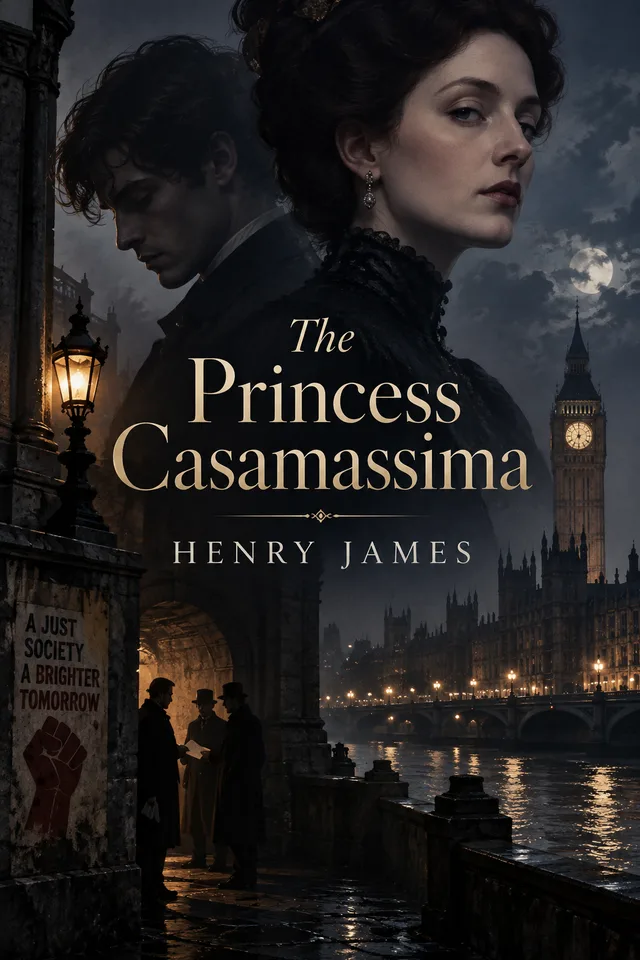
The Princess Casamassima
Edição BooksWhale em inglês por Henry James
A classic English-language work about class, revolution, identity and conscience.
- Prévia
- Amostra do texto preparado
- Formatos
- Leitor online, EPUB, PDF
- Acesso
- Claim da Biblioteca
Introdução do livro
The Princess Casamassima
The Princess Casamassima explores class, revolution, identity and conscience. The work combines memorable characters, social observation and a sustained conflict between private desire, public expectation and moral choice.
Edição BooksWhale
Como esta edição foi preparada
Esta edição se baseia em um texto em domínio público e foi preparada pela BooksWhale para leitura digital.
Base de domínio público
Por que pode ser compartilhada
Henry James died in 1916, and The Princess Casamassima was first published or composed in 1886. These dates support the public-domain basis for this original-language edition.
Ler prévia
Amostra do texto preparado
Prévia selecionada do texto preparado.
Capítulo de préviaFull textLer prévia
The Princess Casamassima
Henry James
Capítulo de préviaBOOK FIRSTPrévia
BOOK FIRST
Capítulo de préviaIPrévia
“Oh yes, I daresay I can find the child, if you would like to see him,” Miss Pynsent said; she had a fluttered wish to assent to every suggestion made by her visitor, whom she regarded as a high and rather terrible personage. To look for the little boy she came out of her small parlour, which she had been ashamed to exhibit in so untidy a state, with paper “patterns” lying about on the furniture and snippings of stuff scattered over the carpet—she came out of this somewhat stuffy sanctuary, dedicated at once to social intercourse and to the ingenious art to which her life had been devoted, and, opening the house-door, turned her eyes up and down the little street. It would presently be tea-time, and she knew that at that solemn hour Hyacinth narrowed the circle of his wanderings. She was anxious and impatient and in a fever of excitement and complacency, not wanting to keep Mrs. Bowerbank waiting, though she sat there, heavily and consideringly, as if she meant to stay; and wondering not a little whether the object of her quest would have a dirty face. Mrs. Bowerbank had intimated so definitely that she thought it remarkable on Miss Pynsent’s part to have taken care of him gratuitously for so many years, that the humble dressmaker, whose imagination took flights about every one but herself and who had never been conscious of an exemplary benevolence, suddenly aspired to appear, throughout, as devoted to the child as she had struck her large, grave guest as being, and felt how much she should like him to come in fresh and frank and looking as pretty as he sometimes did. Miss Pynsent, who blinked confusedly as she surveyed the outer prospect, was very much flushed, partly with the agitation of what Mrs. Bowerbank had told her and partly because, when she offered that lady a drop of refreshment at the end of so long an expedition, she had said she couldn’t think of touching anything unless Miss Pynsent would keep her company. The “cheffoneer,” as Amanda was always careful to call it, yielded up a small bottle which, formerly containing eau-de-cologne, now exhibited half a pint of a rich gold-coloured liquid. Miss Pynsent was very delicate; she lived on tea and watercress and kept the little bottle in the cheffoneer only for great emergencies. She didn’t like hot brandy and water with a lump or two of sugar, but she partook of half a tumbler on the present occasion, which was of a highly exceptional kind. At this time of day the boy was often planted in front of the little sweet-shop on the other side of the street, an establishment where periodical literature, as well as tough toffy and hard lollipops, was dispensed and where song-books and pictorial sheets were attractively exhibited in the small-paned dirty window. He used to stand there for half an hour at a time and spell out the first page of the romances in the _Family Herald_ and the _London Journal_, where he particularly admired the obligatory illustration in which the noble characters (they were always of the highest birth) were presented to the carnal eye. When he had a penny he spent only a fraction of it on stale sugar-candy; for the remaining halfpenny he always bought a ballad with a vivid woodcut at the top. Now, however, he was not at his post of contemplation, nor was he visible anywhere to Miss Pynsent’s impatient glance.
“Millicent ’Enning, tell me quickly, have you seen my child?” These words were addressed by Miss Pynsent to a little girl who sat on the doorstep of the adjacent house nursing a dingy doll and whose extraordinary luxuriance of dark brown hair was surmounted by a torn straw hat.
The child looked up from her dandling and patting and, after a stare of which the blankness was visibly overdone, replied: “Law no, Miss Pynsent, I never see him.”
Sumário
Nesta edição
- 01Full text
- 02BOOK FIRST
- 03I
- 04II
- 05MISS AMANDA PYNSENT
- 06DRESSMAKING IN ALL ITS BRANCHES: COURT-DRESSES:
- 07MANTLES AND FASHIONABLE BONNETS
- 08III
- 09IV
- 10V
- 11VI
- 12VII
- 13VIII
- 14IX
- 15X
- 16XI
- 17BOOK SECOND
- 18XII
- 19XIII
- 20XIV
- 21XV
- 22XVI
- 23XVII
- 24XVIII
- 25XIX
- 26XX
- 27XXI
Disponibilidade de idiomas
Outros idiomas
Outras edições de idioma ainda não foram publicadas. Elas aparecerão aqui quando disponíveis.
Solicitar outro idioma