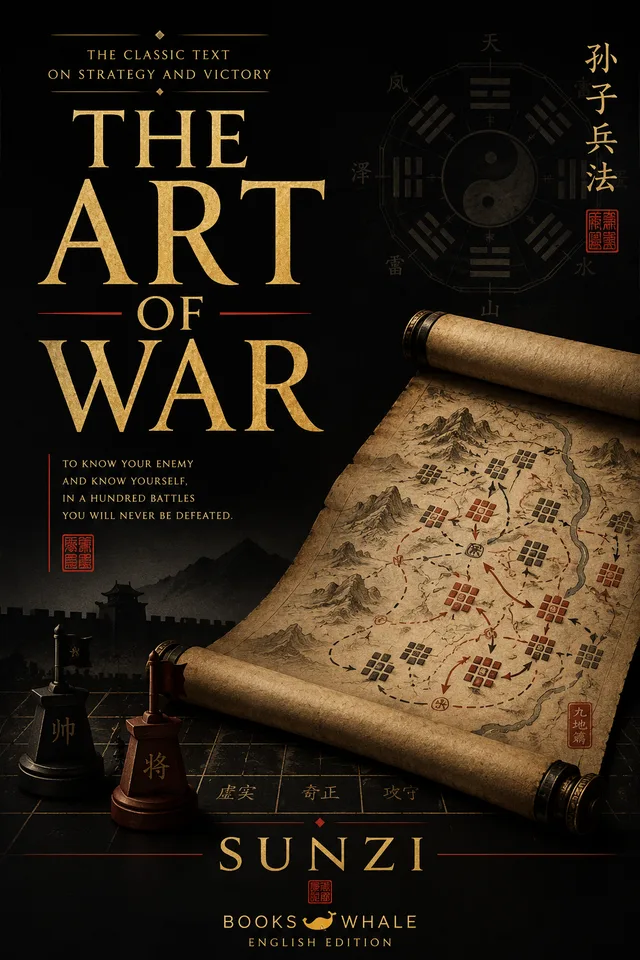
inglês Edição
Militar
The Art of War
Edição BooksWhale em inglês por Sun Tzu
Título original: 孫子兵法
A concise strategic classic on conflict, command, timing, terrain, deception, and disciplined restraint.
- Prévia
- Amostra do texto preparado
- Formatos
- Leitor online, EPUB, PDF
- Acesso
- Claim da Biblioteca
Introdução do livro
The Art of War
The Art of War presents strategy as a matter of information, timing, terrain, morale, and disciplined command. Its lasting force comes from its preference for clarity over brute force and for victory achieved with the least unnecessary cost.
Edição BooksWhale
Como esta edição foi preparada
Esta edição é uma tradução assistida por IA e revisada por pessoas, preparada pela BooksWhale para legibilidade, formatação e consistência.
Base de domínio público
Por que pode ser compartilhada
The original Chinese text is an ancient public-domain classic. This BooksWhale English edition is an AI-assisted, human-reviewed translation prepared from the public-domain source text.
Ler prévia
Amostra do texto preparado
Prévia selecionada do texto preparado.
Capítulo de préviaFull textLer prévia
The Art of War
Sun Tzu
Capítulo de préviaChapter on Laying PlansPrévia
Sun Tzu said: War is a great matter of the state. It is the ground of life and death, the way of survival and extinction, and must not be left unexamined.
Therefore, measure it by five matters, compare it by calculations, and seek out its true conditions: first is the Way, second is Heaven, third is Earth, fourth is the commander, fifth is method. The Way is that which causes the people to share the same purpose as their ruler; therefore they can die with him, live with him, and not fear danger. Heaven is darkness and light, cold and heat, and the ordering of the seasons. Earth is distance and nearness, danger and ease, breadth and narrowness, death and life. The commander is wisdom, trustworthiness, benevolence, courage, and strictness. Method is organization, official ranks, and the management of supplies. In all these five things, no commander has not heard of them; he who knows them wins, he who does not know them does not win. Therefore compare them by calculations and seek out their true conditions, saying: Which ruler possesses the Way? Which commander has ability? Which side has the advantage of Heaven and Earth? On which side are laws and orders carried out? Which army is stronger? Which officers and soldiers are better trained? On which side are rewards and punishments clearer? By these things I know victory and defeat. If the general listens to my calculations and uses them, he will surely win; keep him. If the general does not listen to my calculations and uses them not, he will surely be defeated; dismiss him.
Having calculated advantages and listened, one then creates strategic power to assist what lies beyond them. Strategic power is controlling expediency according to advantage. War is the way of deception. Therefore, when able, show inability; when in use, show disuse; when near, show distance; when distant, show nearness. Entice him with advantage; take him when he is disordered; prepare against him when he is substantial; avoid him when he is strong; disturb him when he is angry; make him arrogant by humility; tire him when he is at ease; divide him when he is united. Attack where he is unprepared; appear where he does not expect. This is the victory of the military strategist, and it cannot be transmitted beforehand.
Now, those who win in the temple calculations before battle are those who have many calculations; those who do not win in the temple calculations before battle are those who have few calculations. Many calculations win; few calculations do not win; how much less no calculations at all! By observing this, victory and defeat become apparent.
Capítulo de préviaChapter on Waging WarPrévia
Sun Tzu said: In the method of using troops, when there are a thousand swift chariots, a thousand armored chariots, one hundred thousand soldiers in armor, and grain transported a thousand li, then the expenses within and without, the needs of envoys and guests, materials such as glue and lacquer, and provisions for chariots and armor will cost a thousand pieces of gold a day; only then can an army of one hundred thousand be raised.
When war is used, if victory is prolonged, the troops become dull and their sharpness is blunted; if they attack cities, their strength is exhausted; if the army is exposed for long, the state’s resources become insufficient. When troops are dulled and sharpness blunted, strength exhausted and wealth depleted, the feudal lords will take advantage of the weakness and rise. Though there be wise men, they cannot make good what follows. Therefore in war one has heard of clumsy speed, but has not seen skillful prolongation. There has never been a war prolonged that benefited the state. Therefore, one who does not fully know the harms of using troops cannot fully know the benefits of using troops.
Those skilled in using troops do not levy soldiers a second time and do not transport grain a third time. They take equipment from the state and rely on grain from the enemy; therefore the army’s food can be sufficient. The poverty of the state because of the army comes from long-distance transport; long-distance transport makes the people poor. Those near the army sell at high prices; high prices exhaust the people’s wealth; when wealth is exhausted, they are hard pressed by levies. With strength exhausted and wealth depleted, the homes of the central plains are empty within. Of the people’s expenses, seven tenths are gone; of the public expenses, with broken chariots and worn-out horses, armor and helmets, arrows and crossbows, halberds and shields, covered siege shields, oxen and great carts, six tenths are gone.
Therefore a wise general is intent on feeding from the enemy. One zhong of the enemy’s food is worth twenty of ours; one shi of fodder is worth twenty of ours.
Therefore, what makes soldiers kill the enemy is anger; what makes them seize the enemy’s advantage is reward. Therefore in chariot battle, when ten or more chariots are captured, reward the one who first takes them, change their flags and banners, mix the chariots into our own and ride them, treat the captured soldiers well and care for them. This is called defeating the enemy and becoming stronger.
Therefore in war, victory is prized; prolongation is not prized. Therefore the general who understands war is the arbiter of the people’s lives and the master of the state’s safety and danger.
Sumário
Nesta edição
- 01Full text
- 02Chapter on Laying Plans
- 03Chapter on Waging War
- 04Chapter on Planning Attack
- 05Chapter on Form
- 06Chapter on Strategic Power
- 07Chapter on Emptiness and Solidity
- 08Chapter on Military Contest
- 09Chapter on Nine Changes
- 10Chapter on Marching the Army
- 11Chapter on Terrain
- 12Chapter on Nine Grounds
- 13Chapter on Fire Attack
- 14Chapter on Using Spies
Disponibilidade de idiomas
Outros idiomas
chinês
chinês Edição
孙子兵法
Sun Tzu · Militar
以战争谈判断、节制、时机与胜负,是战略思维中最精炼的中国古典文本。
italiano
italiano Edição
L’arte della guerra
Sun Tzu · Militar
Un trattato strategico su informazione, inganno, terreno, tempo e comando disciplinato.
espanhol
espanhol Edição
El arte de la guerra
Sun Tzu · Militar
Clásico de Sun Tzu: El arte de la guerra, presentado en una traducción propia de BooksWhale.