inglês Edição
Literatura
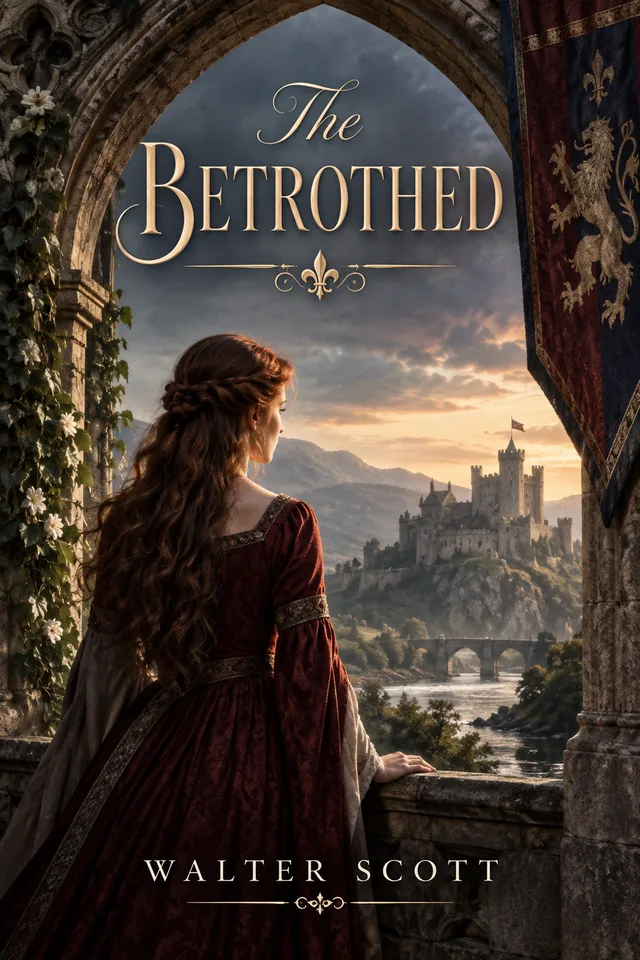
The Betrothed
Edição BooksWhale em inglês por Walter Scott
A Norman knight, a Welsh heiress, and a kingdom in transition meet in Scott’s richly staged tale of loyalty and political change.
- Prévia
- Amostra do texto preparado
- Formatos
- Leitor online, EPUB, PDF
- Acesso
- Claim da Biblioteca
Introdução do livro
The Betrothed
Set in medieval Britain under Henry II, The Betrothed follows Eveline Berenger as family duty and romantic allegiance become entangled in the conflict between Norman rule and Welsh resistance. Scott combines tournament pageantry, religious life, and regional politics in a historical romance about the fragile promises that bind individuals and nations.
Edição BooksWhale
Como esta edição foi preparada
Esta edição se baseia em um texto em domínio público e foi preparada pela BooksWhale para leitura digital.
Base de domínio público
Por que pode ser compartilhada
The original work was first published in 1825; Walter Scott died in 1832. The source text is in the public domain under the applicable author-life-plus-term rules. This edition is the original-language text.
Ler prévia
Amostra do texto preparado
Prévia selecionada do texto preparado.
Capítulo de préviaFull textLer prévia
The Betrothed
Walter Scott
THE BETROTHED
INTRODUCTION--(1832.)
The Tales of the Crusaders was determined upon as the title of the following series of the Novels, rather by the advice of the few friends whom, death has now rendered still fewer, than by the author's own taste. Not but that he saw plainly enough the interest which might be excited by the very name of the Crusaders, but he was conscious at the same time that that interest was of a character which it might be more easy to create than to satisfy, and that by the mention of so magnificent a subject each reader might be induced to call up to his imagination a sketch so extensive and so grand that it might not be in the power of the author to fill it up, who would thus stand in the predicament of the dwarf bringing with him a standard to measure his own stature, and showing himself, therefore, says Sterne, "a dwarf more ways than one."
It is a fact, if it were worth while to examine it, that the publisher and author, however much their general interests are the same, may be said to differ so far as title pages are concerned; and it is a secret of the tale-telling art, if it could be termed a secret worth knowing, that a taking-title, as it is called, best answers the purpose of the bookseller, since it often goes far to cover his risk, and sells an edition not unfrequently before the public have well seen it. But the author ought to seek more permanent fame, and wish that his work, when its leaves are first cut open, should be at least fairly judged of. Thus many of the best novelists have been anxious to give their works such titles as render it out of the reader's power to conjecture their contents, until they should have an opportunity of reading them.
All this did not prevent the Tales of the Crusaders from being the title fixed on; and the celebrated year of projects (eighteen hundred and twenty-five) being the time of publication, an introduction was prefixed according to the humour of the day.
The first tale of the series was influenced in its structure, rather by the wish to avoid the general expectations which might be formed from the title, than to comply with any one of them, and so disappoint the rest. The story was, therefore, less an incident belonging to the Crusades, than one which was occasioned by the singular cast of mind introduced and spread wide by those memorable undertakings. The confusion among families was not the least concomitant evil of the extraordinary preponderance of this superstition. It was no unusual thing for a Crusader, returning from his long toils of war and pilgrimage, to find his family augmented by some young off-shoot, of whom the deserted matron could give no very accurate account, or perhaps to find his marriage-bed filled, and that, instead of becoming nurse to an old man, his household dame had preferred being the lady-love of a young one. Numerous are the stories of this kind told in different parts of Europe; and the returned knight or baron, according to his temper, sat down good naturedly contented with the account which his lady gave of a doubtful matter, or called in blood and fire to vindicate his honour, which, after all, had been endangered chiefly by his forsaking his household gods to seek adventures in Palestine.
Scottish tradition, quoted, I think, in some part of the Border Minstrelsy, ascribes to the clan of Tweedie, a family once stout and warlike, a descent which would not have misbecome a hero of antiquity. A baron, somewhat elderly we may suppose, had wedded a buxom young lady, and some months after their union he left her to ply the distaff alone in his old tower, among the mountains of the county of Peebles, near the sources of the Tweed. He returned after seven or eight years, no uncommon space for a pilgrimage to Palestine, and found his family had not been lonely in his absence, the lady having; been cheered by the arrival of a stranger, (of whose approach she could give the best account of any one,) who hung on her skirts, and called her mammy, and was just such as the baron would have longed to call his son, but that he could by no means make his age correspond, according to the doctrine of civilians, with his own departure for Palestine. He applied to his wife, therefore, for the solution of this dilemma. The lady, after many floods of tears, which she had reserved for the occasion, informed the honest gentleman, that, walking one day alone by the banks of the infant river, a human form arose from a deep eddy, still known and termed Tweed-pool, who deigned to inform her that he was the tutelar genius of the stream, and, bongre malgre, became the father of the sturdy fellow, whose appearance had so much surprised her husband. This story, however suitable to Pagan times, would have met with full credence from few of the baron's contemporaries, but the wife was young and beautiful, the husband old and in his dotage; her family (the Frazers, it is believed) were powerful and warlike, and the baron had had fighting enough in the holy wars. The event was, that he believed, or seemed to believe, the tale, and remained contented with the child with whom his wife and the Tweed had generously presented him. The only circumstance which preserved the memory of the incident was, that the youth retained the name of Tweed, or Tweedie. The baron, meanwhile, could not, as the old Scotch song says, "Keep the cradle rowing," and the Tweed apparently thought one natural son was family enough for a decent Presbyterian lover; and so little gall had the baron in his composition, that having bred up the young Tweed as his heir while he lived, he left him in that capacity when he died, and the son of the river-god founded the family of Drummelzier and others, from whom have flowed, in the phrase of the Ettrick Shepherd, "many a brave fellow, and many a bauld feat."
Capítulo de préviaCHAPTER THE FIRST.Prévia
Now in these days were hotte wars upon the Marches of Wales. LEWIS'S History.
The Chronicles, from which this narrative is extracted, assure us, that during the long period when the Welsh princes maintained their independence, the year 1187 was peculiarly marked as favourable to peace betwixt them and their warlike neighbours, the Lords Marchers, who inhabited those formidable castles on the frontiers of the ancient British, on the ruins of which the traveller gazes with wonder. This was the time when Baldwin, Archbishop of Canterbury, accompanied by the learned Giraldus de Barri, afterwards Bishop of Saint David's, preached the Crusade from castle to castle, from town to town; awakened the inmost valleys of his native Cambria with the call to arms for recovery of the Holy Sepulchre; and, while he deprecated the feuds and wars of Christian men against each other, held out to the martial spirit of the age a general object of ambition, and a scene of adventure, where the favour of Heaven, as well as earthy renown, was to reward the successful champions.
Yet the British chieftains, among the thousands whom this spirit- stirring summons called from their native land to a distant and perilous expedition, had perhaps the best excuse for declining the summons. The superior skill of the Anglo-Norman knights, who were engaged in constant inroads on the Welsh frontier, and who were frequently detaching from it large portions, which they fortified with castles, thus making good what they had won, was avenged, indeed, but not compensated, by the furious inroads of the British, who, like the billows of a retiring tide, rolled on successively, with noise, fury, and devastation; but, on each retreat, yielded ground insensibly to their invaders.
A union among the native princes might have opposed a strong and permanent barrier to the encroachments of the strangers; but they were, unhappily, as much at discord among themselves as they were with the Normans, and were constantly engaged in private war with each other, of which the common enemy had the sole advantage.
The invitation to the Crusade promised something at least of novelty to a nation peculiarly ardent in their temper; and it was accepted by many, regardless of the consequences which must ensue, to the country which they left defenceless. Even the most celebrated enemies of the Saxon and Norman race laid aside their enmity against the invaders of their country, to enrol themselves under the banners of the Crusade.
Amongst these was reckoned Gwenwyn, (or more properly Gwenwynwen, though we retain the briefer appellative,) a British prince who continued exercising a precarious sovereignty over such parts of Powys-Land as had not been subjugated by the Mortimers, Guarines, Latimers, FitzAlans, and other Norman nobles, who, under various pretexts, and sometimes contemning all other save the open avowal of superior force, had severed and appropriated large portions of that once extensive and independent principality, which, when Wales was unhappily divided into three parts on the death of Roderick Mawr, fell to the lot of his youngest son, Mervyn. The undaunted resolution and stubborn ferocity of Gwenwyn, descendant of that prince, had long made him beloved among the "Tall men" or Champions of Wales; and he was enabled, more by the number of those who served under him, attracted by his reputation, than by the natural strength of his dilapidated principality, to retaliate the encroachments of the English by the most wasteful inroads.
Yet even Gwenwyn on the present occasion seemed to forget his deeply sworn hatred against his dangerous neighbours. The Torch of Pengwern (for so Gwenwyn was called, from his frequently laying the province of Shrewsbury in conflagration) seemed at present to burn as calmly as a taper in the bower of a lady; and the Wolf of Plinlimmon, another name with which the bards had graced Gwenwyn, now slumbered as peacefully as the shepherd's dog on the domestic hearth.
Capítulo de préviaCHAPTER THE SECONDPrévia
In Madoc's tent the clarion sounds, With rapid clangor hurried far; Each hill and dale the note rebounds, But when return the sons of war? Thou, born of stern Necessity, Dull Peace! the valley yields to thee, And owns thy melancholy sway. WELSH POEM.
The feasts of the ancient British princes usually exhibited all the rude splendour and liberal indulgence of mountain hospitality, and Gwenwyn was, on the present occasion, anxious to purchase popularity by even an unusual display of profusion; for he was sensible that the alliance which he meditated might indeed be tolerated, but could not be approved, by his subjects and followers.
The following incident, trifling in itself, confirmed his apprehensions. Passing one evening, when it was become nearly dark, by the open window of a guard-room, usually occupied by some few of his most celebrated soldiers, who relieved each other in watching his palace, he heard Morgan, a man distinguished for strength, courage, and ferocity, say to the companion with whom he was sitting by the watch-fire, "Gwenwyn is turned to a priest, or a woman! When was it before these last months, that a follower of his was obliged to gnaw the meat from the bone so closely, as I am now peeling the morsel which I hold in my hand?"
"Wait but awhile," replied his comrade, "till the Norman match be accomplished; and so small will be the prey we shall then drive from the Saxon churls, that we may be glad to swallow, like hungry dogs, the very bones themselves."
Gwenwyn heard no more of their conversation; but this was enough to alarm his pride as a soldier, and his jealousy as a prince. He was sensible, that the people over whom he ruled were at once fickle in their disposition, impatient of long repose, and full of hatred against their neighbours; and he almost dreaded the consequences of the inactivity to which a long truce might reduce them. The risk was now incurred, however; and to display even more than his wonted splendour and liberality, seemed the best way of reconciling the wavering affections of his subjects.
A Norman would have despised the barbarous magnificence of an entertainment, consisting of kine and sheep roasted whole, of goat's flesh and deer's flesh seethed in the skins of the animals themselves; for the Normans piqued themselves on the quality rather than the quantity of their food, and, eating rather delicately than largely, ridiculed the coarser taste of the Britons, although the last were in their banquets much more moderate than were the Saxons; nor would the oceans of Crw and hydromel, which overwhelmed the guests like a deluge, have made up, in their opinion, for the absence of the more elegant and costly beverage which they had learnt to love in the south of Europe. Milk, prepared in various ways, was another material of the British entertainment, which would not have received their approbation, although a nutriment which, on ordinary occasions, often supplied the Avant of all others among the ancient inhabitants, whose country was rich in flocks and herds, but poor in agricultural produce.
The banquet was spread in a long low hall, built of rough wood lined with shingles, having a fire at each end, the smoke of which, unable to find its way through the imperfect chimneys in the roof, rolled in cloudy billows above the heads of the revellers, who sat on low seats, purposely to avoid its stifling fumes. The mien and appearance of the company assembled was wild, and, even in their social hours, almost terrific. Their prince himself had the gigantic port and fiery eye fitted to sway an unruly people, whose delight was in the field of battle; and the long mustaches which he and most of his champions wore, added to the formidable dignity of his presence. Like most of those present, Gwenwyn was clad in a simple tunic of white linen cloth, a remnant of the dress which the Romans had introduced into provincial Britain; and he was distinguished by the Eudorchawg, or chain of twisted gold links, with which the Celtic tribes always decorated their chiefs. The collar, indeed, representing in form the species of links made by children out of rushes, was common to chieftains of inferior rank, many of whom bore it in virtue of their birth, or had won it by military exploits; but a ring of gold, bent around the head, intermingled with Gwenwyn's hair--for he claimed the rank of one of three diademed princes of Wales, and his armlets and anklets, of the same metal, were peculiar to the Prince of Powys, as an independent sovereign. Two squires of his body, who dedicated their whole attention to his service, stood at the Prince's back; and at his feet sat a page, whose duty it was to keep them warm by chafing and by wrapping them in his mantle. The same right of sovereignty, which assigned to Gwenwyn his golden crownlet, gave him a title to the attendance of the foot-bearer, or youth, who lay on the rushes, and whose duty it was to cherish the Prince's feet in his lap or bosom.
Sumário
Nesta edição
- 01Full text
- 02CHAPTER THE FIRST.
- 03CHAPTER THE SECOND
- 04CHAPTER THE THIRD
- 05CHAPTER THE FOURTH
- 06CHAPTER THE FIFTH
- 07CHAPTER THE SIXTH
- 08CHAPTER THE SEVENTH
- 09CHAPTER THE EIGHTH
- 10CHAPTER THE NINTH
- 11CHAPTER THE TENTH
- 12CHAPTER THE ELEVENTH.
- 13CHAPTER THE TWELFTH.
- 14CHAPTER THE THIRTEENTH
- 15CHAPTER THE FOURTEENTH
- 16CHAPTER THE FIFTEENTH.
- 17CHAPTER THE SIXTEENTH
- 18CHAPTER THE SEVENTEENTH.
- 19CHAPTER THE EIGHTEENTH.
- 20CHAPTER THE NINETEENTH.
- 21CHAPTER THE TWENTIETH
- 22CHAPTER THE TWENTY-FIRST.
- 23CHAPTER THE TWENTY-SECOND
- 24CHAPTER THE TWENTY-THIRD
- 25CHAPTER THE TWENTY-FOURTH.
- 26CHAPTER THE TWENTY-FIFTH.
- 27CHAPTER THE TWENTY-SIXTH.
- 28CHAPTER THE TWENTY-SEVENTH
- 29CHAPTER THE TWENTY-EIGHTH
- 30CHAPTER THE TWENTY-NINTH
- 31CHAPTER THE THIRTIETH
- 32CHAPTER THE THIRTY-FIRST
Disponibilidade de idiomas
Outros idiomas
Outras edições de idioma ainda não foram publicadas. Elas aparecerão aqui quando disponíveis.
Solicitar outro idioma