inglês Edição
Literatura
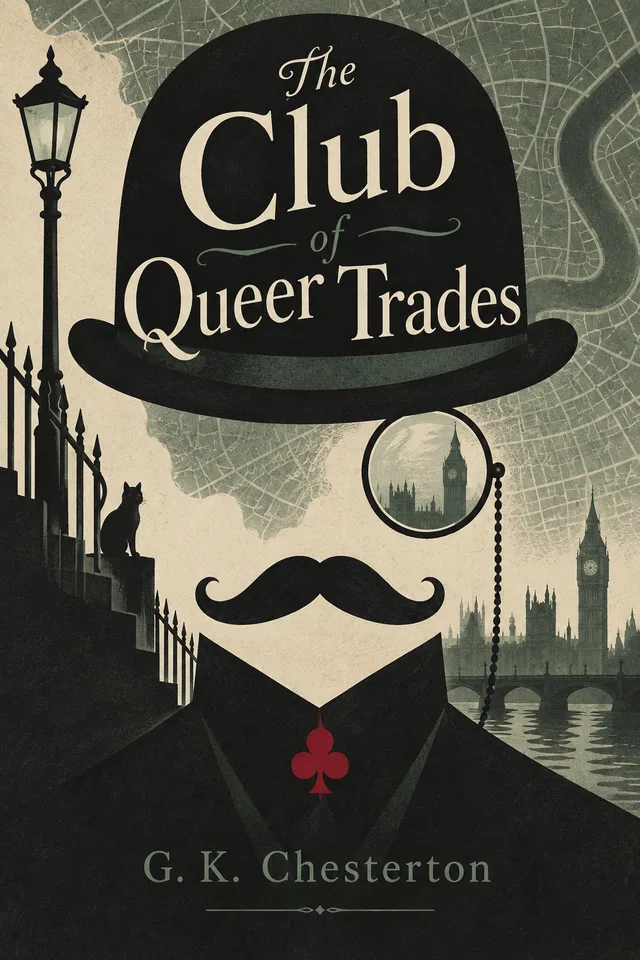
The Club of Queer Trades
Edição BooksWhale em inglês por G. K. Chesterton
Playful mysteries built around strange professions, ingenious schemes, and London eccentricity.
- Prévia
- Amostra do texto preparado
- Formatos
- Leitor online, EPUB, PDF
- Acesso
- Claim da Biblioteca
Introdução do livro
The Club of Queer Trades
Chesterton turns unusual occupations and social absurdity into detective puzzles that mix comedy, moral surprise, and philosophical wit.
Edição BooksWhale
Como esta edição foi preparada
Esta edição se baseia em um texto em domínio público e foi preparada pela BooksWhale para leitura digital.
Base de domínio público
Por que pode ser compartilhada
The source text is public domain; G. K. Chesterton died in 1936 and the work dates from 1905.
Ler prévia
Amostra do texto preparado
Prévia selecionada do texto preparado.
Capítulo de préviaFull textLer prévia
The Club of Queer Trades
G. K. Chesterton
Capítulo de préviaby G. K. ChestertonPrévia
by G. K. Chesterton
Capítulo de préviaChapter 1. The Tremendous Adventures of Major BrownPrévia
Rabelais, or his wild illustrator Gustave Dore, must have had something to do with the designing of the things called flats in England and America. There is something entirely Gargantuan in the idea of economising space by piling houses on top of each other, front doors and all. And in the chaos and complexity of those perpendicular streets anything may dwell or happen, and it is in one of them, I believe, that the inquirer may find the offices of the Club of Queer Trades. It may be thought at the first glance that the name would attract and startle the passer-by, but nothing attracts or startles in these dim immense hives. The passer-by is only looking for his own melancholy destination, the Montenegro Shipping Agency or the London office of the Rutland Sentinel, and passes through the twilight passages as one passes through the twilight corridors of a dream. If the Thugs set up a Strangers' Assassination Company in one of the great buildings in Norfolk Street, and sent in a mild man in spectacles to answer inquiries, no inquiries would be made. And the Club of Queer Trades reigns in a great edifice hidden like a fossil in a mighty cliff of fossils.
The nature of this society, such as we afterwards discovered it to be, is soon and simply told. It is an eccentric and Bohemian Club, of which the absolute condition of membership lies in this, that the candidate must have invented the method by which he earns his living. It must be an entirely new trade. The exact definition of this requirement is given in the two principal rules. First, it must not be a mere application or variation of an existing trade. Thus, for instance, the Club would not admit an insurance agent simply because instead of insuring men's furniture against being burnt in a fire, he insured, let us say, their trousers against being torn by a mad dog. The principle (as Sir Bradcock Burnaby-Bradcock, in the extraordinarily eloquent and soaring speech to the club on the occasion of the question being raised in the Stormby Smith affair, said wittily and keenly) is the same. Secondly, the trade must be a genuine commercial source of income, the support of its inventor. Thus the Club would not receive a man simply because he chose to pass his days collecting broken sardine tins, unless he could drive a roaring trade in them. Professor Chick made that quite clear. And when one remembers what Professor Chick's own new trade was, one doesn't know whether to laugh or cry.
The discovery of this strange society was a curiously refreshing thing; to realize that there were ten new trades in the world was like looking at the first ship or the first plough. It made a man feel what he should feel, that he was still in the childhood of the world. That I should have come at last upon so singular a body was, I may say without vanity, not altogether singular, for I have a mania for belonging to as many societies as possible: I may be said to collect clubs, and I have accumulated a vast and fantastic variety of specimens ever since, in my audacious youth, I collected the Athenaeum. At some future day, perhaps, I may tell tales of some of the other bodies to which I have belonged. I will recount the doings of the Dead Man's Shoes Society (that superficially immoral, but darkly justifiable communion); I will explain the curious origin of the Cat and Christian, the name of which has been so shamefully misinterpreted; and the world shall know at last why the Institute of Typewriters coalesced with the Red Tulip League. Of the Ten Teacups, of course I dare not say a word. The first of my revelations, at any rate, shall be concerned with the Club of Queer Trades, which, as I have said, was one of this class, one which I was almost bound to come across sooner or later, because of my singular hobby. The wild youth of the metropolis call me facetiously 'The King of Clubs'. They also call me 'The Cherub', in allusion to the roseate and youthful appearance I have presented in my declining years. I only hope the spirits in the better world have as good dinners as I have. But the finding of the Club of Queer Trades has one very curious thing about it. The most curious thing about it is that it was not discovered by me; it was discovered by my friend Basil Grant, a star-gazer, a mystic, and a man who scarcely stirred out of his attic.
Sumário
Nesta edição
- 01Full text
- 02by G. K. Chesterton
- 03Chapter 1. The Tremendous Adventures of Major Brown
- 04Chapter 2. The Painful Fall of a Great Reputation
- 05Chapter 3. The Awful Reason of the Vicar's Visit
- 06Chapter 4. The Singular Speculation of the House-Agent
- 07Chapter 5. The Noticeable Conduct of Professor Chadd
- 08Chapter 6. The Eccentric Seclusion of the Old Lady
Disponibilidade de idiomas
Outros idiomas
Outras edições de idioma ainda não foram publicadas. Elas aparecerão aqui quando disponíveis.
Solicitar outro idioma