inglês Edição
Literatura
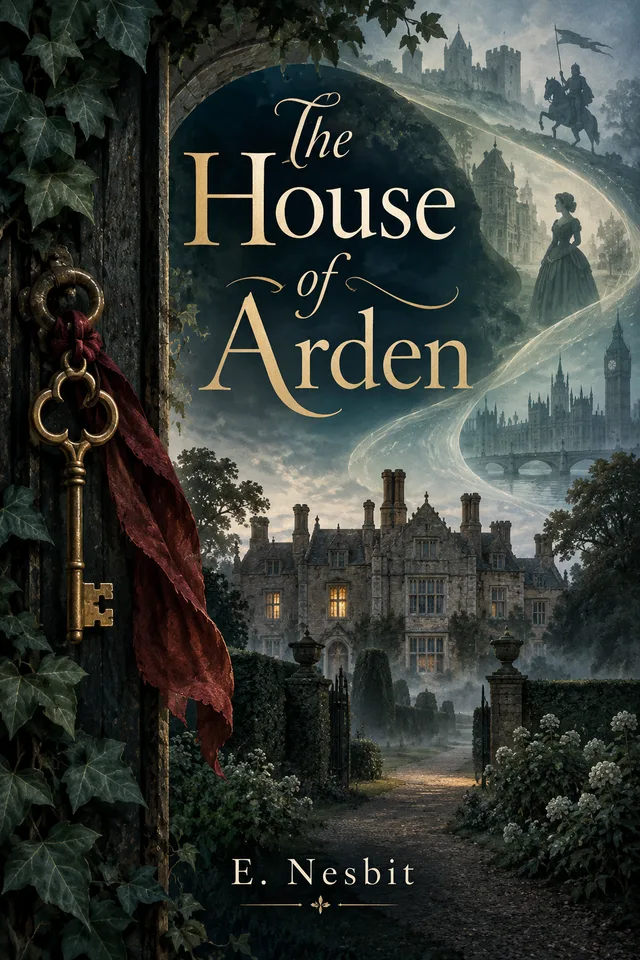
The House of Arden
Edição BooksWhale em inglês por E. Nesbit
A young heir travels through England’s past to recover a family fortune.
- Prévia
- Amostra do texto preparado
- Formatos
- Leitor online, EPUB, PDF
- Acesso
- Claim da Biblioteca
Introdução do livro
The House of Arden
Edred and Elfrida Arden discover that their inheritance is tied to a mysterious family history. Their journeys across different periods of English history mix magic, adventure, Tudor intrigue, and Nesbit’s characteristic humor.
Edição BooksWhale
Como esta edição foi preparada
Esta edição se baseia em um texto em domínio público e foi preparada pela BooksWhale para leitura digital.
Base de domínio público
Por que pode ser compartilhada
E. Nesbit died in 1924; the source work was first published in 1908. The source text is public domain under applicable life-plus-term and publication-date rules.
Ler prévia
Amostra do texto preparado
Prévia selecionada do texto preparado.
Capítulo de préviaFull textLer prévia
The House of Arden
E. Nesbit
Capítulo de préviaCHAPTER I ARDEN’S LORDPrévia
It had been a great house once, with farms and fields, money and jewels—with tenants and squires and men-at-arms. The head of the house had ridden out three days’ journey to meet King Henry at the boundary of his estate, and the King had ridden back with him to lie in the tall State bed in the castle guest-chamber. The heir of the house had led his following against Cromwell; younger sons of the house had fought in foreign lands, to the honour of England and the gilding and regilding with the perishable gold of glory of the old Arden name. There had been Ardens in Saxon times, and there were Ardens still—but few and impoverished. The lands were gone, and the squires and men-at-arms; the castle itself was roofless, and its unglazed windows stared blankly across the fields of strangers, that stretched right up to the foot of its grey, weather-worn walls. And of the male Ardens there were now known two only—an old man and a child.
The old man was Lord Arden, the head of the house, and he lived lonely in a little house built of the fallen stones that Time and Cromwell’s round-shot had cast from the castle walls. The child was Edred Arden, and he lived in a house in a clean, wind-swept town on a cliff.
It was a bright-faced house with bow-windows and a green balcony that looked out over the sparkling sea. It had three neat white steps and a brass knocker, pale and smooth with constant rubbing. It was a pretty house, and it would have been a pleasant house but for one thing—the lodgers. For I cannot conceal from you any longer that Edred Arden lived with his aunt, and that his aunt let lodgings. Letting lodgings is one of the most unpleasant of all possible ways of earning your living, and I advise you to try every other honest way of earning your living before you take to that.
Because people who go to the seaside and take lodgings seem, somehow, much harder to please than the people who go to hotels. They want ever so much more waiting on; they want so many meals, and at such odd times. They ring the bell almost all day long. They bring in sand from the shore in every fold of their clothes, and it shakes out of them on to the carpets and the sofa cushions, and everything in the house. They hang long streamers of wet seaweed against the pretty roses of the new wall-papers, and their washhand basins are always full of sea anemones and shells. Also, they are noisy; their boots seem to be always on the stairs, no matter how bad a headache you may have; and when you give them their bill they always think it is too much, no matter how little it may be. So do not let lodgings if you can help it.
Miss Arden could not help it. It happened like this.
Edred and his sister were at school. (Did I tell you that he had a sister? Well, he had, and her name was Elfrida.) Miss Arden lived near the school, so that she could see the children often. She was getting her clothes ready for her wedding, and the gentleman who was going to marry her was coming home from South America, where he had made a fortune. The children’s father was coming home from South America, too, with the fortune that he had made, for he and Miss Arden’s sweetheart were partners. The children and their aunt talked whenever they met of the glorious time that was coming, and how, when father and Uncle Jim—they called him Uncle Jim already—came home, they were all going to live in the country and be happy ever after.
And then the news came that father and Uncle Jim had been captured by brigands, and all the money was lost, too, and there was nothing left but the house on the cliff. So Miss Arden took the children from the expensive school in London, and they all went to live in the cliff house, and as there was no money to live on, and no other way of making money to live on except letting lodgings, Miss Arden let them, like the brave lady she was, and did it well. And then came the news that father and Uncle Jim were dead, and for a time the light of life went out in Cliff House.
Capítulo de préviaCHAPTER II THE MOULDIWARPPrévia
And it was—it was the living image of the little pig-like animal that was stamped in gold above the chequered shield on the cover of the white book in which they had found the spell. And as on the yellowy white of the vellum book-cover, so here on the thymy grass of the knoll it shone golden. The children stood perfectly still. They were afraid to move lest they should scare away this little creature which, though golden, was alive and moved about at their feet, turning a restless nose to right and left.
“It is,” said Elfrida again, very softly, so as not to frighten it.
“What?” Edred asked, though he knew well enough.
“Off the book that we got the spell out of.”
“That was our crest on the top of our coat-of-arms, like on the old snuff-box that was great-grandpapa’s.”
“Well, this is our crest come alive, that’s all.”
“Don’t you be too clever,” said Edred. “It said badge; I don’t believe badge is the same thing as crest. A badge is leeks, or roses, or thistles—something you can wear in your cap. I shouldn’t like to wear that in my cap.”
And still the golden thing at their feet moved cautiously and without ceasing.
“Why,” said Edred suddenly, “it’s just a common old mole.”
“It isn’t; it’s our own crest, that’s on the spoons and things. It’s our own old family mole that’s our crest. How can it be a common mole? It’s all golden.”
And, even as she spoke, it left off being golden. For the last bit of sun dipped behind the shoulder of the downs, and in the grey twilight that was left the mole was white—any one could see that.
“Oh!” said Elfrida—but she stuck to her point. “So you see,” she went on, “it can’t be just a really-mole. Really-moles are black.”
“Well,” said Edred, “it’s very tame. I will say that.”
“Well——” Edred was beginning; but at that same moment the mole also, suddenly and astonishingly, said, “Well?”
There was a hushed pause. Then——
“Did you say that?” Elfrida whispered.
“No,” said Edred, “you did.”
“Don’t whisper, now,” said the mole; “’tain’t purty manners, so I tells ’ee.”
With one accord the two children came to their knees, one on each side of the white mole.
“I say!” said Edred.
“Now, don’t,” said the mole, pointing its nose at him quite as disdainfully as any human being could have pointed a finger. “Don’t you go for to pretend you don’t know as Mouldiwarps ’as got tongues in dere heads same’s what you’ve got.”
“But not to talk with?” said Elfrida softly.
“Don’t you tell me,” said the Mouldiwarp, bristling a little. “Hasn’t no one told you e’er a fairy tale? All us beastes has tongues, and when we’re dere us uses of en.”
“When you’re where?” said Edred, rather annoyed at being forced to believe in fairy tales, which he had never really liked.
“Why, in a fairy tale for sure,” said the mole. “Wherever to goodness else on earth do you suppose you be?”
“We’re here,” said Edred, kicking the ground to make it feel more solid and himself more sure of things, “on Arden Knoll.”
“An’ ain’t that in a fairy tale?” demanded the Mouldiwarp triumphantly. “You do talk so free. You called me, and here I be. What d’you want?”
“Are you,” said Elfrida, thrilling with surprise and fear, and pleasure and hope, and wonder, and a few other things which, taken in the lump, are usually called “a thousand conflicting emotions,”—“are you the ‘badge of Arden’s house’?”
“Course I be,” said the mole,—“what’s left of it; and never did I think to be called one by the Arden boy and gell as didn’t know their own silly minds. What do you want, eh?”
Sumário
Nesta edição
- 01Full text
- 02CHAPTER I ARDEN’S LORD
- 03CHAPTER II THE MOULDIWARP
- 04CHAPTER III IN BONEY’S TIMES
- 05CHAPTER IV THE LANDING OF THE FRENCH
- 06CHAPTER V THE HIGHWAYMAN AND THE ——
- 07CHAPTER VI THE SECRET PANEL
- 08CHAPTER VII THE KEY OF THE PARLOUR
- 09CHAPTER VIII GUY FAWKES
- 10CHAPTER IX THE PRISONERS IN THE TOWER
- 11CHAPTER X WHITE WINGS AND A BROWNIE
- 12CHAPTER XI DEVELOPMENTS
- 13CHAPTER XII FILMS AND CLOUDS
- 14CHAPTER XIII MAY-BLOSSOM AND PEARLS
- 15CHAPTER XIV THE FINDING OF THE TREASURE
Disponibilidade de idiomas
Outros idiomas
Outras edições de idioma ainda não foram publicadas. Elas aparecerão aqui quando disponíveis.
Solicitar outro idioma