inglês Edição
Literatura
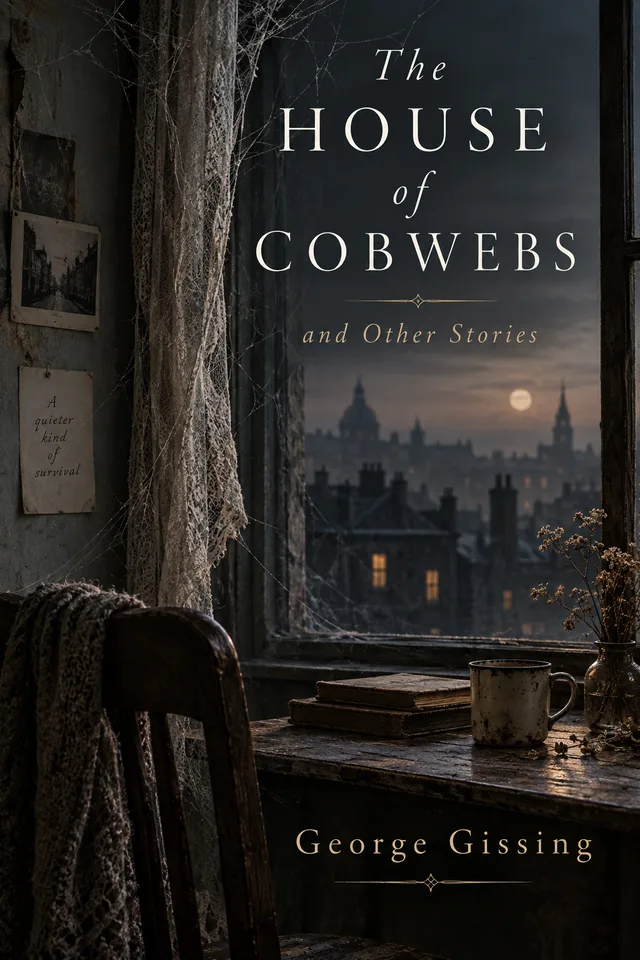
The House of Cobwebs and Other Stories
Edição BooksWhale em inglês por George Gissing
Quietly devastating stories of poverty, failed ambition, loneliness, and the fragile dignity of ordinary lives.
- Prévia
- Amostra do texto preparado
- Formatos
- Leitor online, EPUB, PDF
- Acesso
- Claim da Biblioteca
Introdução do livro
The House of Cobwebs and Other Stories
George Gissing’s late stories move through boarding houses, struggling artists, worn-out families, and disappointed intellectuals, observing social hardship with sympathy rather than melodrama.
Edição BooksWhale
Como esta edição foi preparada
Esta edição se baseia em um texto em domínio público e foi preparada pela BooksWhale para leitura digital.
Base de domínio público
Por que pode ser compartilhada
The original work is public domain under applicable copyright-term rules; the source text belongs to the public domain in the relevant publication and author-term jurisdictions.
Ler prévia
Amostra do texto preparado
Prévia selecionada do texto preparado.
Capítulo de préviaFull textLer prévia
The House of Cobwebs and Other Stories
Capítulo de préviaAND OTHER STORIESPrévia
TO WHICH IS PREFIXED THE WORK OF GEORGE GISSING AN INTRODUCTORY SURVEY BY THOMAS SECCOMBE
Capítulo de préviaTHE WORK OF GEORGE GISSINGPrévia
'Les gens tout à fait heureux, forts et bien portants, sont-ils préparés comme il faut pour comprendre, pénétrer, exprimer la vie, notre vie si tourmentée et si courte?'
In England during the sixties and seventies of last century the world of books was dominated by one Gargantuan type of fiction. The terms book and novel became almost synonymous in houses which were not Puritan, yet where books and reading, in the era of few and unfree libraries, were strictly circumscribed. George Gissing was no exception to this rule. The English novel was at the summit of its reputation during his boyish days. As a lad of eight or nine he remembered the parts of Our Mutual Friend coming to the house, and could recall the smile of welcome with which they were infallibly received. In the dining-room at home was a handsomely framed picture which he regarded with an almost idolatrous veneration. It was an engraved portrait of Charles Dickens. Some of the best work of George Eliot, Reade, and Trollope was yet to make its appearance; Meredith and Hardy were still the treasured possession of the few; the reigning models during the period of Gissing's adolescence were probably Dickens and Trollope, and the numerous satellites of these great stars, prominent among them Wilkie Collins, William Black, and Besant and Rice.
Of the cluster of novelists who emerged from this school of ideas, the two who will attract most attention in the future were clouded and obscured for the greater period of their working lives. Unobserved, they received, and made their own preparations for utilising, the legacy of the mid-Victorian novel—moral thesis, plot, underplot, set characters, descriptive machinery, landscape colouring, copious phraseology, Herculean proportions, and the rest of the cumbrous and grandiose paraphernalia of Chuzzlewit, Pendennis , and Middlemarch . But they received the legacy in a totally different spirit. Mark Rutherford, after a very brief experiment, put all these elaborate properties and conventions reverently aside. Cleverer and more docile, George Gissing for the most part accepted them; he put his slender frame into the ponderous collar of the author of the Mill on the Floss , and nearly collapsed in wind and limb in the heart-breaking attempt to adjust himself to such an heroic type of harness.
The distinctive qualities of Gissing at the time of his setting forth were a scholarly style, rather fastidious and academic in its restraint, and the personal discontent, slightly morbid, of a self-conscious student who finds himself in the position of a sensitive woman in a crowd. His attitude through life was that of a man who, having set out on his career with the understanding that a second-class ticket is to be provided, allows himself to be unceremoniously hustled into the rough and tumble of a noisy third. Circumstances made him revolt against an anonymous start in life for a refined and educated man under such conditions. They also made him prolific. He shrank from the restraints and humiliations to which the poor and shabbily dressed private tutor is exposed—revealed to us with a persuasive terseness in the pages of The Unclassed, New Grub Street, Ryecroft , and the story of Topham's Chance. Writing fiction in a garret for a sum sufficient to keep body and soul together for the six months following payment was at any rate better than this. The result was a long series of highly finished novels, written in a style and from a point of view which will always render them dear to the studious and the book-centred. Upon the larger external rings of the book-reading multitude it is not probable that Gissing will ever succeed in impressing himself. There is an absence of transcendental quality about his work, a failure in humour, a remoteness from actual life, a deficiency in awe and mystery, a shortcoming in emotional power, finally, a lack of the dramatic faculty, not indeed indispensable to a novelist, but almost indispensable as an ingredient in great novels of this particular genre. In temperament and vitality he is palpably inferior to the masters (Dickens, Thackeray, Hugo, Balzac) whom he reverenced with such a cordial admiration and envy. A 'low vitality' may account for what has been referred to as the 'nervous exhaustion' of his style. It were useless to pretend that Gissing belongs of right to the 'first series' of English Men of Letters. But if debarred by his limitations from a resounding or popular success, he will remain exceptionally dear to the heart of the recluse, who thinks that the scholar does well to cherish a grievance against the vulgar world beyond the cloister; and dearer still, perhaps, to a certain number of enthusiasts who began reading George Gissing as a college night-course; who closed Thyrza and Demos as dawn was breaking through the elms in some Oxford quadrangle, and who have pursued his work patiently ever since in a somewhat toilsome and broken ascent, secure always of suave writing and conscientious workmanship, of an individual prose cadence and a genuine vein of Penseroso:—
Sumário
Nesta edição
- 01Full text
- 02AND OTHER STORIES
- 03THE WORK OF GEORGE GISSING
- 04A CHRONOLOGICAL RECORD
- 05THE HOUSE OF COBWEBS
- 06A CAPITALIST
- 07I stooped, but was unable to give him the information he desired.
- 08I named the village, two miles away.
- 09I mused and wondered.
- 10I smiled.
- 11I made no answer, and, after looking at me for a moment, Ireton resumed:
- 12I observed his face, and saw that even now he suffered from the recollection.
- 13CHRISTOPHERSON
- 14I was growing curious and interested. Venturing no more direct questions, I asked whether, at the time he spoke of, he lived in London.
- 15HUMPLEBEE
- 16THE SCRUPULOUS FATHER
- 17A POOR GENTLEMAN
- 18MISS RODNEY'S LEISURE
- 19A DAUGHTER OF THE LODGE
- 20THE RIDING-WHIP
- 21FATE AND THE APOTHECARY
- 22TOPHAM'S CHANCE
- 23CHAPTER I
- 24CHAPTER II
- 25CHAPTER III
- 26CHAPTER IV
- 27A LODGER IN MAZE POND
- 28THE SALT OF THE EARTH
- 29THE PIG AND WHISTLE
Disponibilidade de idiomas
Outros idiomas
Outras edições de idioma ainda não foram publicadas. Elas aparecerão aqui quando disponíveis.
Solicitar outro idioma