inglês Edição
Literatura
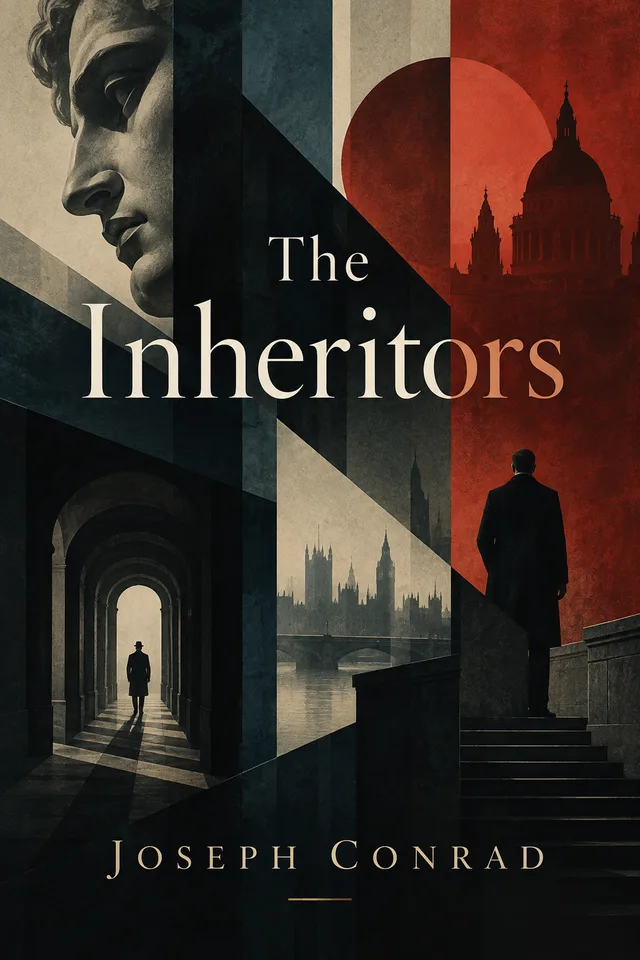
The Inheritors
Edição BooksWhale em inglês por Joseph Conrad
A satirical, unsettling novel about idealism confronting modern politics, money, and the machinery of power.
- Prévia
- Amostra do texto preparado
- Formatos
- Leitor online, EPUB, PDF
- Acesso
- Claim da Biblioteca
Introdução do livro
The Inheritors
A chance encounter with a mysterious political figure draws the idealistic journalist Charles Gould into a world where noble intentions become entangled with influence and manipulation. Conrad’s strange, compressed narrative probes how civilization can disguise predatory impulses.
Edição BooksWhale
Como esta edição foi preparada
Esta edição se baseia em um texto em domínio público e foi preparada pela BooksWhale para leitura digital.
Base de domínio público
Por que pode ser compartilhada
The author died more than seventy years ago and the work was first published before 1931; the original text is treated as public domain for this catalog.
Ler prévia
Amostra do texto preparado
Prévia selecionada do texto preparado.
Capítulo de préviaFull textLer prévia
The Inheritors
Capítulo de préviaCHAPTER ONEPrévia
“Ideas,” she said. “Oh, as for ideas—”
“Well?” I hazarded, “as for ideas—?”
We went through the old gateway and I cast a glance over my shoulder. The noon sun was shining over the masonry, over the little saints’ effigies, over the little fretted canopies, the grime and the white streaks of bird-dropping.
“There,” I said, pointing toward it, “doesn’t that suggest something to you?”
She made a motion with her head—half negative, half contemptuous.
“But,” I stuttered, “the associations—the ideas—the historical ideas—”
She said nothing.
“You Americans,” I began, but her smile stopped me. It was as if she were amused at the utterances of an old lady shocked by the habits of the daughters of the day. It was the smile of a person who is confident of superseding one fatally.
In conversations of any length one of the parties assumes the superiority—superiority of rank, intellectual or social. In this conversation she, if she did not attain to tacitly acknowledged temperamental superiority, seemed at least to claim it, to have no doubt as to its ultimate according. I was unused to this. I was a talker, proud of my conversational powers.
I had looked at her before; now I cast a sideways, critical glance at her. I came out of my moodiness to wonder what type this was. She had good hair, good eyes, and some charm. Yes. And something besides—a something—a something that was not an attribute of her beauty. The modelling of her face was so perfect and so delicate as to produce an effect of transparency, yet there was no suggestion of frailness; her glance had an extraordinary strength of life. Her hair was fair and gleaming, her cheeks coloured as if a warm light had fallen on them from somewhere. She was familiar till it occurred to you that she was strange.
“Which way are you going?” she asked.
“I am going to walk to Dover,” I answered.
“And I may come with you?”
I looked at her—intent on divining her in that one glance. It was of course impossible. “There will be time for analysis,” I thought.
“The roads are free to all,” I said. “You are not an American?”
She shook her head. No. She was not an Australian either, she came from none of the British colonies.
“You are not English,” I affirmed. “You speak too well.” I was piqued. She did not answer. She smiled again and I grew angry. In the cathedral she had smiled at the verger’s commendation of particularly abominable restorations, and that smile had drawn me toward her, had emboldened me to offer deferential and condemnatory remarks as to the plaster-of-Paris mouldings. You know how one addresses a young lady who is obviously capable of taking care of herself. That was how I had come across her. She had smiled at the gabble of the cathedral guide as he showed the obsessed troop, of which we had formed units, the place of martyrdom of Blessed Thomas, and her smile had had just that quality of superseder’s contempt. It had pleased me then; but, now that she smiled thus past me—it was not quite at me—in the crooked highways of the town, I was irritated. After all, I was somebody; I was not a cathedral verger. I had a fancy for myself in those days—a fancy that solitude and brooding had crystallised into a habit of mind. I was a writer with high—with the highest—ideals. I had withdrawn myself from the world, lived isolated, hidden in the countryside, lived as hermits do, on the hope of one day doing something—of putting greatness on paper. She suddenly fathomed my thoughts: “You write,” she affirmed. I asked how she knew, wondered what she had read of mine—there was so little.
“Are you a popular author?” she asked.
Capítulo de préviaCHAPTER TWOPrévia
Her figure faded into the darkness, as pale things waver down into deep water, and as soon as she disappeared my sense of humour returned. The episode appeared more clearly, as a flirtation with an enigmatic, but decidedly charming, chance travelling companion. The girl was a riddle, and a riddle once guessed is a very trivial thing. She, too, would be a very trivial thing when I had found a solution. It occurred to me that she wished me to regard her as a symbol, perhaps, of the future—as a type of those who are to inherit the earth, in fact. She had been playing the fool with me, in her insolent modernity. She had wished me to understand that I was old-fashioned; that the frame of mind of which I and my fellows were the inheritors was over and done with. We were to be compulsorily retired; to stand aside superannuated. It was obvious that she was better equipped for the swiftness of life. She had a something—not only quickness of wit, not only ruthless determination, but a something quite different and quite indefinably more impressive. Perhaps it was only the confidence of the superseder, the essential quality that makes for the empire of the Occidental. But I was not a negro—not even relatively a Hindoo. I was somebody, confound it, I was somebody.
As an author, I had been so uniformly unsuccessful, so absolutely unrecognised, that I had got into the way of regarding myself as ahead of my time, as a worker for posterity. It was a habit of mind—the only revenge that I could take upon despiteful Fate. This girl came to confound me with the common herd—she declared herself to be that very posterity for which I worked.
She was probably a member of some clique that called themselves Fourth Dimensionists—just as there had been pre-Raphaelites. It was a matter of cant allegory. I began to wonder how it was that I had never heard of them. And how on earth had they come to hear of me!
“She must have read something of mine,” I found myself musing: “the Jenkins story perhaps. It must have been the Jenkins story; they gave it a good place in their rotten magazine. She must have seen that it was the real thing, and....” When one is an author one looks at things in that way, you know.
By that time I was ready to knock at the door of the great Callan. I seemed to be jerked into the commonplace medium of a great, great—oh, an infinitely great—novelist’s home life. I was led into a well-lit drawing-room, welcomed by the great man’s wife, gently propelled into a bedroom, made myself tidy, descended and was introduced into the sanctum, before my eyes had grown accustomed to the lamp-light. Callan was seated upon his sofa surrounded by an admiring crowd of very local personages. I forget what they looked like. I think there was a man whose reddish beard did not become him and another whose face might have been improved by the addition of a reddish beard; there was also an extremely moody dark man and I vaguely recollect a person who lisped.
They did not talk much; indeed there was very little conversation. What there was Callan supplied. He—spoke—very—slowly—and—very —authoritatively, like a great actor whose aim is to hold the stage as long as possible. The raising of his heavy eyelids at the opening door conveyed the impression of a dark, mental weariness; and seemed somehow to give additional length to his white nose. His short, brown beard was getting very grey, I thought. With his lofty forehead and with his superior, yet propitiatory smile, I was of course familiar. Indeed one saw them on posters in the street. The notables did not want to talk. They wanted to be spell-bound—and they were. Callan sat there in an appropriate attitude—the one in which he was always photographed. One hand supported his head, the other toyed with his watch-chain. His face was uniformly solemn, but his eyes were disconcertingly furtive. He cross-questioned me as to my walk from Canterbury; remarked that the cathedral was a—magnificent—Gothic—Monument and set me right as to the lie of the roads. He seemed pleased to find that I remembered very little of what I ought to have noticed on the way. It gave him an opportunity for the display of his local erudition.
Sumário
Nesta edição
- 01Full text
- 02CHAPTER ONE
- 03CHAPTER TWO
- 04CHAPTER THREE
- 05CHAPTER FOUR
- 06CHAPTER FIVE
- 07CHAPTER SIX
- 08CHAPTER SEVEN
- 09CHAPTER EIGHT
- 10CHAPTER NINE
- 11CHAPTER TEN
- 12CHAPTER ELEVEN
- 13CHAPTER TWELVE
- 14CHAPTER THIRTEEN
- 15CHAPTER FOURTEEN
- 16CHAPTER FIFTEEN
- 17CHAPTER SIXTEEN
- 18CHAPTER SEVENTEEN
- 19CHAPTER EIGHTEEN
- 20CHAPTER NINETEEN
Disponibilidade de idiomas
Outros idiomas
Outras edições de idioma ainda não foram publicadas. Elas aparecerão aqui quando disponíveis.
Solicitar outro idioma