inglês Edição
Literatura
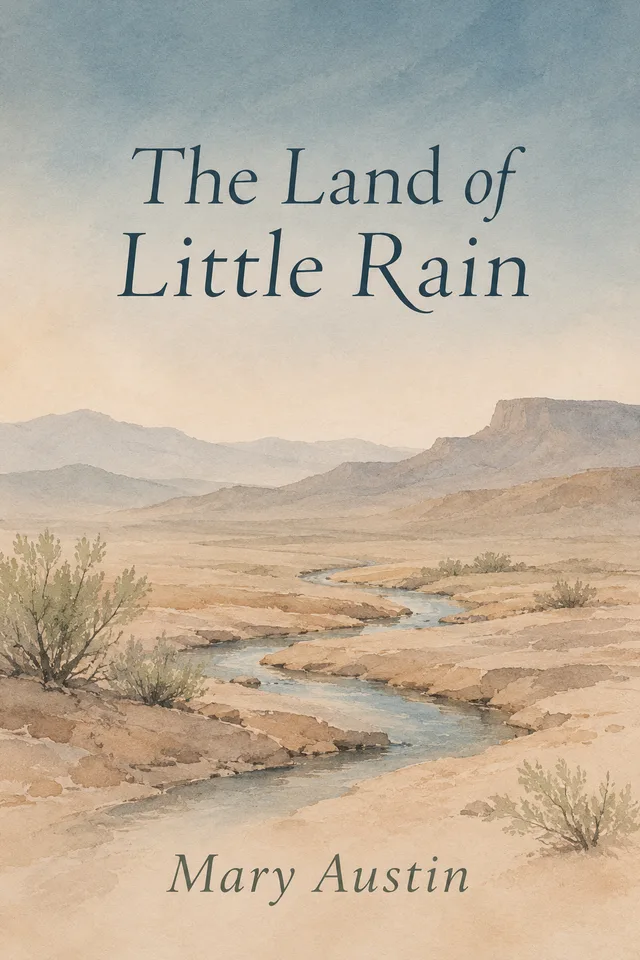
The Land of Little Rain
Edição BooksWhale em inglês por Mary Austin
Mary Austin follows water, wildlife, and human settlement through the dry country east of the Sierra Nevada.
- Prévia
- Amostra do texto preparado
- Formatos
- Leitor online, EPUB, PDF
- Acesso
- Claim da Biblioteca
Introdução do livro
The Land of Little Rain
These fourteen essays follow desert water trails, carrion birds, mountain streams, and the lives of people who know how to live in arid country. Austin moves between the desert, the mining town of Jimville, and the grape-growing village of Las Uvas. Her close observations connect the habits of plants and animals with the demands the land makes on people.
Edição BooksWhale
Como esta edição foi preparada
Esta edição se baseia em um texto em domínio público e foi preparada pela BooksWhale para leitura digital.
Base de domínio público
Por que pode ser compartilhada
Mary Austin died in 1934. The original English text was published in 1903.
Ler prévia
Amostra do texto preparado
Prévia selecionada do texto preparado.
Capítulo de préviaFull textLer prévia
The Land of Little Rain
TO EVE, "THE COMFORTRESS OF UNSUCCESS"
Capítulo de préviaPREFACEPrévia
I confess to a great liking for the Indian fashion of name-giving: every man known by that phrase which best expresses him to whoso names him. Thus he may be Mighty-Hunter, or Man-Afraid-of-a-Bear, according as he is called by friend or enemy, and Scar-Face to those who knew him by the eye's grasp only. No other fashion, I think, sets so well with the various natures that inhabit in us, and if you agree with me you will understand why so few names are written here as they appear in the geography. For if I love a lake known by the name of the man who discovered it, which endears itself by reason of the close-locked pines it nourishes about its borders, you may look in my account to find it so described. But if the Indians have been there before me, you shall have their name, which is always beautifully fit and does not originate in the poor human desire for perpetuity.
Nevertheless there are certain peaks, cañons, and clear meadow spaces which are above all compassing of words, and have a certain fame as of the nobly great to whom we give no familiar names. Guided by these you may reach my country and find or not find, according as it lieth in you, much that is set down here. And more. The earth is no wanton to give up all her best to every comer, but keeps a sweet, separate intimacy for each. But if you do not find it all as I write, think me not less dependable nor yourself less clever. There is a sort of pretense allowed in matters of the heart, as one should say by way of illustration, "I know a man who…," and so give up his dearest experience without betrayal. And I am in no mind to direct you to delectable places toward which you will hold yourself less tenderly than I. So by this fashion of naming I keep faith with the land and annex to my own estate a very great territory to which none has a surer title.
The country where you may have sight and touch of that which is written lies between the high Sierras south from Yosemite—east and south over a very great assemblage of broken ranges beyond Death Valley, and on illimitably into the Mojave Desert. You may come into the borders of it from the south by a stage journey that has the effect of involving a great lapse of time, or from the north by rail, dropping out of the overland route at Reno. The best of all ways is over the Sierra passes by pack and trail, seeing and believing. But the real heart and core of the country are not to be come at in a month's vacation. One must summer and winter with the land and wait its occasions. Pine woods that take two and three seasons to the ripening of cones, roots that lie by in the sand seven years awaiting a growing rain, firs that grow fifty years before flowering,—these do not scrape acquaintance. But if ever you come beyond the borders as far as the town that lies in a hill dimple at the foot of Kearsarge, never leave it until you have knocked at the door of the brown house under the willow-tree at the end of the village street, and there you shall have such news of the land, of its trails and what is astir in them, as one lover of it can give to another.
Capítulo de préviaThe Land of Little RainPrévia
East away from the Sierras, south from Panamint and Amargosa, east and south many an uncounted mile, is the Country of Lost Borders.
Ute, Paiute, Mojave, and Shoshone inhabit its frontiers, and as far into the heart of it as a man dare go. Not the law, but the land sets the limit. Desert is the name it wears upon the maps, but the Indian's is the better word. Desert is a loose term to indicate land that supports no man; whether the land can be bitted and broken to that purpose is not proven. Void of life it never is, however dry the air and villainous the soil.
This is the nature of that country. There are hills, rounded, blunt, burned, squeezed up out of chaos, chrome and vermilion painted, aspiring to the snow-line. Between the hills lie high level-looking plains full of intolerable sun glare, or narrow valleys drowned in a blue haze. The hill surface is streaked with ash drift and black, unweathered lava flows. After rains water accumulates in the hollows of small closed valleys, and, evaporating, leaves hard dry levels of pure desertness that get the local name of dry lakes. Where the mountains are steep and the rains heavy, the pool is never quite dry, but dark and bitter, rimmed about with the efflorescence of alkaline deposits. A thin crust of it lies along the marsh over the vegetating area, which has neither beauty nor freshness. In the broad wastes open to the wind the sand drifts in hummocks about the stubby shrubs, and between them the soil shows saline traces. The sculpture of the hills here is more wind than water work, though the quick storms do sometimes scar them past many a year's redeeming. In all the Western desert edges there are essays in miniature at the famed, terrible Grand Cañon, to which, if you keep on long enough in this country, you will come at last.
Since this is a hill country one expects to find springs, but not to depend upon them; for when found they are often brackish and unwholesome, or maddening, slow dribbles in a thirsty soil. Here you find the hot sink of Death Valley, or high rolling districts where the air has always a tang of frost. Here are the long heavy winds and breathless calms on the tilted mesas where dust devils dance, whirling up into a wide, pale sky. Here you have no rain when all the earth cries for it, or quick downpours called cloud-bursts for violence. A land of lost rivers, with little in it to love; yet a land that once visited must be come back to inevitably. If it were not so there would be little told of it.
This is the country of three seasons. From June on to November it lies hot, still, and unbearable, sick with violent unrelieving storms; then on until April, chill, quiescent, drinking its scant rain and scanter snows; from April to the hot season again, blossoming, radiant, and seductive. These months are only approximate; later or earlier the rain-laden wind may drift up the water gate of the Colorado from the Gulf, and the land sets its seasons by the rain.
The desert floras shame us with their cheerful adaptations to the seasonal limitations. Their whole duty is to flower and fruit, and they do it hardly, or with tropical luxuriance, as the rain admits. It is recorded in the report of the Death Valley expedition that after a year of abundant rains, on the Colorado desert was found a specimen of Amaranthus ten feet high. A year later the same species in the same place matured in the drought at four inches. One hopes the land may breed like qualities in her human offspring, not tritely to "try," but to do. Seldom does the desert herb attain the full stature of the type. Extreme aridity and extreme altitude have the same dwarfing effect, so that we find in the high Sierras and in Death Valley related species in miniature that reach a comely growth in mean temperatures. Very fertile are the desert plants in expedients to prevent evaporation, turning their foliage edgewise toward the sun, growing silky hairs, exuding viscid gum. The wind, which has a long sweep, harries and helps them. It rolls up dunes about the stocky stems, encompassing and protective, and above the dunes, which may be, as with the mesquite, three times as high as a man, the blossoming twigs flourish and bear fruit.
Sumário
Nesta edição
- 01Full text
- 02PREFACE
- 03The Land of Little Rain
- 04WATER TRAILS OF THE CERISO
- 05THE SCAVENGERS
- 06THE POCKET HUNTER
- 07SHOSHONE LAND
- 08JIMVILLE—A BRET HARTE TOWN
- 09MY NEIGHBOR'S FIELD
- 10THE MESA TRAIL
- 11THE BASKET MAKER
- 12THE STREETS OF THE MOUNTAINS
- 13WATER BORDERS
- 14OTHER WATER BORDERS
- 15NURSLINGS OF THE SKY
- 16THE LITTLE TOWN OF THE GRAPE VINES
Disponibilidade de idiomas
Outros idiomas
Outras edições de idioma ainda não foram publicadas. Elas aparecerão aqui quando disponíveis.
Solicitar outro idioma