inglês Edição
Literatura
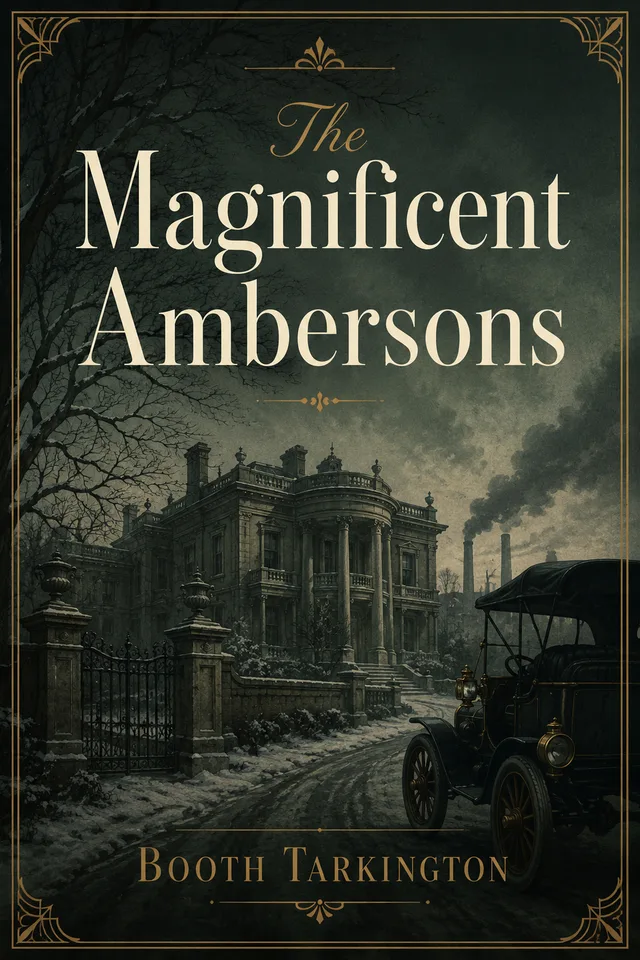
The Magnificent Ambersons
Edição BooksWhale em inglês por Booth Tarkington
A proud family declines as automobiles, industry, and modern manners remake America.
- Prévia
- Amostra do texto preparado
- Formatos
- Leitor online, EPUB, PDF
- Acesso
- Claim da Biblioteca
Introdução do livro
The Magnificent Ambersons
Booth Tarkington traces the Amberson family from provincial grandeur into social displacement, with George Amberson Minafer resisting the industrial world rising around him. The novel captures class pride, technological change, lost inheritance, and the emotional cost of modernization.
Edição BooksWhale
Como esta edição foi preparada
Esta edição se baseia em um texto em domínio público e foi preparada pela BooksWhale para leitura digital.
Base de domínio público
Por que pode ser compartilhada
Original English novel first published in 1918. Tarkington died in 1946, and the text is public domain through expired publication copyright and life-plus-70 terms.
Ler prévia
Amostra do texto preparado
Prévia selecionada do texto preparado.
Capítulo de préviaFull textLer prévia
The Magnificent Ambersons
Booth Tarkington
Capítulo de préviaChapter IPrévia
Major Amberson had “made a fortune” in 1873, when other people were losing fortunes, and the magnificence of the Ambersons began then. Magnificence, like the size of a fortune, is always comparative, as even Magnificent Lorenzo may now perceive, if he has happened to haunt New York in 1916; and the Ambersons were magnificent in their day and place. Their splendour lasted throughout all the years that saw their Midland town spread and darken into a city, but reached its topmost during the period when every prosperous family with children kept a Newfoundland dog.
In that town, in those days, all the women who wore silk or velvet knew all the other women who wore silk or velvet, and when there was a new purchase of sealskin, sick people were got to windows to see it go by. Trotters were out, in the winter afternoons, racing light sleighs on National Avenue and Tennessee Street; everybody recognized both the trotters and the drivers; and again knew them as well on summer evenings, when slim buggies whizzed by in renewals of the snow-time rivalry. For that matter, everybody knew everybody else’s family horse-and-carriage, could identify such a silhouette half a mile down the street, and thereby was sure who was going to market, or to a reception, or coming home from office or store to noon dinner or evening supper.
During the earlier years of this period, elegance of personal appearance was believed to rest more upon the texture of garments than upon their shaping. A silk dress needed no remodelling when it was a year or so old; it remained distinguished by merely remaining silk. Old men and governors wore broadcloth; “full dress” was broadcloth with “doeskin” trousers; and there were seen men of all ages to whom a hat meant only that rigid, tall silk thing known to impudence as a “stove-pipe.” In town and country these men would wear no other hat, and, without self-consciousness, they went rowing in such hats.
Shifting fashions of shape replaced aristocracy of texture: dressmakers, shoemakers, hatmakers, and tailors, increasing in cunning and in power, found means to make new clothes old. The long contagion of the “Derby” hat arrived: one season the crown of this hat would be a bucket; the next it would be a spoon. Every house still kept its bootjack, but high-topped boots gave way to shoes and “congress gaiters”; and these were played through fashions that shaped them now with toes like box-ends and now with toes like the prows of racing shells.
Trousers with a crease were considered plebeian; the crease proved that the garment had lain upon a shelf, and hence was “ready-made”; these betraying trousers were called “hand-me-downs,” in allusion to the shelf. In the early ’eighties, while bangs and bustles were having their way with women, that variation of dandy known as the “dude” was invented: he wore trousers as tight as stockings, dagger-pointed shoes, a spoon “Derby,” a single-breasted coat called a “Chesterfield,” with short flaring skirts, a torturing cylindrical collar, laundered to a polish and three inches high, while his other neckgear might be a heavy, puffed cravat or a tiny bow fit for a doll’s braids. With evening dress he wore a tan overcoat so short that his black coat-tails hung visible, five inches below the over-coat; but after a season or two he lengthened his overcoat till it touched his heels, and he passed out of his tight trousers into trousers like great bags. Then, presently, he was seen no more, though the word that had been coined for him remained in the vocabularies of the impertinent.
It was a hairier day than this. Beards were to the wearers’ fancy, and things as strange as the Kaiserliche boar-tusk moustache were commonplace. “Side-burns” found nourishment upon childlike profiles; great Dundreary whiskers blew like tippets over young shoulders; moustaches were trained as lambrequins over forgotten mouths; and it was possible for a Senator of the United States to wear a mist of white whisker upon his throat only, not a newspaper in the land finding the ornament distinguished enough to warrant a lampoon. Surely no more is needed to prove that so short a time ago we were living in another age!
Capítulo de préviaChapter IIPrévia
Another citizen said an eloquent thing about Miss Isabel Amberson’s looks. This was Mrs. Henry Franklin Foster, the foremost literary authority and intellectual leader of the community—-for both the daily newspapers thus described Mrs. Foster when she founded the Women’s Tennyson Club; and her word upon art, letters, and the drama was accepted more as law than as opinion. Naturally, when “Hazel Kirke” finally reached the town, after its long triumph in larger places, many people waited to hear what Mrs. Henry Franklin Foster thought of it before they felt warranted in expressing any estimate of the play. In fact, some of them waited in the lobby of the theatre, as they came out, and formed an inquiring group about her.
“I didn’t see the play,” she informed them.
“What! Why, we saw you, right in the middle of the fourth row!”
“Yes,” she said, smiling, “but I was sitting just behind Isabel Amberson. I couldn’t look at anything except her wavy brown hair and the wonderful back of her neck.”
The ineligible young men of the town (they were all ineligible) were unable to content themselves with the view that had so charmed Mrs. Henry Franklin Foster: they spent their time struggling to keep Miss Amberson’s face turned toward them. She turned it most often, observers said, toward two: one excelling in the general struggle by his sparkle, and the other by that winning if not winsome old trait, persistence. The sparkling gentleman “led germans” with her, and sent sonnets to her with his bouquets—sonnets lacking neither music nor wit. He was generous, poor, well-dressed, and his amazing persuasiveness was one reason why he was always in debt. No one doubted that he would be able to persuade Isabel, but he unfortunately joined too merry a party one night, and, during a moonlight serenade upon the lawn before the Amberson Mansion, was easily identified from the windows as the person who stepped through the bass viol and had to be assisted to a waiting carriage. One of Miss Amberson’s brothers was among the serenaders, and, when the party had dispersed, remained propped against the front door in a state of helpless liveliness; the Major going down in a dressing-gown and slippers to bring him in, and scolding mildly, while imperfectly concealing strong impulses to laughter. Miss Amberson also laughed at this brother, the next day, but for the suitor it was a different matter: she refused to see him when he called to apologize. “You seem to care a great deal about bass viols!” he wrote her. “I promise never to break another.” She made no response to the note, unless it was an answer, two weeks later, when her engagement was announced. She took the persistent one, Wilbur Minafer, no breaker of bass viols or of hearts, no serenader at all.
A few people, who always foresaw everything, claimed that they were not surprised, because though Wilbur Minafer “might not be an Apollo, as it were,” he was “a steady young business man, and a good church-goer,” and Isabel Amberson was “pretty sensible—for such a showy girl.” But the engagement astounded the young people, and most of their fathers and mothers, too; and as a topic it supplanted literature at the next meeting of the “Women’s Tennyson Club.”
“Wilbur _Minafer!_” a member cried, her inflection seeming to imply that Wilbur’s crime was explained by his surname. “Wilbur _Minafer!_ It’s the queerest thing I ever heard! To think of her taking Wilbur Minafer, just because a man _any_ woman would like a thousand times better was a little wild one night at a serenade!”
“No,” said Mrs. Henry Franklin Foster. “It isn’t that. It isn’t even because she’s afraid he’d be a dissipated husband and she wants to be safe. It isn’t because she’s religious or hates wildness; it isn’t even because she hates wildness in _him_.”
Sumário
Nesta edição
- 01Full text
- 02Chapter I
- 03Chapter II
- 04Chapter III
- 05Chapter IV
- 06Chapter V
- 07Chapter VI
- 08Chapter VII
- 09Chapter VIII
- 10Chapter IX
- 11Chapter X
- 12Chapter XI
- 13Chapter XII
- 14Chapter XIII
- 15Chapter XIV
- 16Chapter XV
- 17Chapter XVI
- 18Chapter XVII
- 19Chapter XVIII
- 20Chapter XIX
- 21Chapter XX
- 22Chapter XXI
- 23“I—”
- 24Chapter XXII
- 25Chapter XXIII
- 26Chapter XXIV
- 27Chapter XXV
- 28Chapter XXVI
- 29Chapter XXVII
- 30Chapter XXVIII
- 31Chapter XXIX
- 32Chapter XXX
- 33Chapter XXXI
- 34Chapter XXXII
- 35Chapter XXXIII
- 36Chapter XXXIV
- 37Chapter XXXV
- 38LEGS BROKEN
Disponibilidade de idiomas
Outros idiomas
Outras edições de idioma ainda não foram publicadas. Elas aparecerão aqui quando disponíveis.
Solicitar outro idioma