inglês Edição
Literatura
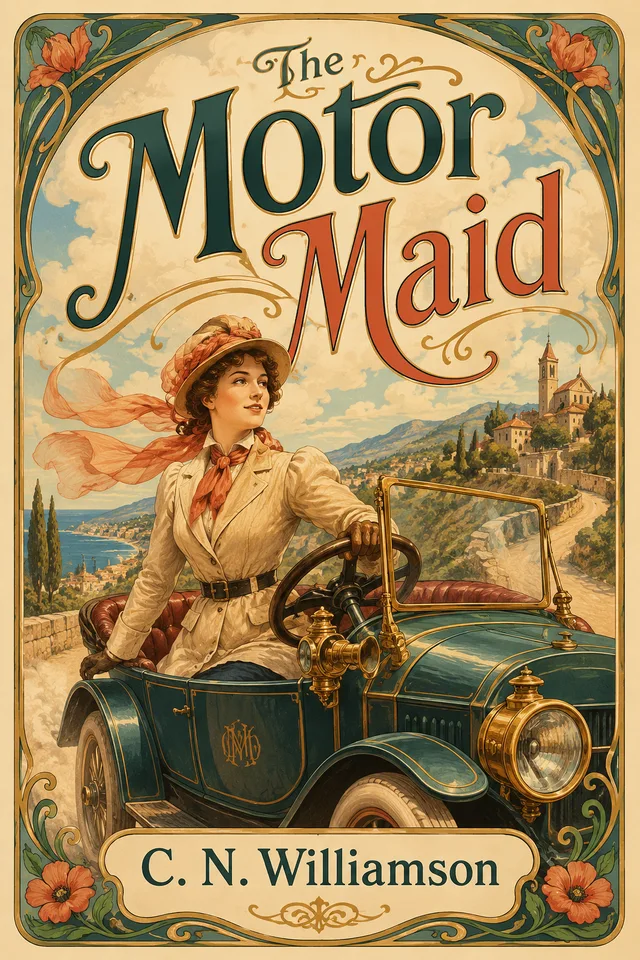
The Motor Maid
Edição BooksWhale em inglês por C. N. Williamson & A. M. Williamson
A brisk early motoring romance of travel, chance encounters, social comedy, and adventure.
- Prévia
- Amostra do texto preparado
- Formatos
- Leitor online, EPUB, PDF
- Acesso
- Claim da Biblioteca
Introdução do livro
The Motor Maid
The Motor Maid follows a lively journey through travel, romance, disguise, and early automobile culture. This English edition keeps the public-domain original text available in a clean digital format.
Edição BooksWhale
Como esta edição foi preparada
Esta edição se baseia em um texto em domínio público e foi preparada pela BooksWhale para leitura digital.
Base de domínio público
Por que pode ser compartilhada
C. N. Williamson died in 1920 and A. M. Williamson died in 1933; The Motor Maid was published in the early twentieth century. These dates support the public-domain basis for the English source text used in this edition.
Ler prévia
Amostra do texto preparado
Prévia selecionada do texto preparado.
Capítulo de préviaFull textLer prévia
The Motor Maid
C. N. Williamson and A. M. Williamson
Capítulo de préviaCHAPTER IPrévia
NE hears of people whose hair turned white in a single night. Last night I thought mine was turning. I had a creepy feeling in the roots, which seemed to crawl all the way down inside each separate hair, wriggling as it went. I suppose you could n't have nervous prostration of the hair? I worried dreadfully, it kept on so long; and my hair is so fair it would be almost a temptation for it, in an emergency, to take the one short step from gold to silver. I did n't dare switch on the light in the wagon-lit and peep at my pocket-book mirror (which reflects one's features in sections of a square inch, giving the survey of one's whole face quite a panorama effect) for fear I might wake up the Bull Dog.
I've spelt him with capitals, after mature deliberation, because it would be nothing less than lèse majesté to fob him off with little letters about the size of his two lower eye-tusks, or chin-molars, or whatever one ought to call them.
He was on the floor, you see, keeping guard over his mistress's shoes; and he might have been misguided enough to think I had designs on them—though what I could have used them for, unless I'd been going to Venice and wanting a private team of gondolas, I can't imagine.
I being in the upper berth, you might (if you had n't seen
him) have fancied me safe; but already he had once padded half-way up the step-ladder, and sniffed at me speculatively, as if I were a piece of meat on the top shelf of a larder; and if half-way up, why not all the way up? Il était capable du tout.
I tried to distract my mind and focus it hard on other things, as Christian Scientists tell you to do when you have a pin sticking into your body for which les convenances forbid you to make an exhaustive search.
I lay on my back with my eyes shut, trying not to hear any of the sounds in the wagon-lit (and they were not confined to the snoring of His Majesty), thinking desperately. "I will concentrate all my mentality," said I to myself, "on thoughts beginning with P, for instance. My Past. Paris. Pamela."
Just for a few minutes it was comparatively easy. "Dear Past!" I sighed, with a great sigh which for divers reasons I was sure could n't be heard beyond my own berth. (And though I try always even to think in English, I find sometimes that the words group themselves in my head in the old patterns—according to French idioms.) "Dear Past, how thou wert kind and sweet! How it is brutalizing to turn my back upon thee and thy charms forever!"
"Oh, my goodness, I shall certainly die!" squeaked a voice in the berth underneath; and then there was a sound of wallowing.
She (my stable-companion, shall I call her?) had been giving vent to all sorts of strange noises at intervals, for a long time, so that it would have been hopeless to try and drown my sorrows in sleep.
Away went the Gentle Past with a bump, as if it had knocked against a snag in the current of my thoughts.
Paris or Pamela instead, then! or both together, since they seem inseparable, even when Pamela is at her most American, and tells me to "talk United States."
It was all natural to think of Pamela, because it was she who gave me the ticket for the train de luxe , and my berth in the wagon-lit . It it had n't been for Pamela I should at this moment have been crawling slowly, cheaply, down Riviera-ward in a second-class train, sitting bolt upright in a second-class carriage with smudges on my nose, while perhaps some second-class child shed jammy crumbs on my frock, and its second-class baby sister howled.
Capítulo de préviaCHAPTER IIPrévia
T HALF-PAST ten this morning we parted, the best of friends, and I dropped a good-bye kiss into the deep black gorge between the promontories of Beau's velvet forehead and plush nose.
We 'd had breakfast together, Miss Paget and I, to say nothing of the dog, and I felt rather cheerful. Of course I dreaded the Princess; but I always did like adventures, and it appeared to me distinctly an adventure to be a companion, even in misery. Besides, it was nice to have come away from Monsieur Charretier, and to feel that not only did he not know where I was, but that he was n't likely to find out. Poor me! I little guessed what an adventure on a grand scale I was in for. Already this morning seems a long time ago; a year at the Convent used to seem shorter.
I drove up to the hotel in the omnibus which was at the station, and asked at the office for the Princess Boriskoff. I said that I was Mademoiselle d'Angely, and would they please send word to the Princess, because she was expecting me.
It was a young assistant manager who received me, and he gave me a very queer, startled sort of look when I said this, as if I were a suspicious person, and he did n't quite know whether it would be better to answer me or call for help.
"I have n't made a mistake, have I?" I asked, beginning to be anxious. "This is the hotel where the Princess is staying, is n't it?"
"She was staying here," the youth admitted. "But ⸺"
"Has she gone? "
"Not exactly."
"She must be either here or gone."
Again he regarded me with suspicion, as if he did not agree with my statement.
"Are you a relative of the Princess?" he inquired.
"No, I 'm engaged to be her companion."
"Oh! If that is all! But perhaps, in any case, it will be better to wait for the manager. He will be here presently. I do not like to take the responsibility."
"The responsibility of what?" I persisted, my heart beginning to feel like a patter of rain on a tin roof.
"Of telling you what has happened."
"If something has happened, I can't wait to hear it. I must know at once," I said, with visions of all sorts of horrid things: that the Princess had decided not to have a companion, and was going to disown me; that my cousin Madame Milvaine had somehow found out everything; that Monsieur Charretier had got on my track, and was here in advance waiting to pounce upon me.
"It is a thing which we do not want to have talked about in the hotel," the young man hesitated.
"I assure you I won't talk to any one. I don't know any one to talk to."
"It is very distressing, but the Princess Boriskoff died about four o'clock this morning, of heart failure."
"Oh!". . . I could not get out another word.
"These things are not liked in hotels, even when not contagious."
The assistant manager looked gloomily at me, as if I might be held responsible for the inconvenient event; but still I could not speak.
"Especially in the high season. It is being kept secret. That is the custom. In some days, or less, it will leak out, but not till the Princess has—been removed. You will kindly not mention it, mademoiselle. This is very bad for us."
No, I would kindly not mention it, but it was worse for me than for them. The Hotel Majestic Palace looked rich; very, very rich. It had heaps of splendid mirrors and curtains, and imitation Louis XVI. sofas, and everything that a hotel needs to make it happy and successful, while I had nothing in the world except what I stood up in, one fitted bag, one small box, and thirty-two francs. I did n't quite see, at first sight, what I was to do; but neither did the assistant manager see what that had to do with him.
Sumário
Nesta edição
- 01Full text
- 02CHAPTER I
- 03CHAPTER II
- 04CHAPTER III
- 05CHAPTER IV
- 06CHAPTER V
- 07CHAPTER VI
- 08CHAPTER VII
- 09CHAPTER VIII
- 10CHAPTER IX
- 11CHAPTER X
- 12CHAPTER XI
- 13CHAPTER XII
- 14CHAPTER XIII
- 15CHAPTER XIV
- 16CHAPTER XV
- 17CHAPTER XVI
- 18CHAPTER XVII
- 19CHAPTER XVIII
- 20CHAPTER XIX
- 21CHAPTER XX
- 22CHAPTER XXI
- 23CHAPTER XXII
- 24CHAPTER XXIII
- 25CHAPTER XXIV
- 26CHAPTER XXV
- 27CHAPTER XXVI
- 28CHAPTER XXVII
- 29CHAPTER XXVIII
- 30CHAPTER XXIX
- 31CHAPTER XXX
- 32CHAPTER XXXI
- 33CHAPTER XXXII
Disponibilidade de idiomas
Outros idiomas
Outras edições de idioma ainda não foram publicadas. Elas aparecerão aqui quando disponíveis.
Solicitar outro idioma