inglês Edição
Literatura
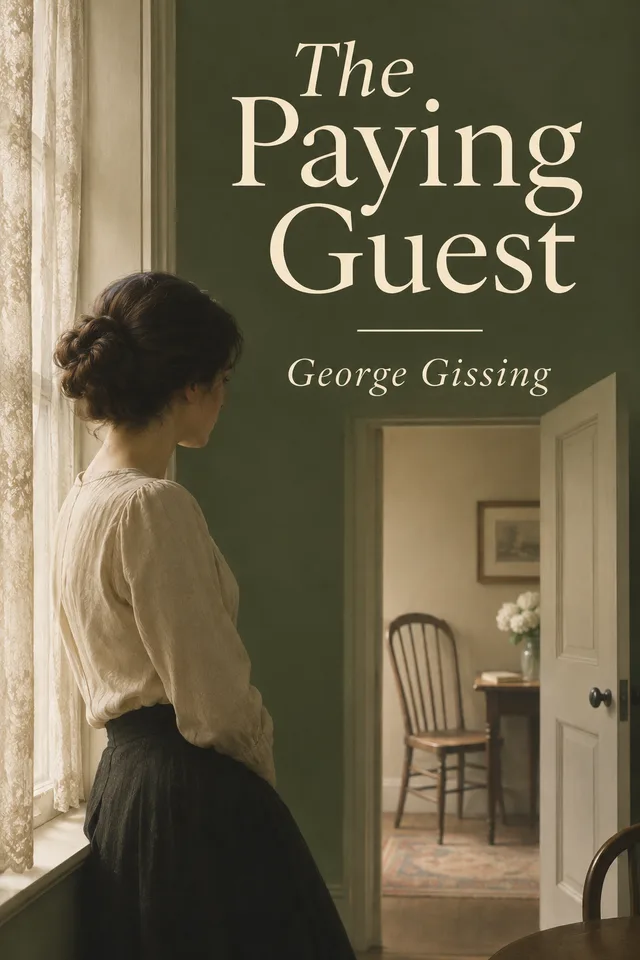
The Paying Guest
Edição BooksWhale em inglês por George Gissing
A suburban couple takes in a paying guest whose ambitions expose the tensions beneath their comfortable domestic arrangements.
- Prévia
- Amostra do texto preparado
- Formatos
- Leitor online, EPUB, PDF
- Acesso
- Claim da Biblioteca
Introdução do livro
The Paying Guest
Clarence and Emmeline Mumford hope that taking a lodger will improve their household finances. Their guest, Louise Derrick, instead unsettles the couple's assumptions about marriage, manners, and social advancement. George Gissing's compact novel follows the collisions between her restless aspirations and suburban respectability, making a small domestic experiment reveal a wider world of class anxiety and emotional bargaining.
Edição BooksWhale
Como esta edição foi preparada
Esta edição se baseia em um texto em domínio público e foi preparada pela BooksWhale para leitura digital.
Base de domínio público
Por que pode ser compartilhada
First published in 1895; George Gissing died in 1903. This edition uses the public-domain English text from Project Gutenberg.
Ler prévia
Amostra do texto preparado
Prévia selecionada do texto preparado.
Capítulo de préviaFull textLer prévia
The Paying Guest
George Gissing
Capítulo de préviaCHAPTER IPrévia
It was Mumford who saw the advertisement and made the suggestion. His wife gave him a startled look.
'But—you don't mean that it's necessary? Have we been extrav—'
'No, no! Nothing of the kind. It just occurred to me that some such arrangement might be pleasant for you. You must feel lonely, now and then, during the day, and as we have plenty of room—'
Emmeline took the matter seriously, but, being a young woman of some discretion, did not voice all her thoughts. The rent was heavy: so was the cost of Clarence's season-ticket. Against this they had set the advantage of the fine air of Sutton, so good for the child and for the mother, both vastly better in health since they quitted London. Moreover, the remoteness of their friends favoured economy; they could easily decline invitations, and need not often issue them. They had a valid excuse for avoiding public entertainments—an expense so often imposed by mere fashion. The house was roomy, the garden delightful. Clarence, good fellow, might be sincere in his wish for her to have companionship; at the same time, this advertisement had probably appealed to him in another way.
'A YOUNG LADY desires to find a home with respectable, well-connected family, in a suburb of London, or not more than 15 miles from Charing Cross. Can give excellent references. Terms not so much a consideration as comfort and pleasant society. No boarding-house.—Address: Louise, Messrs. Higgins & Co., Fenchurch St., E.C.'
She read it again and again.
'It wouldn't be nice if people said that we were taking lodgers.'
'No fear of that. This is evidently some well-to-do person. It's a very common arrangement nowadays, you know; they are called "paying guests." Of course I shouldn't dream of having anyone you didn't thoroughly like the look of.'
'Do you think,' asked Emmeline doubtfully, 'that we should quite do? "Well-connected family"—'
'My dear girl! Surely we have nothing to be ashamed of?'
'Of course not, Clarence. But—and "pleasant society." What about that?'
'Your society is pleasant enough, I hope,' answered Mumford, gracefully. 'And the Fentimans—'
This was the only family with whom they were intimate at Sutton. Nice people; a trifle sober, perhaps, and not in conspicuously flourishing circumstances; but perfectly presentable.
'I'm afraid—' murmured Emmeline, and stopped short. 'As you say,' she added presently, 'this is someone very well off. "Terms not so much a consideration"—'
'Well, I tell you what—there can be no harm in dropping a note. The kind of note that commits one to nothing, you know. Shall I write it, or will you?'
They concocted it together, and the rough draft was copied by Emmeline. She wrote a very pretty hand, and had no difficulty whatever about punctuation. A careful letter, calculated for the eye of refinement; it supplied only the indispensable details of the writer's position, and left terms for future adjustment.
'It's so easy to explain to people,' said Mumford, with an air of satisfaction, when he came back from the post, 'that you wanted a companion. As I'm quite sure you do. A friend coming to stay with you for a time—that's how I should put it.'
A week passed, and there came no reply. Mumford pretended not to care much, but Emmeline imagined a new anxiety in his look.
'Do be frank with me, dear,' she urged one evening. 'Are we living too—'
He answered her with entire truthfulness. Ground for serious uneasiness there was none whatever; he could more than make ends meet, and had every reason to hope it would always be so; but it would relieve his mind if the end of the year saw a rather larger surplus. He was now five-and-thirty—getting on in life. A man ought to make provision beyond the mere life-assurance—and so on.
'Shall I look out for other advertisements?' asked Emmeline.
Capítulo de préviaCHAPTER IIPrévia
'Runnymede' (so the Mumfords' house was named) stood on its own little plot of ground in one of the tree-shadowed roads which persuade the inhabitants of Sutton that they live in the country. It was of red brick, and double-fronted, with a porch of wood and stucco; bay windows on one side of the entrance, and flat on the other, made a contrast pleasing to the suburban eye. The little front garden had a close fence of unpainted lath, a characteristic of the neighbourhood. At the back of the house lay a long, narrow lawn, bordered with flower-beds, and shaded at the far end by a fine horse-chestnut.
Emmeline talked much of the delightful proximity of the Downs; one would have imagined her taking long walks over the breezy uplands to Banstead or Epsom, or yet further afield The fact was, she saw no more of the country than if she had lived at Brixton. Her windows looked only upon the surrounding houses and their garden foliage. Occasionally she walked along the asphalte pavement of the Brighton Road—a nursemaids' promenade—as far as the stone which marks twelve miles from Westminster Bridge. Here, indeed, she breathed the air of the hills, but villas on either hand obstructed the view, and brought London much nearer than the measured distance. Like her friends and neighbours, Emmeline enjoyed Sutton because it was a most respectable little portion of the great town, set in a purer atmosphere. The country would have depressed her.
In this respect Miss Derrick proved a congenial companion. Louise made no pretence of rural inclinations, but had a great liking for tree-shadowed asphalte, for the results of elaborate horticulture, for the repose and the quiet of villadom.
'I should like to have a house just like this,' she declared, on her first evening at "Runnymede," talking with her host and hostess out in the garden. 'It's quite big enough, unless, of course, you have a very large family, which must be rather a bore.' She laughed ingenuously. 'And one gets to town so easily. What do you pay for your season-ticket, Mr. Mumford? Oh, well! that isn't much. I almost think I shall get one.'
'Do you wish to go up very often, then?' asked Emmeline, reflecting on her new responsibilities.
'Oh! not every day, of course. But a season-ticket saves the bother each time, and you have a sort of feeling, you know, that you can be in town whenever you like.'
It had not hitherto been the Mumfords' wont to dress for dinner, but this evening they did so, and obviously to Miss Derrick's gratification. She herself appeared in a dress which altogether outshone that of her hostess. Afterwards, in private, she drew Emmeline's attention to this garb, and frankly asked her opinion of it.
'Very nice indeed,' murmured the married lady, with a good-natured smile. 'Perhaps a little—'
'There, I know what you're going to say. You think it's too showy. Now I want you to tell me just what you think about everything—everything. I shan't be offended. I'm not so silly. You know I've come here to learn all sorts of things. To-morrow you shall go over all my dresses with me, and those you don't like I'll get rid of. I've never had anyone to tell me what's nice and what isn't. I want to be—oh, well, you know what I mean.'
'But, my dear,' said Emmeline, 'there's something I don't quite understand. You say I'm to speak plainly, and so I will. How is it that you haven't made friends long ago with the sort of people you wish to know? It isn't as if you were in poor circumstances.'
'How could I make friends with nice people when I was ashamed to have them at home? The best I know are quite poor—girls I went to school with. They're much better educated than I am, but they make their own living, and so I can't see very much of them, and I'm not sure they want to see much of me. I wish I knew what people think of me; they call me vulgar, I believe—the kind I'm speaking of. Now, do tell me, Mrs. Mumford, am I vulgar?'
Sumário
Nesta edição
- 01Full text
- 02CHAPTER I
- 03CHAPTER II
- 04CHAPTER III
- 05CHAPTER IV
- 06CHAPTER V
- 07CHAPTER VI
- 08CHAPTER VII
- 09CHAPTER VIII
- 10CHAPTER IX
Disponibilidade de idiomas
Outros idiomas
Outras edições de idioma ainda não foram publicadas. Elas aparecerão aqui quando disponíveis.
Solicitar outro idioma