inglês Edição
Literatura
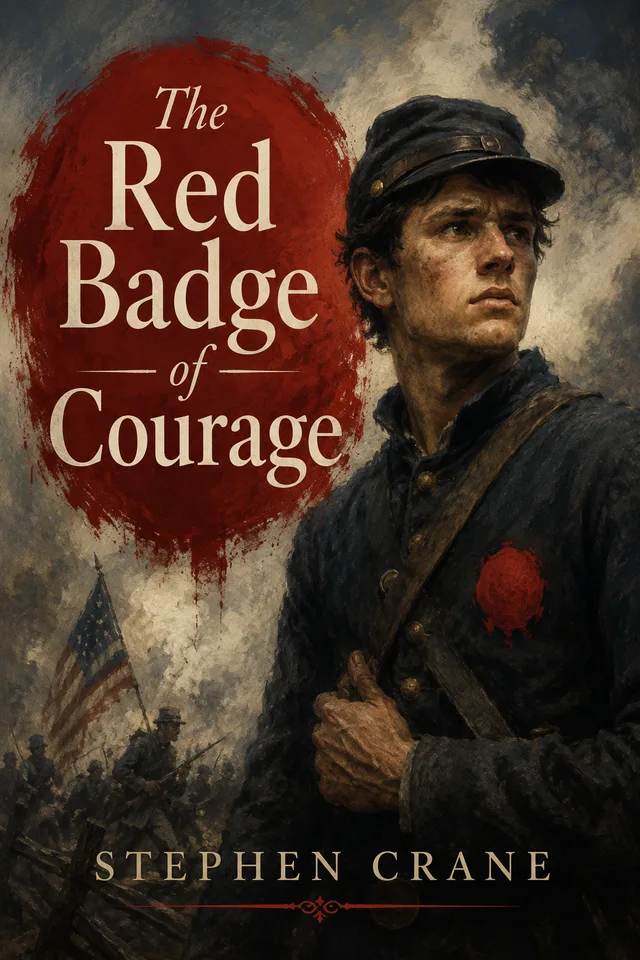
The Red Badge of Courage
Edição BooksWhale em inglês por Stephen Crane
A compact Civil War novel of fear, courage, shame, and battlefield perception.
- Prévia
- Amostra do texto preparado
- Formatos
- Leitor online, EPUB, PDF
- Acesso
- Claim da Biblioteca
Introdução do livro
The Red Badge of Courage
The Red Badge of Courage follows a young soldier through panic, confusion, pride, and combat during the American Civil War. Crane’s psychological realism and compressed style make it a landmark English-language war novel.
Edição BooksWhale
Como esta edição foi preparada
Esta edição se baseia em um texto em domínio público e foi preparada pela BooksWhale para leitura digital.
Base de domínio público
Por que pode ser compartilhada
Stephen Crane died in 1900, and The Red Badge of Courage was first published in 1895. These dates support the public-domain basis for this English original-language edition.
Ler prévia
Amostra do texto preparado
Prévia selecionada do texto preparado.
Capítulo de préviaFull textLer prévia
The Red Badge of Courage
An Episode of the American Civil War
Stephen Crane
Capítulo de préviaChapter I.Prévia
The cold passed reluctantly from the earth, and the retiring fogs revealed an army stretched out on the hills, resting. As the landscape changed from brown to green, the army awakened, and began to tremble with eagerness at the noise of rumors. It cast its eyes upon the roads, which were growing from long troughs of liquid mud to proper thoroughfares. A river, amber-tinted in the shadow of its banks, purled at the army’s feet; and at night, when the stream had become of a sorrowful blackness, one could see across it the red, eyelike gleam of hostile camp-fires set in the low brows of distant hills.
Once a certain tall soldier developed virtues and went resolutely to wash a shirt. He came flying back from a brook waving his garment bannerlike. He was swelled with a tale he had heard from a reliable friend, who had heard it from a truthful cavalryman, who had heard it from his trustworthy brother, one of the orderlies at division headquarters. He adopted the important air of a herald in red and gold.
“We’re goin’ t’ move t’morrah—sure,” he said pompously to a group in the company street. “We’re goin’ ’way up the river, cut across, an’ come around in behint ’em.”
To his attentive audience he drew a loud and elaborate plan of a very brilliant campaign. When he had finished, the blue-clothed men scattered into small arguing groups between the rows of squat brown huts. A negro teamster who had been dancing upon a cracker box with the hilarious encouragement of twoscore soldiers was deserted. He sat mournfully down. Smoke drifted lazily from a multitude of quaint chimneys.
“It’s a lie! that’s all it is—a thunderin’ lie!” said another private loudly. His smooth face was flushed, and his hands were thrust sulkily into his trouser’s pockets. He took the matter as an affront to him. “I don’t believe the derned old army’s ever going to move. We’re set. I’ve got ready to move eight times in the last two weeks, and we ain’t moved yet.”
The tall soldier felt called upon to defend the truth of a rumor he himself had introduced. He and the loud one came near to fighting over it.
A corporal began to swear before the assemblage. He had just put a costly board floor in his house, he said. During the early spring he had refrained from adding extensively to the comfort of his environment because he had felt that the army might start on the march at any moment. Of late, however, he had been impressed that they were in a sort of eternal camp.
Many of the men engaged in a spirited debate. One outlined in a peculiarly lucid manner all the plans of the commanding general. He was opposed by men who advocated that there were other plans of campaign. They clamored at each other, numbers making futile bids for the popular attention. Meanwhile, the soldier who had fetched the rumor bustled about with much importance. He was continually assailed by questions.
“What’s up, Jim?”
“Th’army’s goin’ t’ move.”
“Ah, what yeh talkin’ about? How yeh know it is?”
“Well, yeh kin b’lieve me er not, jest as yeh like. I don’t care a hang.”
There was much food for thought in the manner in which he replied. He came near to convincing them by disdaining to produce proofs. They grew much excited over it.
There was a youthful private who listened with eager ears to the words of the tall soldier and to the varied comments of his comrades. After receiving a fill of discussions concerning marches and attacks, he went to his hut and crawled through an intricate hole that served it as a door. He wished to be alone with some new thoughts that had lately come to him.
Capítulo de préviaChapter II.Prévia
The next morning the youth discovered that his tall comrade had been the fast-flying messenger of a mistake. There was much scoffing at the latter by those who had yesterday been firm adherents of his views, and there was even a little sneering by men who had never believed the rumor. The tall one fought with a man from Chatfield Corners and beat him severely.
The youth felt, however, that his problem was in no wise lifted from him. There was, on the contrary, an irritating prolongation. The tale had created in him a great concern for himself. Now, with the newborn question in his mind, he was compelled to sink back into his old place as part of a blue demonstration.
For days he made ceaseless calculations, but they were all wondrously unsatisfactory. He found that he could establish nothing. He finally concluded that the only way to prove himself was to go into the blaze, and then figuratively to watch his legs to discover their merits and faults. He reluctantly admitted that he could not sit still and with a mental slate and pencil derive an answer. To gain it, he must have blaze, blood, and danger, even as a chemist requires this, that, and the other. So he fretted for an opportunity.
Meanwhile, he continually tried to measure himself by his comrades. The tall soldier, for one, gave him some assurance. This man’s serene unconcern dealt him a measure of confidence, for he had known him since childhood, and from his intimate knowledge he did not see how he could be capable of anything that was beyond him, the youth. Still, he thought that his comrade might be mistaken about himself. Or, on the other hand, he might be a man heretofore doomed to peace and obscurity, but, in reality, made to shine in war.
The youth would have liked to have discovered another who suspected himself. A sympathetic comparison of mental notes would have been a joy to him.
He occasionally tried to fathom a comrade with seductive sentences. He looked about to find men in the proper mood. All attempts failed to bring forth any statement which looked in any way like a confession to those doubts which he privately acknowledged in himself. He was afraid to make an open declaration of his concern, because he dreaded to place some unscrupulous confidant upon the high plane of the unconfessed from which elevation he could be derided.
In regard to his companions his mind wavered between two opinions, according to his mood. Sometimes he inclined to believing them all heroes. In fact, he usually admired in secret the superior development of the higher qualities in others. He could conceive of men going very insignificantly about the world bearing a load of courage unseen, and although he had known many of his comrades through boyhood, he began to fear that his judgment of them had been blind. Then, in other moments, he flouted these theories, and assured him that his fellows were all privately wondering and quaking.
His emotions made him feel strange in the presence of men who talked excitedly of a prospective battle as of a drama they were about to witness, with nothing but eagerness and curiosity apparent in their faces. It was often that he suspected them to be liars.
He did not pass such thoughts without severe condemnation of himself. He dinned reproaches at times. He was convicted by himself of many shameful crimes against the gods of traditions.
In his great anxiety his heart was continually clamoring at what he considered the intolerable slowness of the generals. They seemed content to perch tranquilly on the river bank, and leave him bowed down by the weight of a great problem. He wanted it settled forthwith. He could not long bear such a load, he said. Sometimes his anger at the commanders reached an acute stage, and he grumbled about the camp like a veteran.
Sumário
Nesta edição
- 01Full text
- 02Chapter I.
- 03Chapter II.
- 04Chapter III.
- 05Chapter IV.
- 06Chapter V.
- 07Chapter VI.
- 08Chapter VII.
- 09Chapter VIII.
- 10Chapter IX.
- 11Chapter X.
- 12Chapter XI.
- 13Chapter XII.
- 14Chapter XIII.
- 15Chapter XIV.
- 16Chapter XV.
- 17Chapter XVI.
- 18Chapter XVII.
- 19Chapter XVIII.
- 20Chapter XIX.
- 21Chapter XX.
- 22Chapter XXI.
- 23Chapter XXII.
- 24Chapter XXIII.
- 25Chapter XXIV.
Disponibilidade de idiomas
Outros idiomas
Outras edições de idioma ainda não foram publicadas. Elas aparecerão aqui quando disponíveis.
Solicitar outro idioma