inglês Edição
Literatura
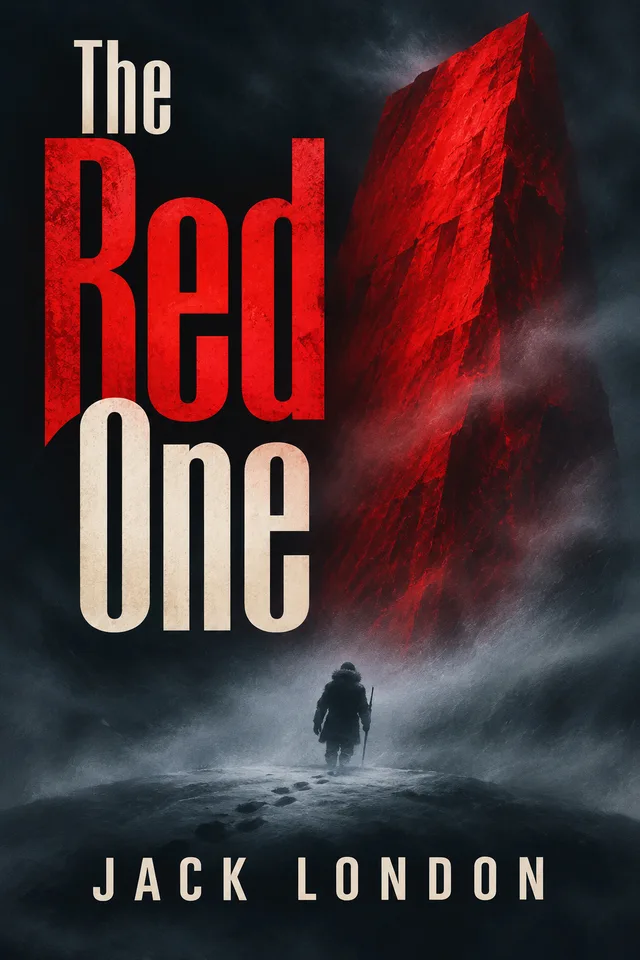
The Red One
Edição BooksWhale em inglês por Jack London
Four Jack London stories bring explorers, wanderers, and adventurers into encounters with obsession, danger, desire, and unsettling mysteries.
- Prévia
- Amostra do texto preparado
- Formatos
- Leitor online, EPUB, PDF
- Acesso
- Claim da Biblioteca
Introdução do livro
The Red One
The Red One collects four stories by Jack London: the title tale, The Hussy, Like Argus of the Ancient Times, and The Princess. Encounters in remote places expose the limits of knowledge and the persistence of appetite. Scientific curiosity, remembered violence, and extravagant storytelling give this collection its mixture of adventure and psychological disturbance.
Edição BooksWhale
Como esta edição foi preparada
Esta edição se baseia em um texto em domínio público e foi preparada pela BooksWhale para leitura digital.
Base de domínio público
Por que pode ser compartilhada
Jack London died in 1916. This edition uses the original English text of The Red One from Project Gutenberg, which identifies this source as public domain in the United States; later editorial notes and illustrations are excluded.
Ler prévia
Amostra do texto preparado
Prévia selecionada do texto preparado.
Capítulo de préviaFull textLer prévia
The Red One
Jack London
Capítulo de préviaTHE RED ONEPrévia
There it was! The abrupt liberation of sound! As he timed it with his watch, Bassett likened it to the trump of an archangel. Walls of cities, he meditated, might well fall down before so vast and compelling a summons. For the thousandth time vainly he tried to analyse the tone-quality of that enormous peal that dominated the land far into the strong-holds of the surrounding tribes. The mountain gorge which was its source rang to the rising tide of it until it brimmed over and flooded earth and sky and air. With the wantonness of a sick man’s fancy, he likened it to the mighty cry of some Titan of the Elder World vexed with misery or wrath. Higher and higher it arose, challenging and demanding in such profounds of volume that it seemed intended for ears beyond the narrow confines of the solar system. There was in it, too, the clamour of protest in that there were no ears to hear and comprehend its utterance.
—Such the sick man’s fancy. Still he strove to analyse the sound. Sonorous as thunder was it, mellow as a golden bell, thin and sweet as a thrummed taut cord of silver—no; it was none of these, nor a blend of these. There were no words nor semblances in his vocabulary and experience with which to describe the totality of that sound.
Time passed. Minutes merged into quarters of hours, and quarters of hours into half-hours, and still the sound persisted, ever changing from its initial vocal impulse yet never receiving fresh impulse—fading, dimming, dying as enormously as it had sprung into being. It became a confusion of troubled mutterings and babblings and colossal whisperings. Slowly it withdrew, sob by sob, into whatever great bosom had birthed it, until it whimpered deadly whispers of wrath and as equally seductive whispers of delight, striving still to be heard, to convey some cosmic secret, some understanding of infinite import and value. It dwindled to a ghost of sound that had lost its menace and promise, and became a thing that pulsed on in the sick man’s consciousness for minutes after it had ceased. When he could hear it no longer, Bassett glanced at his watch. An hour had elapsed ere that archangel’s trump had subsided into tonal nothingness.
Was this, then, his dark tower?—Bassett pondered, remembering his Browning and gazing at his skeleton-like and fever-wasted hands. And the fancy made him smile—of Childe Roland bearing a slug-horn to his lips with an arm as feeble as his was. Was it months, or years, he asked himself, since he first heard that mysterious call on the beach at Ringmanu? To save himself he could not tell. The long sickness had been most long. In conscious count of time he knew of months, many of them; but he had no way of estimating the long intervals of delirium and stupor. And how fared Captain Bateman of the blackbirder Nari? he wondered; and had Captain Bateman’s drunken mate died of delirium tremens yet?
From which vain speculations, Bassett turned idly to review all that had occurred since that day on the beach of Ringmanu when he first heard the sound and plunged into the jungle after it. Sagawa had protested. He could see him yet, his queer little monkeyish face eloquent with fear, his back burdened with specimen cases, in his hands Bassett’s butterfly net and naturalist’s shot-gun, as he quavered, in Bêche-de-mer English: “Me fella too much fright along bush. Bad fella boy, too much stop’m along bush.”
Bassett smiled sadly at the recollection. The little New Hanover boy had been frightened, but had proved faithful, following him without hesitancy into the bush in the quest after the source of the wonderful sound. No fire-hollowed tree-trunk, that, throbbing war through the jungle depths, had been Bassett’s conclusion. Erroneous had been his next conclusion, namely, that the source or cause could not be more distant than an hour’s walk, and that he would easily be back by mid-afternoon to be picked up by the Nari’s whale-boat.
Capítulo de préviaTHE HUSSYPrévia
There are some stories that have to be true—the sort that cannot be fabricated by a ready fiction-reckoner. And by the same token there are some men with stories to tell who cannot be doubted. Such a man was Julian Jones. Although I doubt if the average reader of this will believe the story Julian Jones told me. Nevertheless I believe it. So thoroughly am I convinced of its verity that I am willing, nay, eager, to invest capital in the enterprise and embark personally on the adventure to a far land.
It was in the Australian Building at the Panama Pacific Exposition that I met him. I was standing before an exhibit of facsimiles of the record nuggets which had been discovered in the goldfields of the Antipodes. Knobbed, misshapen and massive, it was as difficult to believe that they were not real gold as it was to believe the accompanying statistics of their weights and values.
“That’s what those kangaroo-hunters call a nugget,” boomed over my shoulder directly at the largest of the specimens.
I turned and looked up into the dim blue eyes of Julian Jones. I looked up, for he stood something like six feet four inches in height. His hair, a wispy, sandy yellow, seemed as dimmed and faded as his eyes. It may have been the sun which had washed out his colouring; at least his face bore the evidence of a prodigious and ardent sun-burn which had long since faded to yellow. As his eyes turned from the exhibit and focussed on mine I noted a queer look in them as of one who vainly tries to recall some fact of supreme importance.
“What’s the matter with it as a nugget?” I demanded.
The remote, indwelling expression went out of his eyes as he boomed
“Why, its size.”
“It does seem large,” I admitted. “But there’s no doubt it’s authentic. The Australian Government would scarcely dare—”
“Large!” he interrupted, with a sniff and a sneer.
“Largest ever discovered—” I started on.
“Ever discovered!” His dim eyes smouldered hotly as he proceeded. “Do you think that every lump of gold ever discovered has got into the newspapers and encyclopedias?”
“Well,” I replied judicially, “if there’s one that hasn’t, I don’t see how we’re to know about it. If a really big nugget, or nugget-finder, elects to blush unseen—”
“But it didn’t,” he broke in quickly. “I saw it with my own eyes, and, besides, I’m too tanned to blush anyway. I’m a railroad man and I’ve been in the tropics a lot. Why, I used to be the colour of mahogany—real old mahogany, and have been taken for a blue-eyed Spaniard more than once—”
It was my turn to interrupt, and I did.
“Was that nugget bigger than those in there, Mr.—er—?”
“Jones, Julian Jones is my name.”
He dug into an inner pocket and produced an envelope addressed to such a person, care of General Delivery, San Francisco; and I, in turn, presented him with my card.
“Pleased to know you, sir,” he said, extending his hand, his voice booming as if accustomed to loud noises or wide spaces. “Of course I’ve heard of you, seen your picture in the papers, and all that, and, though I say it that shouldn’t, I want to say that I didn’t care a rap about those articles you wrote on Mexico. You’re wrong, all wrong. You make the mistake of all Gringos in thinking a Mexican is a white man. He ain’t. None of them ain’t—Greasers, Spiggoties, Latin-Americans and all the rest of the cattle. Why, sir, they don’t think like we think, or reason, or act. Even their multiplication table is different. You think seven times seven is forty-nine; but not them. They work it out different. And white isn’t white to them, either. Let me give you an example. Buying coffee retail for house-keeping in one-pound or ten-pound lots—”
Sumário
Nesta edição
- 01Full text
- 02THE RED ONE
- 03THE HUSSY
- 04LIKE ARGUS OF THE ANCIENT TIMES
- 05THE PRINCESS
Disponibilidade de idiomas
Outros idiomas
Outras edições de idioma ainda não foram publicadas. Elas aparecerão aqui quando disponíveis.
Solicitar outro idioma