inglês Edição
Arte
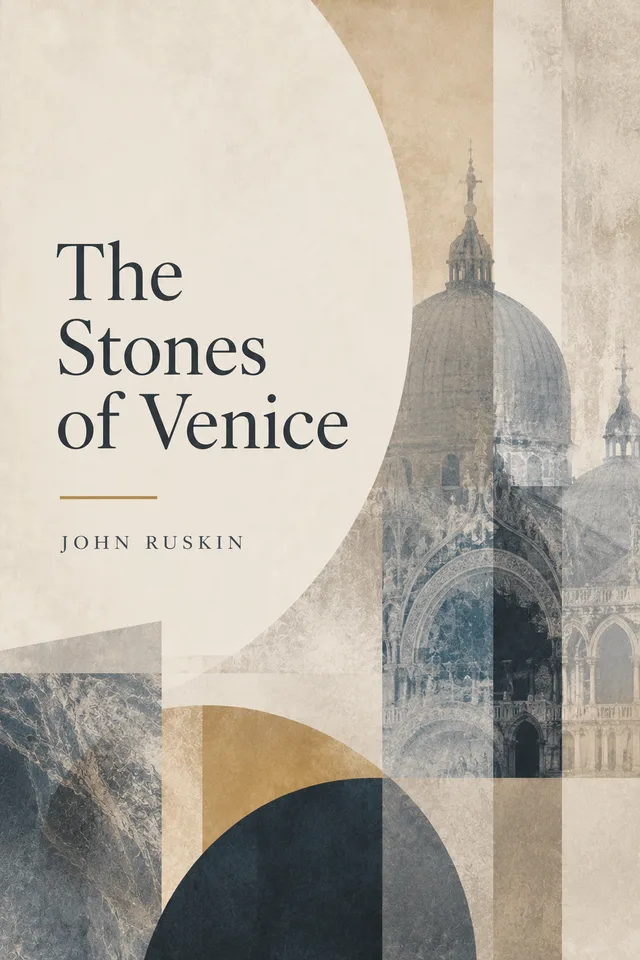
The Stones of Venice
Edição BooksWhale em inglês por John Ruskin
A major work of art and architectural criticism on Venice, Gothic design, craft, and culture.
- Prévia
- Amostra do texto preparado
- Formatos
- Leitor online, EPUB, PDF
- Acesso
- Claim da Biblioteca
Introdução do livro
The Stones of Venice
The Stones of Venice combines architectural history, art criticism, moral reflection, and close observation of Venetian buildings. Ruskin’s work shaped nineteenth-century thinking about art and craft.
Edição BooksWhale
Como esta edição foi preparada
Esta edição se baseia em um texto em domínio público e foi preparada pela BooksWhale para leitura digital.
Base de domínio público
Por que pode ser compartilhada
John Ruskin died in 1900, and The Stones of Venice was published in the 1850s; these dates support the public-domain basis for this English edition.
Ler prévia
Amostra do texto preparado
Prévia selecionada do texto preparado.
Capítulo de préviaFull textLer prévia
The Stones of Venice
John Ruskin
Capítulo de préviaVolume I: The FoundationsPrévia
Volume I: The Foundations
Capítulo de préviaPrefacePrévia
In the course of arranging the following essay, I put many things aside in my thoughts to be said in the Preface, things which I shall now put aside altogether, and pass by; for when a book has been advertised a year and a half, it seems best to present it with as little preface as possible.
Thus much, however, it is necessary for the reader to know, that, when I planned the work, I had materials by me, collected at different times of sojourn in Venice during the last seventeen years, which it seemed to me might be arranged with little difficulty, and which I believe to be of value as illustrating the history of Southern Gothic. Requiring, however, some clearer assurance respecting certain points of chronology, I went to Venice finally in the autumn of 1849, not doubting but that the dates of the principal edifices of the ancient city were either ascertained, or ascertainable without extraordinary research. To my consternation, I found that the Venetian antiquaries were not agreed within a century as to the date of the building of the façades of the Ducal Palace, and that nothing was known of any other civil edifice of the early city, except that at some time or other it had been fitted up for somebody's reception, and been thereupon fresh painted. Every date in question was determinable only by internal evidence, and it became necessary for me to examine not only every one of the older palaces, stone by stone, but every fragment throughout the city which afforded any clue to the formation of its styles. This I did as well as I could, and I believe there will be found, in the following pages, the only existing account of the details of early Venetian architecture on which dependence can be placed, as far as it goes. I do not care to point out the deficiencies of other works on this subject; the reader will find, if he examines them, either that the buildings to which I shall specially direct his attention have been hitherto undescribed, or else that there are great discrepancies between previous descriptions and mine: for which discrepancies I may be permitted to give this single and sufficient reason, that my account of every building is based on personal examination and measurement of it, and that my taking the pains so to examine what I had to describe, was a subject of grave surprise to my Italian friends. The work of the Marchese Selvatico is, however, to be distinguished with respect; it is clear in arrangement, and full of useful, though vague, information; and I have found cause to adopt, in great measure, its views of the chronological succession of the edifices of Venice. I shall have cause hereafter to quarrel with it on other grounds, but not without expression of gratitude for the assistance it has given me. Fontana's "Fabbriche di Venezia" is also historically valuable, but does not attempt to give architectural detail. Cicognara, as is now generally known, is so inaccurate as hardly to deserve mention.
Indeed, it is not easy to be accurate in an account of anything, however simple. Zoologists often disagree in their descriptions of the curve of a shell, or the plumage of a bird, though they may lay their specimen on the table, and examine it at their leisure; how much greater becomes the likelihood of error in the description of things which must be in many parts observed from a distance, or under unfavorable circumstances of light and shade; and of which many of the distinctive features have been worn away by time. I believe few people have any idea of the cost of truth in these things; of the expenditure of time necessary to make sure of the simplest facts, and of the strange way in which separate observations will sometimes falsify each other, incapable of reconcilement, owing to some imperceptible inadvertency. I am ashamed of the number of times in which I have had to say, in the following pages, "I am not sure," and I claim for them no authority, as if they were thoroughly sifted from error, even in what they more confidently state. Only, as far as my time, and strength, and mind served me, I have endeavored down to the smallest matters, to ascertain and speak the truth.
Sumário
Nesta edição
- 01Full text
- 02Volume I: The Foundations
- 03Preface
- 04CHAPTER I: THE QUARRY
- 05Footnotes
- 06CHAPTER II: THE VIRTUES OF ARCHITECTURE
- 071. That it act well, and do the things it was intended to do in the best way
- 082. That it speak well, and say the things it was intended to say in the best words
- 09Footnotes
- 10CHAPTER III: THE SIX DIVISIONS OF ARCHITECTURE
- 11CHAPTER IV: THE WALL BASE
- 12Footnotes
- 13CHAPTER V: THE WALL VEIL
- 14Footnotes
- 15CHAPTER VI: THE WALL CORNICE
- 16CHAPTER VII: THE PIER BASE
- 17Footnotes
- 18CHAPTER VIII: THE SHAFT
- 19Footnotes
- 20CHAPTER IX: THE CAPITAL
- 21Footnotes
- 22CHAPTER X: THE ARCH LINE
- 23CHAPTER XI: THE ARCH MASONRY
- 24Footnotes
- 25CHAPTER XII: THE ARCH LOAD
- 26CHAPTER XIII: THE ROOF
- 27Footnotes
- 28CHAPTER XIV: THE ROOF CORNICE
- 29Footnotes
- 30CHAPTER XV: THE BUTTRESS
- 31CHAPTER XVI: FORM OF APERTURE
- 321. The form of the aperture, i.e., its outline, its size, and the forms of its sides
- 332. The filling of the aperture, i.e., valves and glass, and their holdings
- 34Footnotes
- 35CHAPTER XVII: FILLING OF APERTURE
- 36Footnotes
- 37CHAPTER XVIII: PROTECTION OF APERTURE
- 38CHAPTER XIX: SUPERIMPOSITION
- 39Footnotes
- 40CHAPTER XX: THE MATERIAL OF ORNAMENT
- 411. Instruments, armor, and dress
- 42Footnotes
- 43CHAPTER XXI: TREATMENT OF ORNAMENT
- 441. How ornament is to be expressed with reference to the mind
- 452. How ornament is to be arranged with reference to the sight
- 463. How ornament is to be arranged with reference to both
- 47Footnotes
- 48CHAPTER XXII: THE ANGLE
- 491. The Angle. 2. The Edge and Fillet. 3. The Roll and Recess
- 50Footnotes
- 51CHAPTER XXIII: THE EDGE AND FILLET
- 52Footnotes
- 53CHAPTER XXIV: THE ROLL AND RECESS
- 54CHAPTER XXV: THE BASE
- 55Footnotes
- 56CHAPTER XXVI: THE WALL VEIL AND SHAFT
- 57Footnotes
- 58CHAPTER XXVII: THE CORNICE AND CAPITAL
- 59Footnotes
- 60CHAPTER XXVIII: THE ARCHIVOLT AND APERTURE
- 61Footnotes
- 62CHAPTER XXIX: THE ROOF
- 63CHAPTER XXX: THE VESTIBULE
- 64Footnotes
- 65Appendix
- 661. FOUNDATION OF VENICE
- 672. POWER OF THE DOGES
- 683. SERRAR DEL CONSIGLIO
- 694. S. PIETRO DI CASTELLO
- 705. PAPAL POWER IN VENICE
- 716. RENAISSANCE ORNAMENTS
- 727. VARIETIES OF THE ORDERS
- 738. THE NORTHERN ENERGY
- 741. Elephant and castle; less graphic than the St. Zeno one
- 753. A boar hunt; the boar under a tree, very spirited
- 764. A bird putting its head between its legs to bite its own tail, which ends in a head
- 775. A dragon with a human head set on the wrong way
- 787. St. Peter led out by the angel
- 798. The miraculous draught of fishes; fish and all, in the small space
- 8011. Martyrdom of St. Sebastian; his body very full of arrows
- 8112. Beasts coming to ark; Noah opening a kind of wicker cage
- 8213. Noah building the ark on shores
- 8314. A vine leaf with a dragon's head and tail, the one biting the other
- 8415. A man riding a goat, catching a flying devil
- 8516. An eel or muraena growing into a bunch of flowers, which turns into two wings
- 869. WOODEN CHURCHES OF THE NORTH
- 8710. CHURCH OF ALEXANDRIA
- 8811. RENAISSANCE LANDSCAPE
- 8912. ROMANIST MODERN ART
- 9013. MR. FERGUSSON'S SYSTEM
- 9114. DIVISIONS OF HUMANITY
- 9215. INSTINCTIVE JUDGMENTS
- 9316. STRENGTH OF SHAFTS
- 9417. ANSWER TO MR. GARBETT
- 9518. EARLY ENGLISH CAPITALS
- 9619. TOMBS NEAR ST. ANASTASIA
- 9720. SHAFTS OF DUCAL PALACE
- 9821. ANCIENT REPRESENTATIONS OF WATER
- 9922. ARABIAN ORNAMENTATION
- 10023. VARIETIES OF CHAMFER
- 10124. RENAISSANCE BASES
- 10225. ROMANIST DECORATION OF BASES
- 103Footnotes
- 104Volume II: The Sea-Stories
- 105First, Or Byzantine, Period
- 106CHAPTER I: THE THRONE
- 107Footnotes
- 108CHAPTER II: Torcello
- 109The Sea Is His, And He Made It: And His Hands Prepared The Dry Land
- 110Footnotes
- 111CHAPTER III: MURANO
- 112Footnotes
- 113CHAPTER IV: ST. MARK'S
- 114Footnotes
- 115CHAPTER V: BYZANTINE PALACES
- 116Footnotes
- 117Second, Or Gothic, Period
- 118CHAPTER VI: THE NATURE OF GOTHIC
- 1191. Savageness. 2. Changefulness. 3. Naturalism. 4. Grotesqueness. 5. Rigidity. 6. Redundance
- 1202. Never demand an exact finish for its own sake, but only for some practical or noble end
- 1213. Never encourage imitation or copying of any kind, except for the sake of preserving record of great works
- 122Footnotes
- 123CHAPTER VII: GOTHIC PALACES
- 124Second Period
- 125Footnotes
- 126CHAPTER VIII: THE DUCAL PALACE
- 127Efice Q Sofre Tur Afa El Reve Rende Quietu
- 128Cary
- 129St. Mark'S. Orcagna. Giotto. Ducal Palace
- 130Footnotes
- 131Appendix
- 1321. THE GONDOLIER'S CRY
- 1332. OUR LADY OF SALVATION
- 1343. TIDES OF VENICE, AND MEASURES AT TORCELLO
- 1354. DATE OF THE DUOMO OF TORCELLO
- 1365. MODERN PULPITS
- 1376. APSE OF MURANO
- 1387. EARLY VENETIAN DRESS
- 1398. INSCRIPTIONS AT MURANO
- 1409. SHAFTS OF ST. MARK
- 14110. PROPER SENSE OF THE WORD IDOLATRY
- 14211. SITUATIONS OF BYZANTINE PALACES
- 14312. MODERN PAINTING ON GLASS
- 144Footnotes
- 145Volume III: The Fall
- 146Third, Or Renaissance, Period
- 147CHAPTER I: EARLY RENAISSANCE
- 148Footnotes
- 149CHAPTER II: ROMAN RENAISSANCE
- 150Vixit Annos Lxx. Devixit Anno Mdclix. "Hic Revixit Anno Mdclxix."
- 151Footnotes
- 152CHAPTER III: GROTESQUE RENAISSANCE
- 153Footnotes
- 154CHAPTER IV: CONCLUSION
- 155Footnotes
- 156Appendix
- 1571. ARCHITECT OF THE DUCAL PALACE
- 1582. THEOLOGY OF SPENSER
- 1593. AUSTRIAN GOVERNMENT IN ITALY
- 1604. DATE OF THE PALACES OF THE BYZANTINE RENAISSANCE
- 1615. RENAISSANCE SIDE OF DUCAL PALACE
- 1626. CHARACTER OF THE DOGE MICHELE MOROSINI
- 1637. MODERN EDUCATION
- 1648. EARLY VENETIAN MARRIAGES
- 1659. CHARACTER OF THE VENETIAN ARISTOCRACY
- 16610. FINAL APPENDIX
- 167Footnotes
Disponibilidade de idiomas
Outros idiomas
Outras edições de idioma ainda não foram publicadas. Elas aparecerão aqui quando disponíveis.
Solicitar outro idioma