inglês Edição
Literatura
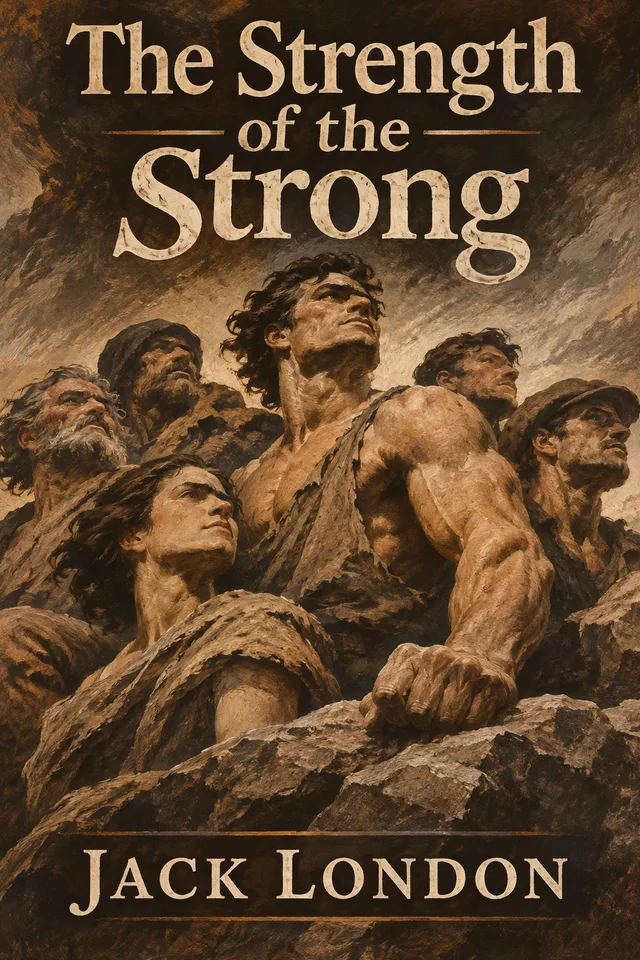
The Strength of the Strong
Edição BooksWhale em inglês por Jack London
Seven Jack London stories explore collective power, social hierarchy, technological violence, and the fragile bargains beneath civilized life.
- Prévia
- Amostra do texto preparado
- Formatos
- Leitor online, EPUB, PDF
- Acesso
- Claim da Biblioteca
Introdução do livro
The Strength of the Strong
Beginning with a prehistoric fable about cooperation and domination, this collection investigates the forces that bind societies together and divide them. Jack London moves among class conflict, speculative warfare, political upheaval, and intimate human dilemmas. Its seven stories include South of the Slot, The Unparalleled Invasion, The Dream of Debs, and the closing story Samuel.
Edição BooksWhale
Como esta edição foi preparada
Esta edição se baseia em um texto em domínio público e foi preparada pela BooksWhale para leitura digital.
Base de domínio público
Por que pode ser compartilhada
Jack London died in 1916. This edition uses the original English text supplied by Project Gutenberg, identified there as public domain in the United States, without added illustrations or editorial notes.
Ler prévia
Amostra do texto preparado
Prévia selecionada do texto preparado.
Capítulo de préviaFull textLer prévia
The Strength of the Strong
Jack London
Capítulo de préviaTHE STRENGTH OF THE STRONGPrévia
Parables don’t lie, but liars will parable.
—Lip-King.
Old Long-Beard paused in his narrative, licked his greasy fingers, and wiped them on his naked sides where his one piece of ragged bearskin failed to cover him. Crouched around him, on their hams, were three young men, his grandsons, Deer-Runner, Yellow-Head, and Afraid-of-the-Dark. In appearance they were much the same. Skins of wild animals partly covered them. They were lean and meagre of build, narrow-hipped and crooked-legged, and at the same time deep-chested, with heavy arms and enormous hands. There was much hair on their chests and shoulders, and on the outsides of their arms and legs. Their heads were matted with uncut hair, long locks of which often strayed before their eyes, beady and black and glittering like the eyes of birds. They were narrow between the eyes and broad between the cheeks, while their lower jaws were projecting and massive.
It was a night of clear starlight, and below them, stretching away remotely, lay range on range of forest-covered hills. In the distance the heavens were red from the glow of a volcano. At their backs yawned the black mouth of a cave, out of which, from time to time, blew draughty gusts of wind. Immediately in front of them blazed a fire. At one side, partly devoured, lay the carcass of a bear, with about it, at a respectable distance, several large dogs, shaggy and wolf-like. Beside each man lay his bow and arrows and a huge club. In the cave-mouth a number of rude spears leaned against the rock.
“So that was how we moved from the cave to the tree,” old Long-Beard spoke up.
They laughed boisterously, like big children, at recollection of a previous story his words called up. Long-Beard laughed, too, the five-inch bodkin of bone, thrust midway through the cartilage of his nose, leaping and dancing and adding to his ferocious appearance. He did not exactly say the words recorded, but he made animal-like sounds with his mouth that meant the same thing.
“And that is the first I remember of the Sea Valley,” Long-Beard went on. “We were a very foolish crowd. We did not know the secret of strength. For, behold, each family lived by itself, and took care of itself. There were thirty families, but we got no strength from one another. We were in fear of each other all the time. No one ever paid visits. In the top of our tree we built a grass house, and on the platform outside was a pile of rocks, which were for the heads of any that might chance to try to visit us. Also, we had our spears and arrows. We never walked under the trees of the other families, either. My brother did, once, under old Boo-oogh’s tree, and he got his head broken and that was the end of him.
“Old Boo-oogh was very strong. It was said he could pull a grown man’s head right off. I never heard of him doing it, because no man would give him a chance. Father wouldn’t. One day, when father was down on the beach, Boo-oogh took after mother. She couldn’t run fast, for the day before she had got her leg clawed by a bear when she was up on the mountain gathering berries. So Boo-oogh caught her and carried her up into his tree. Father never got her back. He was afraid. Old Boo-oogh made faces at him.
“But father did not mind. Strong-Arm was another strong man. He was one of the best fishermen. But one day, climbing after sea-gull eggs, he had a fall from the cliff. He was never strong after that. He coughed a great deal, and his shoulders drew near to each other. So father took Strong-Arm’s wife. When he came around and coughed under our tree, father laughed at him and threw rocks at him. It was our way in those days. We did not know how to add strength together and become strong.”
Capítulo de préviaSOUTH OF THE SLOTPrévia
Old San Francisco, which is the San Francisco of only the other day, the day before the Earthquake, was divided midway by the Slot. The Slot was an iron crack that ran along the centre of Market Street, and from the Slot arose the burr of the ceaseless, endless cable that was hitched at will to the cars it dragged up and down. In truth, there were two slots, but in the quick grammar of the West time was saved by calling them, and much more that they stood for, “The Slot.” North of the Slot were the theatres, hotels, and shopping district, the banks and the staid, respectable business houses. South of the Slot were the factories, slums, laundries, machine-shops, boiler works, and the abodes of the working class.
The Slot was the metaphor that expressed the class cleavage of Society, and no man crossed this metaphor, back and forth, more successfully than Freddie Drummond. He made a practice of living in both worlds, and in both worlds he lived signally well. Freddie Drummond was a professor in the Sociology Department of the University of California, and it was as a professor of sociology that he first crossed over the Slot, lived for six mouths in the great labour-ghetto, and wrote The Unskilled Labourer—a book that was hailed everywhere as an able contribution to the literature of progress, and as a splendid reply to the literature of discontent. Politically and economically it was nothing if not orthodox. Presidents of great railway systems bought whole editions of it to give to their employees. The Manufacturers’ Association alone distributed fifty thousand copies of it. In a way, it was almost as immoral as the far-famed and notorious Message to Garcia, while in its pernicious preachment of thrift and content it ran Mr. Wiggs of the Cabbage Patch a close second.
At first, Freddie Drummond found it monstrously difficult to get along among the working people. He was not used to their ways, and they certainly were not used to his. They were suspicious. He had no antecedents. He could talk of no previous jobs. His hands were soft. His extraordinary politeness was ominous. His first idea of the rôle he would play was that of a free and independent American who chose to work with his hands and no explanations given. But it wouldn’t do, as he quickly discovered. At the beginning they accepted him, very provisionally, as a freak. A little later, as he began to know his way about better, he insensibly drifted into the rôle that would work—namely, he was a man who had seen better days, very much better days, but who was down on his luck, though, to be sure, only temporarily.
He learned many things, and generalized much and often erroneously, all of which can be found in the pages of The Unskilled Labourer. He saved himself, however, after the sane and conservative manner of his kind, by labelling his generalizations as “tentative.” One of his first experiences was in the great Wilmax Cannery, where he was put on piece-work making small packing cases. A box factory supplied the parts, and all Freddie Drummond had to do was to fit the parts into a form and drive in the wire nails with a light hammer.
It was not skilled labour, but it was piece-work. The ordinary labourers in the cannery got a dollar and a half per day. Freddie Drummond found the other men on the same job with him jogging along and earning a dollar and seventy-five cents a day. By the third day he was able to earn the same. But he was ambitious. He did not care to jog along and, being unusually able and fit, on the fourth day earned two dollars.
The next day, having keyed himself up to an exhausting high-tension, he earned two dollars and a half. His fellow workers favoured him with scowls and black looks, and made remarks, slangily witty and which he did not understand, about sucking up to the boss and pace-making and holding her down, when the rains set in. He was astonished at their malingering on piece-work, generalized about the inherent laziness of the unskilled labourer, and proceeded next day to hammer out three dollars’ worth of boxes.
Sumário
Nesta edição
- 01Full text
- 02THE STRENGTH OF THE STRONG
- 03SOUTH OF THE SLOT
- 04THE UNPARALLELED INVASION
- 05THE ENEMY OF ALL THE WORLD
- 06THE DREAM OF DEBS
- 07THE SEA-FARMER
- 08SAMUEL
Disponibilidade de idiomas
Outros idiomas
Outras edições de idioma ainda não foram publicadas. Elas aparecerão aqui quando disponíveis.
Solicitar outro idioma