inglês Edição
Literatura
Travels with a Donkey in the Cévennes
Edição BooksWhale em inglês por Robert Louis Stevenson
Stevenson walks through the French Cévennes with Modestine, reflecting on travel, solitude, local faith, and companionship.
- Prévia
- Amostra do texto preparado
- Formatos
- Leitor online, EPUB, PDF
- Acesso
- Claim da Biblioteca
Introdução do livro
Travels with a Donkey in the Cévennes
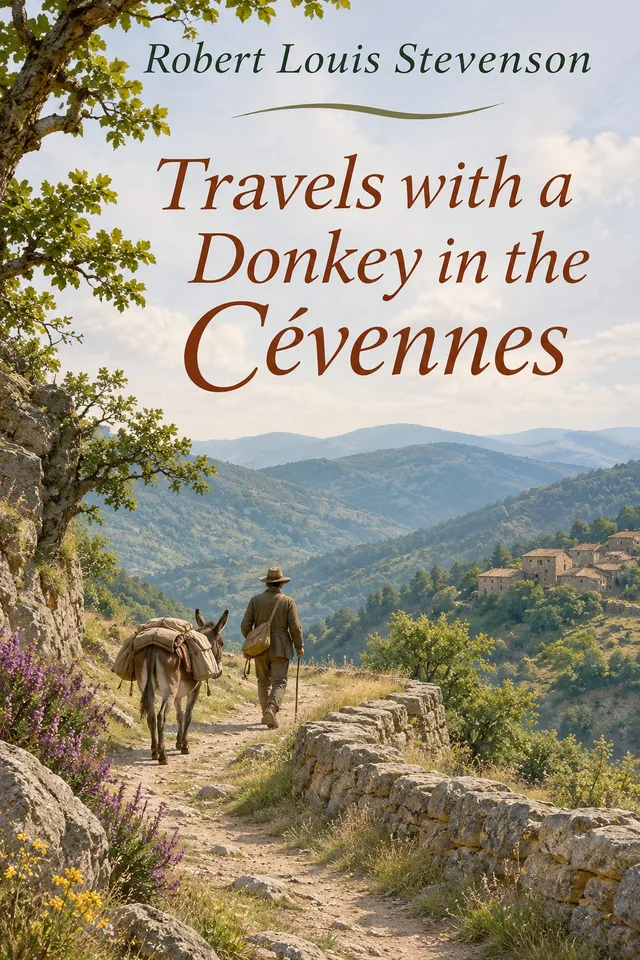
Robert Louis Stevenson recounts a walking journey through southern France with the stubborn donkey Modestine. Nights outdoors, encounters with villagers and monks, and the religious history of the Cévennes shape a travel narrative that is both practical and reflective. The journey moves from the Velay towards the country of the Camisards, ending with the traveler’s farewell to his unlikely companion.
Edição BooksWhale
Como esta edição foi preparada
Esta edição se baseia em um texto em domínio público e foi preparada pela BooksWhale para leitura digital.
Base de domínio público
Por que pode ser compartilhada
Robert Louis Stevenson died in 1894, and this work was first published in 1879. This edition uses the public-domain original English text from Project Gutenberg, without later editorial notes or illustrations.
Ler prévia
Amostra do texto preparado
Prévia selecionada do texto preparado.
Capítulo de préviaFull textLer prévia
Travels with a Donkey in the Cévennes
Robert Louis Stevenson
My Dear Sidney Colvin,
The journey which this little book is to describe was very agreeable and fortunate for me. After an uncouth beginning, I had the best of luck to the end. But we are all travellers in what John Bunyan calls the wilderness of this world—all, too, travellers with a donkey: and the best that we find in our travels is an honest friend. He is a fortunate voyager who finds many. We travel, indeed, to find them. They are the end and the reward of life. They keep us worthy of ourselves; and when we are alone, we are only nearer to the absent.
Every book is, in an intimate sense, a circular letter to the friends of him who writes it. They alone take his meaning; they find private messages, assurances of love, and expressions of gratitude, dropped for them in every corner. The public is but a generous patron who defrays the postage. Yet though the letter is directed to all, we have an old and kindly custom of addressing it on the outside to one. Of what shall a man be proud, if he is not proud of his friends? And so, my dear Sidney Colvin, it is with pride that I sign myself affectionately yours,
R. L. S.
Capítulo de préviaVELAYPrévia
Many are the mighty things, and nought is more mighty than man. . . . He masters by his devices the tenant of the fields.
SOPHOCLES.
Who hath loosed the bands of the wild ass?
JOB.
Capítulo de préviaTHE DONKEY, THE PACK, AND THE PACK-SADDLEPrévia
In a little place called Le Monastier, in a pleasant highland valley fifteen miles from Le Puy, I spent about a month of fine days. Monastier is notable for the making of lace, for drunkenness, for freedom of language, and for unparalleled political dissension. There are adherents of each of the four French parties—Legitimists, Orleanists, Imperialists, and Republicans—in this little mountain-town; and they all hate, loathe, decry, and calumniate each other. Except for business purposes, or to give each other the lie in a tavern brawl, they have laid aside even the civility of speech. ’Tis a mere mountain Poland. In the midst of this Babylon I found myself a rallying-point; every one was anxious to be kind and helpful to the stranger. This was not merely from the natural hospitality of mountain people, nor even from the surprise with which I was regarded as a man living of his own free will in Le Monastier, when he might just as well have lived anywhere else in this big world; it arose a good deal from my projected excursion southward through the Cevennes. A traveller of my sort was a thing hitherto unheard of in that district. I was looked upon with contempt, like a man who should project a journey to the moon, but yet with a respectful interest, like one setting forth for the inclement Pole. All were ready to help in my preparations; a crowd of sympathisers supported me at the critical moment of a bargain; not a step was taken but was heralded by glasses round and celebrated by a dinner or a breakfast.
It was already hard upon October before I was ready to set forth, and at the high altitudes over which my road lay there was no Indian summer to be looked for. I was determined, if not to camp out, at least to have the means of camping out in my possession; for there is nothing more harassing to an easy mind than the necessity of reaching shelter by dusk, and the hospitality of a village inn is not always to be reckoned sure by those who trudge on foot. A tent, above all for a solitary traveller, is troublesome to pitch, and troublesome to strike again; and even on the march it forms a conspicuous feature in your baggage. A sleeping-sack, on the other hand, is always ready—you have only to get into it; it serves a double purpose—a bed by night, a portmanteau by day; and it does not advertise your intention of camping out to every curious passer-by. This is a huge point. If a camp is not secret, it is but a troubled resting-place; you become a public character; the convivial rustic visits your bedside after an early supper; and you must sleep with one eye open, and be up before the day. I decided on a sleeping-sack; and after repeated visits to Le Puy, and a deal of high living for myself and my advisers, a sleeping-sack was designed, constructed, and triumphantly brought home.
This child of my invention was nearly six feet square, exclusive of two triangular flaps to serve as a pillow by night and as the top and bottom of the sack by day. I call it ‘the sack,’ but it was never a sack by more than courtesy: only a sort of long roll or sausage, green waterproof cart-cloth without and blue sheep’s fur within. It was commodious as a valise, warm and dry for a bed. There was luxurious turning room for one; and at a pinch the thing might serve for two. I could bury myself in it up to the neck; for my head I trusted to a fur cap, with a hood to fold down over my ears and a band to pass under my nose like a respirator; and in case of heavy rain I proposed to make myself a little tent, or tentlet, with my waterproof coat, three stones, and a bent branch.
Sumário
Nesta edição
- 01Full text
- 02VELAY
- 03THE DONKEY, THE PACK, AND THE PACK-SADDLE
- 04THE GREEN DONKEY-DRIVER
- 05I HAVE A GOAD
- 06UPPER GÉVAUDAN
- 07A CAMP IN THE DARK
- 08CHEYLARD AND LUC
- 09OUR LADY OF THE SNOWS
- 10FATHER APOLLINARIS
- 11THE MONKS
- 12THE BOARDERS
- 13UPPER GÉVAUDAN (continued)
- 14ACROSS THE GOULET
- 15A NIGHT AMONG THE PINES
- 16THE COUNTRY OF THE CAMISARDS
- 17ACROSS THE LOZÈRE
- 18PONT DE MONTVERT
- 19IN THE VALLEY OF THE TARN
- 20FLORAC
- 21IN THE VALLEY OF THE MIMENTE
- 22THE HEART OF THE COUNTRY
- 23THE LAST DAY
- 24FAREWELL, MODESTINE!
Disponibilidade de idiomas
Outros idiomas
Outras edições de idioma ainda não foram publicadas. Elas aparecerão aqui quando disponíveis.
Solicitar outro idioma