英语 版本
文学
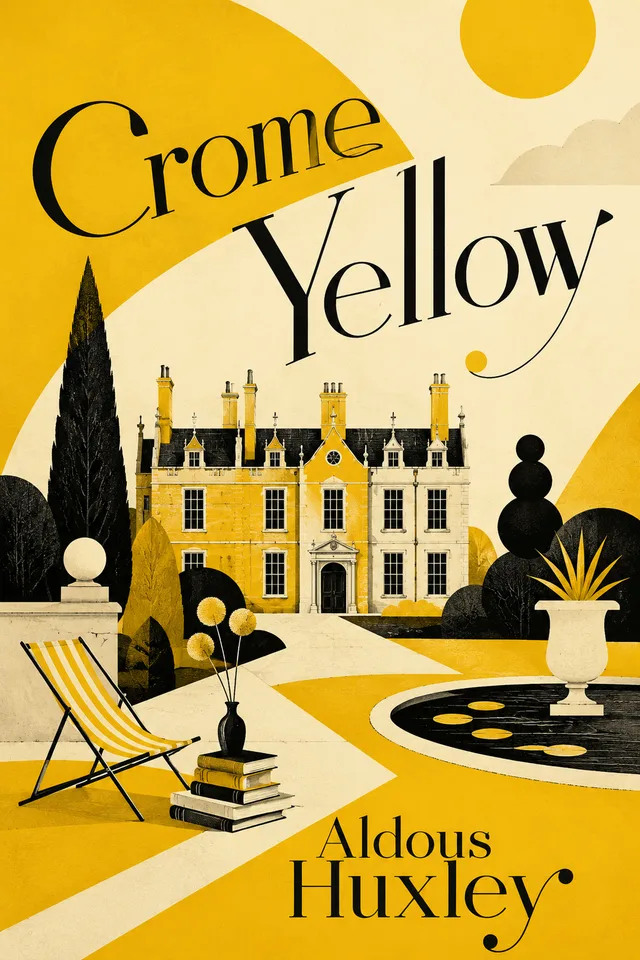
Crome Yellow
英语 BooksWhale 版本 · Aldous Huxley
A witty English country-house satire of postwar manners, art, philosophy, and modern intellectual life.
- 预览
- 文本节选
- 格式
- 在线阅读, EPUB, PDF
- 访问
- Library 获取
图书简介
Crome Yellow
Crome Yellow gathers artists, writers, thinkers, hosts, and young romantics in a brilliant country-house comedy. Aldous Huxley’s English original is ideal for readers of modernist satire, literary wit, intellectual fiction, postwar manners, and early twentieth-century style.
BooksWhale 版本
此版本如何整理
此版本基于公版文本,并由 BooksWhale 整理为适合数字阅读的版本。
公版依据
为什么此版本可以分享
Aldous Huxley died in 1963, and Crome Yellow was first published in 1921; these dates support the public-domain basis for this original English edition.
阅读预览
文本节选
预览选自整理后的阅读文本。
预览章节Full text阅读预览
Crome Yellow
Aldous Huxley
预览章节CHAPTER II.预览
He took nobody by surprise; there was nobody to take. All was quiet; Denis wandered from room to empty room, looking with pleasure at the familiar pictures and furniture, at all the little untidy signs of life that lay scattered here and there. He was rather glad that they were all out; it was amusing to wander through the house as though one were exploring a dead, deserted Pompeii. What sort of life would the excavator reconstruct from these remains; how would he people these empty chambers? There was the long gallery, with its rows of respectable and (though, of course, one couldn’t publicly admit it) rather boring Italian primitives, its Chinese sculptures, its unobtrusive, dateless furniture. There was the panelled drawing-room, where the huge chintz-covered arm-chairs stood, oases of comfort among the austere flesh-mortifying antiques. There was the morning-room, with its pale lemon walls, its painted Venetian chairs and rococo tables, its mirrors, its modern pictures. There was the library, cool, spacious, and dark,
预览章节book-lined from floor to ceiling, rich in portentous folios. There was预览
the dining-room, solidly, portwinily English, with its great mahogany table, its eighteenth-century chairs and sideboard, its eighteenth-century pictures--family portraits, meticulous animal paintings. What could one reconstruct from such data? There was much of Henry Wimbush in the long gallery and the library, something of Anne, perhaps, in the morning-room. That was all. Among the accumulations of ten generations the living had left but few traces.
Lying on the table in the morning-room he saw his own book of poems. What tact! He picked it up and opened it. It was what the reviewers call “a slim volume.” He read at hazard:
”...But silence and the topless dark
Vault in the lights of Luna Park;
And Blackpool from the nightly gloom
Hollows a bright tumultuous tomb.”
He put it down again, shook his head, and sighed. “What genius I had then!” he reflected, echoing the aged Swift. It was nearly six months since the book had been published; he was glad to think he would never write anything of the same sort again. Who could have been reading it, he wondered? Anne, perhaps; he liked to think so. Perhaps, too, she had at last recognised herself in the Hamadryad of the poplar sapling; the slim Hamadryad whose movements were like the swaying of a young tree in the wind. “The Woman who was a Tree” was what he had called the poem. He had given her the book when it came out, hoping that the poem would tell her what he hadn’t dared to say. She had never referred to it.
He shut his eyes and saw a vision of her in a red velvet cloak, swaying into the little restaurant where they sometimes dined together in London--three quarters of an hour late, and he at his table, haggard with anxiety, irritation, hunger. Oh, she was damnable!
It occurred to him that perhaps his hostess might be in her boudoir. It was a possibility; he would go and see. Mrs. Wimbush’s boudoir was in the central tower on the garden front. A little staircase cork-screwed up to it from the hall. Denis mounted, tapped at the door. “Come in.” Ah, she was there; he had rather hoped she wouldn’t be. He opened the door.
Priscilla Wimbush was lying on the sofa. A blotting-pad rested on her
“Hullo,” she said, looking up. “I’d forgotten you were coming.”
“Well, here I am, I’m afraid,” said Denis deprecatingly. “I’m awfully sorry.”
Mrs. Wimbush laughed. Her voice, her laughter, were deep and masculine. Everything about her was manly. She had a large, square, middle-aged face, with a massive projecting nose and little greenish eyes, the whole surmounted by a lofty and elaborate coiffure of a curiously improbable shade of orange. Looking at her, Denis always thought of Wilkie Bard as the cantatrice.
“That’s why I’m going to
Sing in op’ra, sing in op’ra,
Sing in op-pop-pop-pop-pop-popera.”
Today she was wearing a purple silk dress with a high collar and a row of pearls. The costume, so richly dowagerish, so suggestive of the Royal Family, made her look more than ever like something on the Halls.
“What have you been doing all this time?” she asked.
“Well,” said Denis, and he hesitated, almost voluptuously. He had a tremendously amusing account of London and its doings all ripe and ready in his mind. It would be a pleasure to give it utterance. “To begin with,” he said...
But he was too late. Mrs. Wimbush’s question had been what the grammarians call rhetorical; it asked for no answer. It was a little conversational flourish, a gambit in the polite game.
“You find me busy at my horoscopes,” she said, without even being aware that she had interrupted him.
A little pained, Denis decided to reserve his story for more receptive ears. He contented himself, by way of revenge, with saying “Oh?” rather icily.
目录
本版本内容
- 01Full text
- 02CHAPTER II.
- 03book-lined from floor to ceiling, rich in portentous folios. There was
- 04book. “Here’s the passage I was thinking of. I marked it. I always mark
- 05book with a clap and uttering her big profound laugh--“that reminds me
- 06CHAPTER III.
- 07CHAPTER IV.
- 08CHAPTER V.
- 09CHAPTER VI.
- 10introduction to the editor of “John o’ London’s Weekly”, or tell him
- 11book about the connection of the Subconscious with the Infinite. Get
- 12CHAPTER VII.
- 13CHAPTER VIII.
- 14CHAPTER IX.
- 15booksellers generally sell by weight. The mantelpiece, the over-mantel,
- 16CHAPTER X.
- 17book was called “The Stock Breeder’s Vade Mecum.”
- 18CHAPTER XI.
- 19CHAPTER XII.
- 20CHAPTER XIII.
- 21CHAPTER XIV.
- 22CHAPTER XV.
- 23activity of any importance in which laughter and pleasure preponderate,
- 24CHAPTER XVI.
- 25CHAPTER XVII.
- 26CHAPTER XVIII.
- 27CHAPTER XIX.
- 28book and taking off the pince-nez which he had just fitted to his
- 29party George alone was unhappy. Lord Timpany was paying his court to
- 30CHAPTER XX.
- 31CHAPTER XXI.
- 32CHAPTER XXII.
- 33CHAPTER XXIII.
- 34CHAPTER XXIV.
- 35particular, found the drawing-room deserted. He was about to go out into
- 36book represented, what they stood for and concretely symbolised. They
- 37CHAPTER XXV.
- 38CHAPTER XXVI.
- 39CHAPTER XXVII.
- 40CHAPTER XXVIII.
- 41actually performing this rather dangerous feat, an action as obvious, as
- 42CHAPTER XXIX.
- 43CHAPTER XXX.
- 44action, of doing something decisive. If only he’d just let things drift!