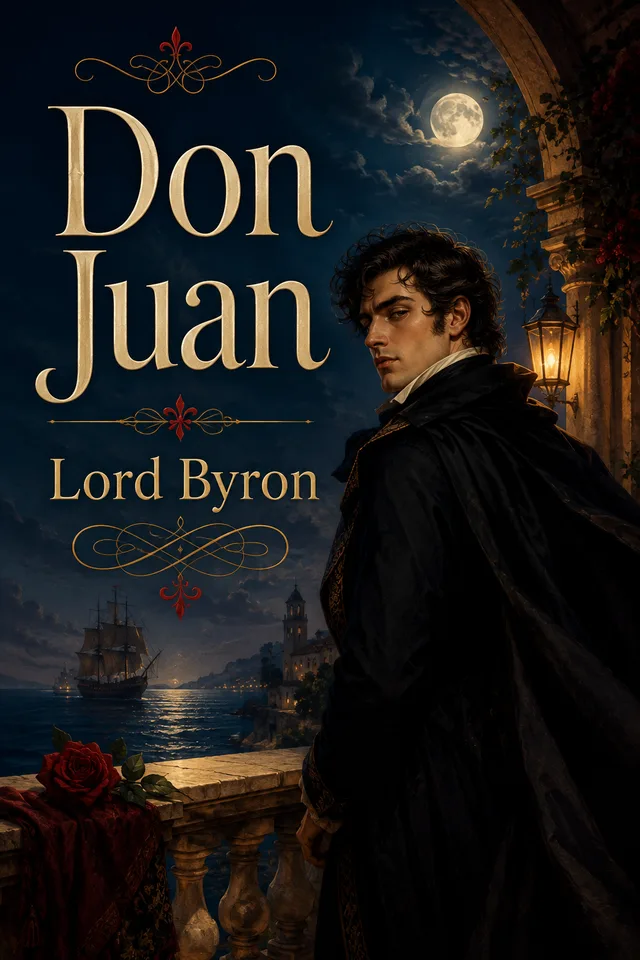
英语 版本
文学
Don Juan
英语 BooksWhale 版本 · Lord Byron
Byron's comic epic turns seduction, travel, politics, and society into dazzling satire.
- 预览
- 文本节选
- 格式
- 在线阅读, EPUB, PDF
- 访问
- Library 获取
图书简介
Don Juan
Don Juan follows its wandering hero through love affairs, shipwreck, war, court life, and social absurdity, all carried by Byron's brilliant satirical verse. This English edition presents the poem as a major work of Romantic wit and irony.
BooksWhale 版本
此版本如何整理
此版本基于公版文本,并由 BooksWhale 整理为适合数字阅读的版本。
公版依据
为什么此版本可以分享
Lord Byron died in 1824, and Don Juan began publication in 1819. These dates support the public-domain basis for the English source text used in this edition.
阅读预览
文本节选
预览选自整理后的阅读文本。
预览章节Full text阅读预览
Don Juan
Lord Byron
预览章节DEDICATION预览
Bob Southey! You’re a poet, poet laureate, And representative of all the race. Although ’tis true that you turned out a Tory at Last, yours has lately been a common case. And now my epic renegade, what are ye at With all the lakers, in and out of place? A nest of tuneful persons, to my eye Like four and twenty blackbirds in a pye,
Which pye being opened they began to sing’ (This old song and new simile holds good), ‘A dainty dish to set before the King’ Or Regent, who admires such kind of food. And Coleridge too has lately taken wing, But like a hawk encumbered with his hood, Explaining metaphysics to the nation. I wish he would explain his explanation.
You, Bob, are rather insolent, you know, At being disappointed in your wish To supersede all warblers here below, And be the only blackbird in the dish. And then you overstrain yourself, or so, And tumble downward like the flying fish Gasping on deck, because you soar too high, Bob, And fall for lack of moisture quite a dry Bob.
And Wordsworth in a rather long Excursion (I think the quarto holds five hundred pages) Has given a sample from the vasty version Of his new system to perplex the sages. ’Tis poetry, at least by his assertion, And may appear so when the Dog Star rages, And he who understands it would be able To add a story to the tower of Babel.
You gentlemen, by dint of long seclusion From better company, have kept your own At Keswick, and through still continued fusion Of one another’s minds at last have grown To deem, as a most logical conclusion, That poesy has wreaths for you alone. There is a narrowness in such a notion, Which makes me wish you’d change your lakes for ocean.
I would not imitate the petty thought, Nor coin my self-love to so base a vice, For all the glory your conversion brought, Since gold alone should not have been its price. You have your salary; was’t for that you wrought? And Wordsworth has his place in the Excise. You’re shabby fellows—true—but poets still And duly seated on the immortal hill.
Your bays may hide the baldness of your brows, Perhaps some virtuous blushes; let them go. To you I envy neither fruit nor boughs, And for the fame you would engross below, The field is universal and allows Scope to all such as feel the inherent glow. Scott, Rogers, Campbell, Moore, and Crabbe will try ’Gainst you the question with posterity.
For me, who, wandering with pedestrian Muses, Contend not with you on the winged’ steed, I wish your fate may yield ye, when she chooses, The fame you envy and the skill you need. And recollect a poet nothing loses In giving to his brethren their full meed Of merit, and complaint of present days Is not the certain path to future praise.
He that reserves his laurels for posterity (Who does not often claim the bright reversion) Has generally no great crop to spare it, he Being only injured by his own assertion. And although here and there some glorious rarity Arise like Titan from the sea’s immersion, The major part of such appellants go To—God knows where—for no one else can know.
If fallen in evil days on evil tongues, Milton appealed to the avenger, Time, If Time, the avenger, execrates his wrongs And makes the word Miltonic mean sublime, He deigned not to belie his soul in songs, Nor turn his very talent to a crime. He did not loathe the sire to laud the son, But closed the tyrant-hater he begun.
Think’st thou, could he, the blind old man, arise Like Samuel from the grave to freeze once more The blood of monarchs with his prophecies, Or be alive again—again all hoar With time and trials, and those helpless eyes And heartless daughters—worn and pale and poor, Would he adore a sultan? He obey The intellectual eunuch Castlereagh?
预览章节CANTO THE FIRST预览
I want a hero: an uncommon want, When every year and month sends forth a new one, Till, after cloying the gazettes with cant, The age discovers he is not the true one; Of such as these I should not care to vaunt, I’ll therefore take our ancient friend Don Juan— We all have seen him, in the pantomime, Sent to the devil somewhat ere his time.
Vernon, the butcher Cumberland, Wolfe, Hawke, Prince Ferdinand, Granby, Burgoyne, Keppel, Howe, Evil and good, have had their tithe of talk, And fill’d their sign posts then, like Wellesley now; Each in their turn like Banquo’s monarchs stalk, Followers of fame, ‘nine farrow’ of that sow: France, too, had Buonaparte and Dumourier Recorded in the Moniteur and Courier.
Barnave, Brissot, Condorcet, Mirabeau, Petion, Clootz, Danton, Marat, La Fayette, Were French, and famous people, as we know: And there were others, scarce forgotten yet, Joubert, Hoche, Marceau, Lannes, Desaix, Moreau, With many of the military set, Exceedingly remarkable at times, But not at all adapted to my rhymes.
Nelson was once Britannia’s god of war, And still should be so, but the tide is turn’d; There’s no more to be said of Trafalgar, ’Tis with our hero quietly inurn’d; Because the army ’s grown more popular, At which the naval people are concern’d; Besides, the prince is all for the land-service, Forgetting Duncan, Nelson, Howe, and Jervis.
Brave men were living before Agamemnon And since, exceeding valorous and sage, A good deal like him too, though quite the same none; But then they shone not on the poet’s page, And so have been forgotten:—I condemn none, But can’t find any in the present age Fit for my poem (that is, for my new one); So, as I said, I’ll take my friend Don Juan.
Most epic poets plunge ‘in medias res’ (Horace makes this the heroic turnpike road), And then your hero tells, whene’er you please, What went before—by way of episode, While seated after dinner at his ease, Beside his mistress in some soft abode, Palace, or garden, paradise, or cavern, Which serves the happy couple for a tavern.
That is the usual method, but not mine— My way is to begin with the beginning; The regularity of my design Forbids all wandering as the worst of sinning, And therefore I shall open with a line (Although it cost me half an hour in spinning) Narrating somewhat of Don Juan’s father, And also of his mother, if you’d rather.
In Seville was he born, a pleasant city, Famous for oranges and women—he Who has not seen it will be much to pity, So says the proverb—and I quite agree; Of all the Spanish towns is none more pretty, Cadiz perhaps—but that you soon may see; Don Juan’s parents lived beside the river, A noble stream, and call’d the Guadalquivir.
His father’s name was Jose—Don, of course,— A true Hidalgo, free from every stain Of Moor or Hebrew blood, he traced his source Through the most Gothic gentlemen of Spain; A better cavalier ne’er mounted horse, Or, being mounted, e’er got down again, Than Jose, who begot our hero, who Begot—but that ’s to come—Well, to renew:
His mother was a learned lady, famed For every branch of every science known In every Christian language ever named, With virtues equall’d by her wit alone, She made the cleverest people quite ashamed, And even the good with inward envy groan, Finding themselves so very much exceeded In their own way by all the things that she did.
Her memory was a mine: she knew by heart All Calderon and greater part of Lope, So that if any actor miss’d his part She could have served him for the prompter’s copy; For her Feinagle’s were an useless art, And he himself obliged to shut up shop—he Could never make a memory so fine as That which adorn’d the brain of Donna Inez.
目录
本版本内容
- 01Full text
- 02DEDICATION
- 03CANTO THE FIRST
- 04CANTO THE SECOND
- 05CANTO THE THIRD
- 06CANTO THE FOURTH
- 07CANTO THE FIFTH
- 08CANTO THE SIXTH
- 09CANTO THE SEVENTH
- 10CANTO THE EIGHTH
- 11CANTO THE NINTH
- 12CANTO THE TENTH
- 13CANTO THE ELEVENTH
- 14CANTO THE TWELFTH
- 15CANTO THE THIRTEENTH
- 16CANTO THE FOURTEENTH
- 17CANTO THE FIFTEENTH
- 18CANTO THE SIXTEENTH
- 19CANTO THE SEVENTEENTH