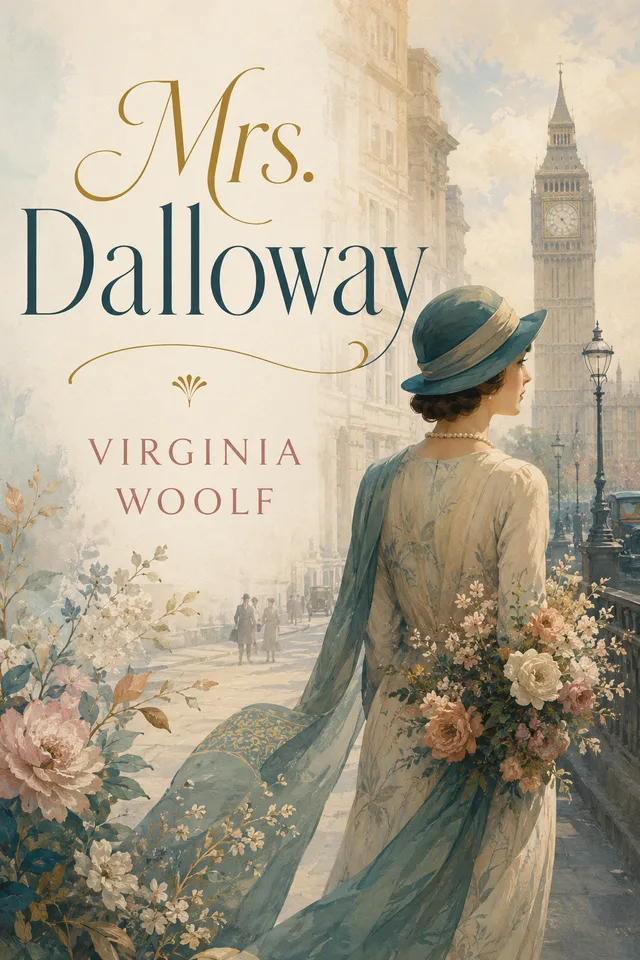
英语 版本
文学
Mrs. Dalloway
英语 BooksWhale 版本 · Virginia Woolf
A single-day modernist novel of memory, society, trauma, time, and inward life.
- 预览
- 文本节选
- 格式
- 在线阅读, EPUB, PDF
- 访问
- Library 获取
图书简介
Mrs. Dalloway
Mrs. Dalloway follows Clarissa Dalloway through London as she prepares a party, while other lives and memories cross the city. Virginia Woolf turns ordinary hours into a flowing study of consciousness, social performance, war trauma, and mortality.
BooksWhale 版本
此版本如何整理
此版本基于公版文本,并由 BooksWhale 整理为适合数字阅读的版本。
公版依据
为什么此版本可以分享
Virginia Woolf died in 1941, and Mrs. Dalloway was first published in 1925. These dates support the public-domain basis for this English original edition.
阅读预览
文本节选
预览选自整理后的阅读文本。
预览章节Part 1阅读预览
Mrs Dalloway
Virginia Woolf
MRS DALLOWAY said she would buy the flowers herself.
For Lucy had her work cut out for her. The doors would be taken off their hinges; Rumpelmayer’s men were coming. And then, thought Clarissa Dalloway, what a morning—fresh as if issued to children on a beach.
What a lark! What a plunge! For so it had always seemed to her when, with a little squeak of the hinges, which she could hear now, she had burst open the French windows and plunged at Bourton into the open air. How fresh, how calm, stiller than this of course, the air was in the early morning; like the flap of a wave; the kiss of a wave; chill and sharp and yet (for a girl of eighteen as she then was) solemn, feeling as she did, standing there at the open window, that something awful was about to happen; looking at the flowers, at the trees with the smoke winding off them and the rooks rising, falling; standing and looking until Peter Walsh said, ‘Musing among the vegetables?’—was that it?—‘I prefer men to cauliflowers’—was that it? He must have said it at breakfast one morning when she had gone out on to the terrace—Peter Walsh. He would be back from India one of these days, June or July, she forgot which, for his letters were awfully dull; it was his sayings one remembered; his eyes, his pocket-knife, his smile, his grumpiness and, when millions of things had utterly vanished—how strange it was!—a few sayings like this about cabbages.
She stiffened a little on the kerb, waiting for Durtnall’s van to pass. A charming woman, Scrope Purvis thought her (knowing her as one does know people who live next door to one in Westminster); a touch of the bird about her, of the jay, blue-green, light, vivacious, though she was over fifty, and grown very white since her illness. There she perched, never seeing him, waiting to cross, very upright.
For having lived in Westminster—how many years now? over twenty,—one feels even in the midst of the traffic, or waking at night, Clarissa was positive, a particular hush, or solemnity; an indescribable pause; a suspense (but that might be her heart, affected, they said, by influenza) before Big Ben strikes. There! Out it boomed. First a warning, musical; then the hour, irrevocable. The leaden circles dissolved in the air. Such fools we are, she thought, crossing Victoria Street. For Heaven only knows why one loves it so, how one sees it so, making it up, building it round one, tumbling it, creating it every moment afresh; but the veriest frumps, the most dejected of miseries sitting on doorsteps (drink their downfall) do the same; can’t be dealt with, she felt positive, by Acts of Parliament for that very reason: they love life. In people’s eyes, in the swing, tramp, and trudge; in the bellow and the uproar; the carriages, motor cars, omnibuses, vans, sandwich men shuffling and swinging; brass bands; barrel organs; in the triumph and the jingle and the strange high singing of some aeroplane overhead was what she loved; life; London; this moment of June.
For it was the middle of June. The War was over, except for some one like Mrs Foxcroft at the Embassy last night eating her heart out because that nice boy was killed and now the old Manor House must go to a cousin; or Lady Bexborough who opened a bazaar, they said, with the telegram in her hand, John, her favourite, killed; but it was over; thank Heaven—over. It was June. The King and Queen were at the Palace. And everywhere, though it was still so early, there was a beating, a stirring of galloping ponies, tapping of cricket bats; Lord’s, Ascot, Ranelagh and all the rest of it; wrapped the soft mesh of the grey-blue morning air, which, as the day wore on, would unwind them, and set down on their lawns and pitches the bouncing ponies, whose forefeet just struck the ground and up they sprung, the whirling young men, and laughing girls in their transparent muslins who, even now, after dancing all night, were taking their absurd woolly dogs for a run; and even now, at this hour, discreet old dowagers were shooting out in their motor cars on errands of mystery; and the shop-keepers were fidgeting in their windows with their paste and diamonds, their lovely old sea-green brooches in eighteenth-century settings to tempt Americans (but one must economize, not buy things rashly for Elizabeth), and she, too, loving it as she did with an absurd and faithful passion, being part of it, since her people were courtiers once in the time of the Georges, she, too, was going that very night to kindle and illuminate; to give her party. But how strange, on entering the Park, the silence; the mist; the hum; the slow-swimming happy ducks; the pouched birds waddling; and who should be coming along with his back against the Government buildings, most appropriately, carrying a despatch box stamped with the Royal Arms, who but Hugh Whitbread; her old friend Hugh—the admirable Hugh!
预览章节Part 2预览
It rasped her, though, to have stirring about in her this brutal monster! to hear twigs cracking and feel hooves planted down in the depths of that leaf-encumbered forest, the soul; never to be content quite, or quite secure, for at any moment the brute would be stirring, this hatred, which, especially since her illness, had power to make her feel scraped, hurt in her spine; gave her physical pain, and made all pleasure in beauty, in friendship, in being well, in being loved and making her home delightful, rock, quiver, and bend as if indeed there were a monster grubbing at the roots, as if the whole panoply of content were nothing but self love! this hatred!
Nonsense, nonsense! she cried to herself, pushing through the swing doors of Mulberry’s the florists.
She advanced, light, tall, very upright, to be greeted at once by button-faced Miss Pym, whose hands were always bright red, as if they had been stood in cold water with the flowers.
There were flowers: delphiniums, sweet peas, bunches of lilac; and carnations, masses of carnations. There were roses; there were irises. Ah yes—so she breathed in the earthy-garden sweet smell as she stood talking to Miss Pym who owed her help, and thought her kind, for kind she had been years ago; very kind, but she looked older, this year, turning her head from side to side among the irises and roses and nodding tufts of lilac with her eyes half closed, snuffing in, after the street uproar, the delicious scent, the exquisite coolness. And then, opening her eyes, how fresh, like frilled linen clean from a laundry laid in wicker trays, the roses looked; and dark and prim the red carnations, holding their heads up; and all the sweet peas spreading in their bowls, tinged violet, snow white, pale—as if it were the evening and girls in muslin frocks came out to pick sweet peas and roses after the superb summer’s day, with its almost blue-black sky, its delphiniums, its carnations, its arum lilies, was over; and it was the moment between six and seven when every flower—roses, carnations, irises, lilac—glows; white, violet, red, deep orange; every flower seems to burn by itself, softly, purely in the misty beds; and how she loved the grey white moths spinning in and out, over the cherry pie, over the evening primroses!
And as she began to go with Miss Pym from jar to jar, choosing, nonsense, nonsense, she said to herself, more and more gently, as if this beauty, this scent, this colour, and Miss Pym liking her, trusting her, were a wave which she let flow over her and surmount that hatred, that monster, surmount it all; and it lifted her up and up when—oh! a pistol shot in the street outside!
‘Dear, those motor cars,’ said Miss Pym, going to the window to look, and coming back and smiling apologetically with her hands full of sweet peas, as if those motor cars, those tyres of motor cars, were all her fault.
The violent explosion which made Mrs Dalloway jump and Miss Pym go to the window and apologize came from a motor car which had drawn to the side of the pavement precisely opposite Mulberry’s shop window. Passers-by, who, of course, stopped and stared, had just time to see a face of the very greatest importance against the dove-grey upholstery, before a male hand drew the blind and there was nothing to be seen except a square of dove grey.
Yet rumours were at once in circulation from the middle of Bond Street to Oxford Street on one side, to Atkinson’s scent shop on the other, passing invisibly, inaudibly, like a cloud, swift, veil-like upon hills, falling indeed with something of a cloud’s sudden sobriety and stillness upon faces which a second before had been utterly disorderly. But now mystery had brushed them with her wing; they had heard the voice of authority; the spirit of religion was abroad with her eyes bandaged tight and her lips gaping wide. But nobody knew whose face had been seen. Was it the Prince of Wales’s, the Queen’s, the Prime Minister’s? Whose face was it? Nobody knew.
预览章节Part 3预览
Lucrezia Warren Smith, sitting by her husband’s side on a seat in Regent’s Park in the Broad Walk, looked up.
‘Look, look, Septimus!’ she cried. For Dr Holmes had told her to make her husband (who had nothing whatever seriously the matter with him but was a little out of sorts) take an interest in things outside himself.
So, thought Septimus, looking up, they are signalling to me. Not indeed in actual words; that is, he could not read the language yet; but it was plain enough, this beauty, this exquisite beauty, and tears filled his eyes as he looked at the smoke words languishing and melting in the sky and bestowing upon him, in their inexhaustible charity and laughing goodness, one shape after another of unimaginable beauty and signalling their intention to provide him, for nothing, for ever, for looking merely, with beauty, more beauty! Tears ran down his cheeks.
It was toffee; they were advertising toffee, a nursemaid told Rezia. Together they began to spell t . . . o . . . f . . .
‘K . . . R . . .’ said the nursemaid, and Septimus heard her say ‘Kay Arr’ close to his ear, deeply, softly, like a mellow organ, but with a roughness in her voice like a grasshopper’s, which rasped his spine deliciously and sent running up into his brain waves of sound, which, concussing, broke. A marvellous discovery indeed—that the human voice in certain atmospheric conditions (for one must be scientific, above all scientific) can quicken trees into life! Happily Rezia put her hand down with a tremendous weight on his knee so that he was weighted down, transfixed, or the excitement of the elm trees rising and falling, rising and falling with all their leaves alight and the colour thinning and thickening from blue to the green of a hollow wave, like plumes on horses’ heads, feathers on ladies’, so proudly they rose and fell, so superbly, would have sent him mad. But he would not go mad. He would shut his eyes; he would see no more.
But they beckoned; leaves were alive; trees were alive. And the leaves being connected by millions of fibres with his own body, there on the seat, fanned it up and down; when the branch stretched he, too, made that statement. The sparrows fluttering, rising, and falling in jagged fountains were part of the pattern; the white and blue, barred with black branches. Sounds made harmonies with premeditation; the spaces between them were as significant as the sounds. A child cried. Rightly far away a horn sounded. All taken together meant the birth of a new religion——
‘Septimus!’ said Rezia. He started violently. People must notice.
‘I am going to walk to the fountain and back,’ she said.
For she could stand it no longer. Dr Holmes might say there was nothing the matter. Far rather would she that he were dead! She could not sit beside him when he stared so and did not see her and made everything terrible; sky and tree, children playing, dragging carts, blowing whistles, falling down; all were terrible. And he would not kill himself; and she could tell no one. ‘Septimus has been working too hard’—that was all she could say to her own mother. To love makes one solitary, she thought. She could tell nobody, not even Septimus now, and looking back, she saw him sitting in his shabby overcoat alone, on the seat, hunched up, staring. And it was cowardly for a man to say he would kill himself, but Septimus had fought; he was brave; he was not Septimus now. She put on her lace collar. She put on her new hat and he never noticed; and he was happy without her. Nothing could make her happy without him! Nothing! He was selfish. So men are. For he was not ill. Dr Holmes said there was nothing the matter with him. She spread her hand before her. Look! Her wedding ring slipped—she had grown so thin. It was she who suffered—but she had nobody to tell.
目录
本版本内容
- 01Part 1
- 02Part 2
- 03Part 3
- 04Part 4
- 05Part 5
- 06Part 6
- 07Part 7
- 08Part 8
- 09Part 9
- 10Part 10
- 11Part 11
- 12Part 12
- 13Part 13
- 14Part 14
- 15Part 15
- 16Part 16
- 17Part 17
- 18Part 18
- 19Part 19
- 20Part 20
- 21Part 21
语言版本
其他语言
法语
法语 版本
Mrs Dalloway
Virginia Woolf · 文学
Une journée londonienne devient une exploration subtile de la mémoire, du désir et du temps intérieur.
德语
德语 版本
Mrs. Dalloway
Virginia Woolf · 文学
Virginia Woolfs moderner Roman folgt einem Londoner Tag voller Erinnerung, Bewusstsein und sozialer Spannung.
意大利语
意大利语 版本
La signora Dalloway
Virginia Woolf · 文学
La versione italiana del romanzo modernista di Virginia Woolf su Clarissa Dalloway e una giornata londinese.