英语 版本
经济
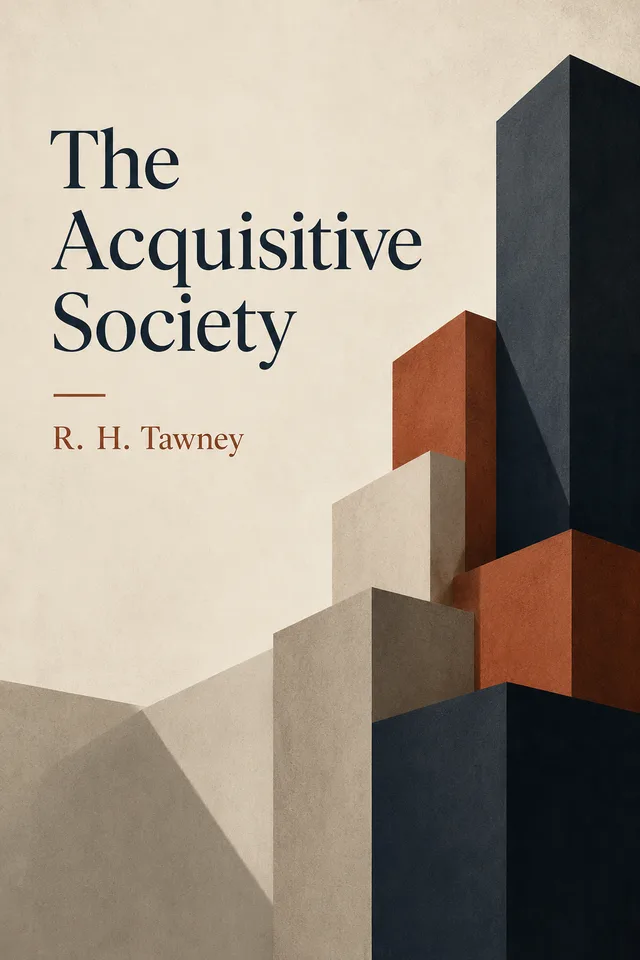
The Acquisitive Society
英语 BooksWhale 版本 · R. H. Tawney
A sharp social-economic critique of profit, property, work, inequality, and industrial responsibility.
- 预览
- 文本节选
- 格式
- 在线阅读, EPUB, PDF
- 访问
- Library 获取
图书简介
The Acquisitive Society
The Acquisitive Society challenges an economy organized around gain rather than service. Tawney argues for social purpose, responsible property, meaningful labor, and institutions that put human needs above competitive accumulation.
BooksWhale 版本
此版本如何整理
此版本基于公版文本,并由 BooksWhale 整理为适合数字阅读的版本。
公版依据
为什么此版本可以分享
The Acquisitive Society was first published in 1920. Its pre-1931 publication date supports the public-domain status of this English original text in the United States.
阅读预览
文本节选
预览选自整理后的阅读文本。
预览章节Full text阅读预览
The Acquisitive Society
R. H. Tawney
预览章节INTRODUCTORY预览
It is a commonplace that the characteristic virtue of Englishmen is their power of sustained practical activity, and their characteristic vice a reluctance to test the quality of that activity by reference to principles. They are incurious as to theory, take fundamentals for granted, and are more interested in the state of the roads than in their place on the map. And it might fairly be argued that in ordinary times that combination of intellectual tameness with practical energy is sufficiently serviceable to explain, if not to justify, the equanimity with which its possessors bear the criticism of more mentally adventurous nations. It is the mood of those who have made their bargain with fate and are content to take what it offers without re-opening the deal. It leaves the mind free to concentrate undisturbed upon profitable activities, because it is not distracted by a taste for unprofitable speculations. Most generations, it might be said, walk in a path which they neither make, nor discover, but accept; the main thing is that they should march. The blinkers worn by Englishmen enable them to trot all the more steadily along the beaten road, without being disturbed by curiosity as to their destination.
But if the medicine of the constitution ought not to be made its daily food, neither can its daily food be made its medicine. There are times which are not ordinary, and in such times it is not enough to follow the road. It is necessary to know where it leads, and, if it leads nowhere, to follow another. The search for another involves reflection, which is uncongenial to the bustling people who describe themselves as practical, because they take things as they are and leave them as they are. But the practical thing for a traveler who is uncertain of his path is not to proceed with the utmost rapidity in the wrong direction: it is to consider how to find the right one. And the practical thing for a nation which has stumbled upon one of the turning-points of history is not to behave as though nothing very important were involved, as if it did not matter whether it turned to the right or to the left, went up hill or down dale, provided that it continued doing with a little more energy what it has done hitherto; but to consider whether what it has done hitherto is wise, and, if it is not wise, to alter it. When the broken ends of its industry, its politics, its social organization, have to be pieced together after a catastrophe, it must make a decision; for it makes a decision even if it refuses to decide. If it is to make a decision which will wear, it must travel beyond the philosophy momentarily in favor with the proprietors of its newspapers. Unless it is to move with the energetic futility of a squirrel in a revolving cage, it must have a clear
apprehension both of the deficiency of what is, and of the
character of what ought to be. And to obtain this apprehension it must appeal to some standard more stable than the momentary exigencies of its commerce or industry or social life, and judge them by it. It
must, in short, have recourse to Principles.
Such considerations are, perhaps, not altogether irrelevant at a time when facts have forced upon Englishmen the reconsideration of their social institutions which no appeal to theory could induce them to
undertake. An appeal to principles is the condition of any
considerable reconstruction of society, because social institutions are the visible expression of the scale of moral values which rules the minds of individuals, and it is impossible to alter institutions without altering that moral valuation. Parliament, industrial organizations, the whole complex machinery through which society expresses itself, is a mill which grinds only what is put into it, and when nothing is put into it grinds air. There are many, of course, who desire no alteration, and who, when it is attempted, will oppose it. They have found the existing economic order profitable in the past. They desire only such changes as will insure that it is equally profitable in the future. _Quand le Roi avait bu, la Pologne etait ivre_. They are genuinely unable to understand why their countrymen cannot bask happily by the fire which warms themselves, and ask, like the French farmer-general:--"When everything goes so happily, why trouble to change it?" Such persons are to be pitied, for they lack the social quality which is proper to man. But they do not need argument; for Heaven has denied them one of the faculties required to
预览章节II预览
II
目录
本版本内容
- 01Full text
- 02INTRODUCTORY
- 03II
- 04RIGHTS AND FUNCTIONS
- 05part of the sixteenth century was commonly conceived, to be the
- 06part of government which had been concerned with social administration,
- 07III
- 08THE ACQUISITIVE SOCIETY
- 09IV
- 10THE NEMESIS OF INDUSTRIALISM
- 11V
- 12PROPERTY AND CREATIVE WORK
- 13conclusion.
- 141. Property in payments made for personal services.
- 152. Property in personal possessions necessary to health and comfort.
- 163. Property in land and tools used by their owners.
- 174. Property in copyright and patent rights owned by authors and
- 185. Property in pure interest, including much agricultural rent.
- 196. Property in profits of luck and good fortune: "quasi-rents."
- 207. Property in monopoly profits.
- 218. Property in urban ground rents.
- 229. Property in royalties.
- 23part of modern property, whether, like mineral rights and urban
- 24VI
- 25THE FUNCTIONAL SOCIETY
- 26part of the system which, under the name of private property, Mr.
- 27VII
- 28INDUSTRY AS A PROFESSION
- 29VIII
- 30THE "VICIOUS CIRCLE"
- 31IX
- 32THE CONDITION OF EFFICIENCY
- 33part of the rank and file of workers would do more to contribute to
- 34X
- 35THE POSITION OF THE BRAIN WORKER
- 36XI
- 37PORRO UNUM NECESSARIUM