英语 版本
文学
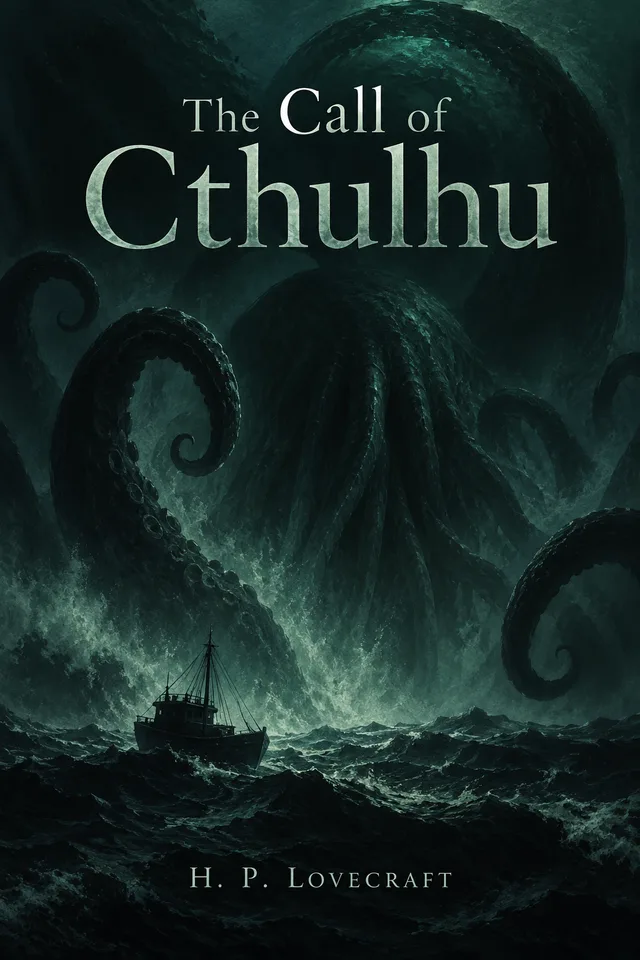
The Call of Cthulhu
英语 BooksWhale 版本 · H. P. Lovecraft
A cosmic-horror story in which an ancient presence reaches into dreams, cults, and the fragile limits of human knowledge.
- 预览
- 文本节选
- 格式
- 在线阅读, EPUB, PDF
- 访问
- Library 获取
图书简介
The Call of Cthulhu
Lovecraft’s “The Call of Cthulhu” moves from scattered testimonies to a terrifying pattern: forbidden images, secret worship, and a vast entity waiting beyond ordinary history. Its blend of investigative structure and cosmic dread made it a defining work of modern horror.
BooksWhale 版本
此版本如何整理
此版本基于公版文本,并由 BooksWhale 整理为适合数字阅读的版本。
公版依据
为什么此版本可以分享
The author died before 1955 and the work was first published before 1931; the original English text is treated as public-domain source material for this edition.
阅读预览
文本节选
预览选自整理后的阅读文本。
预览章节Full text阅读预览
The Call of Cthulhu
H. P. Lovecraft
"Of such great powers or beings there may be conceivably a survival ... a survival of a hugely remote period when ... consciousness was manifested, perhaps, in shapes and forms long since withdrawn before the tide of advancing humanity ... forms of which poetry and legend alone have caught a flying memory and called them gods, monsters, mythical beings of all sorts and kinds...."
—Algernon Blackwood.
"The ring of worshipers moved in endless bacchanale between the ring of bodies and the ring of fire."
预览章节1. The Horror in Clay.预览
The most merciful thing in the world, I think, is the inability of the human mind to correlate all its contents. We live on a placid island of ignorance in the midst of black seas of infinity, and it was not meant that we should voyage far. The sciences, each straining in its own direction, have hitherto harmed us little; but some day the piecing together of dissociated knowledge will open up such terrifying vistas of reality, and of our frightful position therein, that we shall either go mad from the revelation or flee from the deadly light into the peace and safety of a new dark age.
Theosophists have guessed at the awesome grandeur of the cosmic cycle wherein our world and human race form transient incidents. They have hinted at strange survivals in terms which would freeze the blood if not masked by a bland optimism. But it is not from them that there came the single glimpse of forbidden eons which chills me when I think of it and maddens me when I dream of it. That glimpse, like all dread glimpses of truth, flashed out from an accidental piecing together of separated things—in this case an old newspaper item and the notes of a dead professor. I hope that no one else will accomplish this piecing out; certainly, if I live, I shall never knowingly supply a link in so hideous a chain. I think that the professor, too, intended to keep silent regarding the part he knew, and that he would have destroyed his notes had not sudden death seized him.
My knowledge of the thing began in the winter of 1926-27 with the death of my grand-uncle, George Gammell Angell, Professor Emeritus of Semitic languages in Brown University, Providence, Rhode Island. Professor Angell was widely known as an authority on ancient inscriptions, and had frequently been resorted to by the heads of prominent museums; so that his passing at the age of ninety-two may be recalled by many. Locally, interest was intensified by the obscurity of the cause of death. The professor had been stricken whilst returning from the Newport boat; falling suddenly, as witnesses said, after having been jostled by a nautical-looking negro who had come from one of the queer dark courts on the precipitous hillside which formed a short cut from the waterfront to the deceased's home in Williams Street. Physicians were unable to find any visible disorder, but concluded after perplexed debate that some obscure lesion of the heart, induced by the brisk ascent of so steep a hill by so elderly a man, was responsible for the end. At the time I saw no reason to dissent from this dictum, but latterly I am inclined to wonder—and more than wonder.
As my granduncle's heir and executor, for he died a childless widower, I was expected to go over his papers with some thoroughness; and for that purpose moved his entire set of files and boxes to my quarters in Boston. Much of the material which I correlated will be later published by the American Archeological Society, but there was one box which I found exceedingly puzzling, and which I felt much averse from showing to other eyes. It had been locked, and I did not find the key till it occurred to me to examine the personal ring which the professor carried always in his pocket. Then, indeed, I succeeded in opening it, but when I did so seemed only to be confronted by a greater and more closely locked barrier. For what could be the meaning of the queer clay bas-relief and the disjointed jottings, ramblings, and cuttings which I found? Had my uncle, in his latter years, become credulous of the most superficial impostures? I resolved to search out the eccentric sculptor responsible for this apparent disturbance of an old man's peace of mind.
The bas-relief was a rough rectangle less than an inch thick and about five by six inches in area; obviously of modern origin. Its designs, however, were far from modern in atmosphere and suggestion; for, although the vagaries of cubism and futurism are many and wild, they do not often reproduce that cryptic regularity which lurks in prehistoric writing. And writing of some kind the bulk of these designs seemed certainly to be; though my memory, despite much familiarity with the papers and collections of my uncle, failed in any way to identify this particular species, or even hint at its remotest affiliations.
预览章节2. The Tale of Inspector Legrasse.预览
The older matters which had made the sculptor's dream and bas-relief so significant to my uncle formed the subject of the second half of his long manuscript. Once before, it appears, Professor Angell had seen the hellish outlines of the nameless monstrosity, puzzled over the unknown hieroglyphics, and heard the ominous syllables which can be rendered only as "Cthulhu"; and all this in so stirring and horrible a connection that it is small wonder he pursued young Wilcox with queries and demands for data.
This earlier experience had come in 1908, seventeen years before, when the American Archeological Society held its annual meeting in St. Louis. Professor Angell, as befitted one of his authority and attainments, had had a prominent part in all the deliberations; and was one of the first to be approached by the several outsiders who took advantage of the convocation to offer questions for correct answering and problems for expert solution.
The chief of these outsiders, and in a short time the focus of interest for the entire meeting, was a commonplace-looking middle-aged man who had traveled all the way from New Orleans for certain special information unobtainable from any local source. His name was John Raymond Legrasse, and he was by profession an inspector of police. With him he bore the subject of his visit, a grotesque, repulsive, and apparently very ancient stone statuette whose origin he was at a loss to determine.
It must not be fancied that Inspector Legrasse had the least interest in archeology. On the contrary, his wish for enlightenment was prompted by purely professional considerations. The statuette, idol, fetish, or whatever it was, had been captured some months before in the wooded swamps south of New Orleans during a raid on a supposed voodoo meeting; and so singular and hideous were the rites connected with it, that the police could not but realize that they had stumbled on a dark cult totally unknown to them, and infinitely more diabolic than even the blackest of the African voodoo circles. Of its origin, apart from the erratic and unbelievable tales extorted from the captured members, absolutely nothing was to be discovered; hence the anxiety of the police for any antiquarian lore which might help them to place the frightful symbol, and through it track down the cult to its fountain-head.
Inspector Legrasse was scarcely prepared for the sensation which his offering created. One sight of the thing had been enough to throw the assembled men of science into a state of tense excitement, and they lost no time in crowding around him to gaze at the diminutive figure whose utter strangeness and air of genuinely abysmal antiquity hinted so potently at unopened and archaic vistas. No recognized school of sculpture had animated this terrible object, yet centuries and even thousands of years seemed recorded in its dim and greenish surface of unplaceable stone.
The figure, which was finally passed slowly from man to man for close and careful study, was between seven and eight inches in height, and of exquisitely artistic workmanship. It represented a monster of vaguely anthropoid outline, but with an octopuslike head whose face was a mass of feelers, a scaly, rubbery-looking body, prodigious claws on hind and fore feet, and long, narrow wings behind. This thing, which seemed instinct with a fearsome and unnatural malignancy, was of a somewhat bloated corpulence, and squatted evilly on a rectangular block or pedestal covered with undecipherable characters. The tips of the wings touched the back edge of the block, the seat occupied the center, whilst the long, curved claws of the doubled-up, crouching hind legs gripped the front edge and extended a quarter of the way down toward the bottom of the pedestal. The cephalopod head was bent forward, so that the ends of the facial feelers brushed the backs of huge forepaws which clasped the croucher's elevated knees. The aspect of the whole was abnormally lifelike, and the more subtly fearful because its source was so totally unknown. Its vast, awesome, and incalculable age was unmistakable; yet not one link did it show with any known type of art belonging to civilization's youth—or indeed to any other time.
目录
本版本内容
- 01Full text
- 021. The Horror in Clay.
- 032. The Tale of Inspector Legrasse.
- 043. The Madness from the Sea.
- 05MYSTERY DERELICT FOUND AT SEA