英语 版本
教育
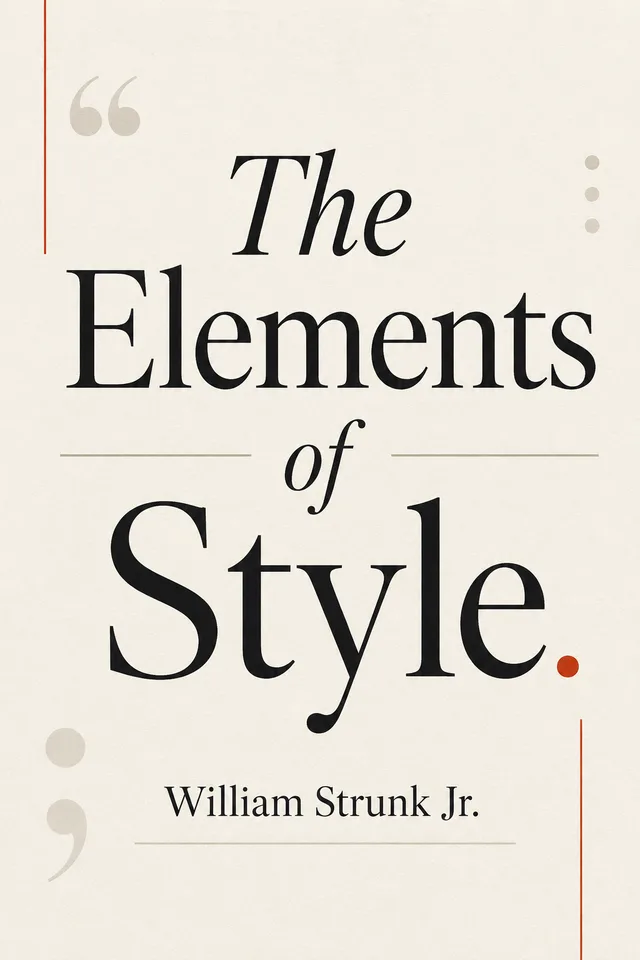
The Elements of Style
英语 BooksWhale 版本 · William Strunk Jr.
A classic education work on English usage, composition, grammar, concision, clarity, and practical writing style.
- 预览
- 文本节选
- 格式
- 在线阅读, EPUB, PDF
- 访问
- Library 获取
图书简介
The Elements of Style
The Elements of Style is a public-domain English classic by William Strunk Jr., centered on English usage, composition, grammar, concision, clarity, and practical writing style. This BooksWhale edition highlights the original text for readers interested in classic literature, historical context, and searchable online reading.
BooksWhale 版本
此版本如何整理
此版本基于公版文本,并由 BooksWhale 整理为适合数字阅读的版本。
公版依据
为什么此版本可以分享
William Strunk Jr. died in 1946, and The Elements of Style was first published in 1918. These dates support the public-domain basis for this English original edition.
阅读预览
文本节选
预览选自整理后的阅读文本。
预览章节Full text阅读预览
The Elements of Style
William Strunk Jr.
预览章节I. INTRODUCTORY预览
This book aims to give in brief space the principal requirements of plain English style. It aims to lighten the task of instructor and student by concentrating attention (in Chapters II and III) on a few essentials, the rules of usage and principles of composition most commonly violated. In accordance with this plan it lays down three rules for the use of the comma, instead of a score or more, and one for the use of the semicolon, in the belief that these four rules provide for all the internal punctuation that is required by nineteen sentences out of twenty. Similarly, it gives in Chapter III only those principles of the paragraph and the sentence which are of the widest application. The book thus covers only a small portion of the field of English style. The experience of its writer has been that once past the essentials, students profit most by individual instruction based on the problems of their own work, and that each instructor has his own body of theory, which he may prefer to that offered by any textbook.
The numbers of the sections may be used as references in correcting manuscript.
The writer's colleagues in the Department of English in Cornell
University have greatly helped him in the preparation of his manuscript.
Mr. George McLane Wood has kindly consented to the inclusion under
Rule 10 of some material from his _Suggestions to Authors_.
The following books are recommended for reference or further study: in connection with Chapters II and IV, F. Howard Collins, _Author and Printer_ (Henry Frowde); Chicago University Press, _Manual of Style_; T. L. De Vinne, _Correct Composition_ (The Century Company); Horace Hart, _Rules for Compositors and Printers_ (Oxford University Press); George McLane Wood, _Extracts from the Style-Book of the Government Printing Office_ (United States Geological Survey); in connection with Chapters III and V, _The King's English_ (Oxford University Press); Sir Arthur Quiller-Couch, _The Art of Writing_ (Putnam), especially the chapter, Interlude on Jargon; George McLane Wood, _Suggestions to Authors_ (United States Geological Survey); John Lesslie Hall, _English Usage_ (Scott, Foresman and Co.); James P. Kelley, _Workmanship in Words_ (Little, Brown and Co.). In these will be found full discussions of many points here briefly treated and an abundant store of
It is an old observation that the best writers sometimes disregard the rules of rhetoric. When they do so, however, the reader will usually find in the sentence some compensating merit, attained at the cost of the violation. Unless he is certain of doing as well, he will probably do best to follow the rules. After he has learned, by their guidance, to write plain English adequate for everyday uses, let him look, for the secrets of style, to the study of the masters of literature.
预览章节II. ELEMENTARY RULES OF USAGE预览
1. Form the possessive singular of nouns by adding 's.
Follow this rule whatever the final consonant. Thus write,
Charles's friend
Burns's poems
the witch's malice
This is the usage of the United States Government Printing Office and of the Oxford University Press.
Exceptions are the possessive of ancient proper names in _-es_ and
_-is_, the possessive _Jesus'_, and such forms as _for conscience'
sake_, _for righteousness' sake_. But such forms as _Achilles' heel_,
_Moses' laws_, _Isis' temple_ are commonly replaced by
the heel of Achilles
the laws of Moses
the temple of Isis
The pronominal possessives _hers_, _its_, _theirs_, _yours_, and _oneself_ have no apostrophe.
2. In a series of three or more terms with a single conjunction, use a comma after each term except the last.
Thus write,
red, white, and blue
gold, silver, or copper
He opened the letter, read it, and made a note of its contents.
This is also the usage of the Government Printing Office and of the Oxford University Press.
In the names of business firms the last comma is omitted, as,
Brown, Shipley & Co.
3. Enclose parenthetic expressions between commas.
The best way to see a country, unless you are pressed for time, is to travel on foot.
This rule is difficult to apply; it is frequently hard to decide whether
a single word, such as _however_, or a brief phrase, is or is not
parenthetic. If the interruption to the flow of the sentence is but
slight, the writer may safely omit the commas. But whether the
interruption be slight or considerable, he must never insert one comma
and omit the other. Such punctuation as
Marjorie's husband, Colonel Nelson paid us a visit yesterday,
or
My brother you will be pleased to hear, is now in perfect health,
is indefensible.
If a parenthetic expression is preceded by a conjunction, place the first comma before the conjunction, not after it.
He saw us coming, and unaware that we had learned of his treachery, greeted us with a smile.
Always to be regarded as parenthetic and to be enclosed between commas
(or, at the end of the sentence, between comma and period) are the
following:
(1) the year, when forming part of a date, and the day of the month, when following the day of the week:
February to July, 1916.
April 6, 1917.
Monday, November 11, 1918.
(2) the abbreviations _etc._ and _jr._
(3) non-restrictive relative clauses, that is, those which do not serve
to identify or define the antecedent noun, and similar clauses
introduced by conjunctions indicating time or place.
The audience, which had at first been indifferent, became more and more interested.
In this sentence the clause introduced by _which_ does not serve to tell which of several possible audiences is meant; what audience is in question is supposed to be already known. The clause adds, parenthetically, a statement supplementing that in the main clause. The sentence is virtually a combination of two statements which might have been made independently:
The audience had at first been indifferent. It became more and more interested.
Compare the restrictive relative clause, not set off by commas, in the sentence,
The candidate who best meets these requirements will obtain the place.
Here the clause introduced by _who_ does serve to tell which of several possible candidates is meant; the sentence cannot be split up into two independent statements.
The difference in punctuation in the two sentences following is based on the same principle:
Nether Stowey, where Coleridge wrote _The Rime of the Ancient Mariner_, is a few miles from Bridgewater.
The day will come when you will admit your mistake.
Nether Stowey is completely identified by its name; the statement about Coleridge is therefore supplementary and parenthetic. The _day_ spoken of is identified only by the dependent clause, which is therefore restrictive.
Similar in principle to the enclosing of parenthetic expressions between
commas is the setting off by commas of phrases or dependent clauses
目录
本版本内容
- 01Full text
- 02I. INTRODUCTORY
- 03II. ELEMENTARY RULES OF USAGE
- 04III. ELEMENTARY PRINCIPLES OF COMPOSITION
- 05IV. A FEW MATTERS OF FORM
- 06Chapter XII
- 07V. WORDS AND EXPRESSIONS COMMONLY MISUSED
- 08VI. SPELLING
- 09WORDS OFTEN MISSPELLED
- 10VII. EXERCISES ON CHAPTERS II AND III