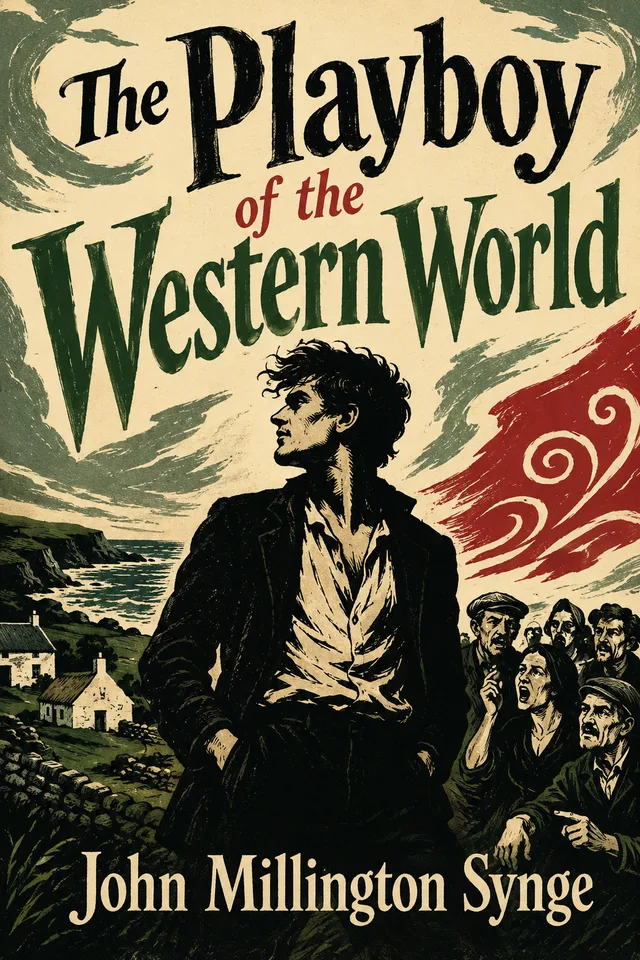
英语 版本
文学
The Playboy of the Western World
英语 BooksWhale 版本 · John Millington Synge
A landmark Irish drama of myth, scandal, rural speech, violence, romance, and comic identity.
- 预览
- 文本节选
- 格式
- 在线阅读, EPUB, PDF
- 访问
- Library 获取
图书简介
The Playboy of the Western World
The Playboy of the Western World is John Millington Synge’s celebrated Irish play of storytelling, desire, local legend, and public scandal. This English original is essential for readers of Irish drama, comic theatre, rural speech, modern stage classics, and literary controversy.
BooksWhale 版本
此版本如何整理
此版本基于公版文本,并由 BooksWhale 整理为适合数字阅读的版本。
公版依据
为什么此版本可以分享
John Millington Synge died in 1909, and The Playboy of the Western World was first published in 1907; these dates support the public-domain basis for this original English edition.
阅读预览
文本节选
预览选自整理后的阅读文本。
预览章节Full text阅读预览
The Playboy of the Western World
John Millington Synge
预览章节PREFACE预览
In writing THE PLAYBOY OF THE WESTERN WORLD, as in my other plays, I
have used one or two words only that I have not heard among the country
people of Ireland, or spoken in my own nursery before I could read the
newspapers. A certain number of the phrases I employ I have heard also
from herds and fishermen along the coast from Kerry to Mayo, or from
beggar-women and ballad-singers nearer Dublin; and I am glad to
acknowledge how much I owe to the folk imagination of these fine
people. Anyone who has lived in real intimacy with the Irish peasantry
will know that the wildest sayings and ideas in this play are tame
indeed, compared with the fancies one may hear in any little hillside
cabin in Geesala, or Carraroe, or Dingle Bay. All art is a
collaboration; and there is little doubt that in the happy ages of
literature, striking and beautiful phrases were as ready to the
story-teller’s or the playwright’s hand, as the rich cloaks and dresses
of his time. It is probable that when the Elizabethan dramatist took
his ink-horn and sat down to his work he used many phrases that he had
just heard, as he sat at dinner, from his mother or his children. In
Ireland, those of us who know the people have the same privilege. When
I was writing _The Shadow of the Glen_, some years ago, I got more aid
than any learning could have given me from a chink in the floor of the
old Wicklow house where I was staying, that let me hear what was being
said by the servant girls in the kitchen. This matter, I think, is of
importance, for in countries where the imagination of the people, and
the language they use, is rich and living, it is possible for a writer
to be rich and copious in his words, and at the same time to give the
reality, which is the root of all poetry, in a comprehensive and
natural form. In the modern literature of towns, however, richness is
found only in sonnets, or prose poems, or in one or two elaborate books
that are far away from the profound and common interests of life. One
has, on one side, Mallarmé and Huysmans producing this literature; and
on the other, Ibsen and Zola dealing with the reality of life in
joyless and pallid words. On the stage one must have reality, and one
must have joy; and that is why the intellectual modern drama has
failed, and people have grown sick of the false joy of the musical
comedy, that has been given them in place of the rich joy found only in
what is superb and wild in reality. In a good play every speech should
be as fully flavoured as a nut or apple, and such speeches cannot be
written by anyone who works among people who have shut their lips on
poetry. In Ireland, for a few years more, we have a popular imagination
that is fiery and magnificent, and tender; so that those of us who wish
to write start with a chance that is not given to writers in places
where the springtime of the local life has been forgotten, and the
harvest is a memory only, and the straw has been turned into bricks.
J. M. S.
_January_ 21_st_, 1907.
预览章节PERSONS预览
CHRISTOPHER MAHON.
OLD MAHON, _his father, a squatter_.
MICHAEL JAMES FLAHERTY (called MICHAEL JAMES), _a publican_.
MARGARET FLAHERTY (called PEGEEN MIKE), _his daughter_.
SHAWN KEOUGH, _her cousin, a young farmer_.
WIDOW QUIN, _a woman of about thirty_.
PHILLY CULLEN and JIMMY FARRELL, _small farmers_.
SARA TANSEY, SUSAN BRADY, and HONOR BLAKE, _village girls_.
A BELLMAN.
SOME PEASANTS.
The action takes place near a village, on a wild coast of Mayo. The
first Act passes on an evening of autumn, the other two Acts on the
following day.
目录
本版本内容
- 01Full text
- 02PREFACE
- 03PERSONS
- 04ACT I.
- 05ACT II.
- 06SARAH
- 07SUSAN
- 08ACT III.