英语 版本
文学
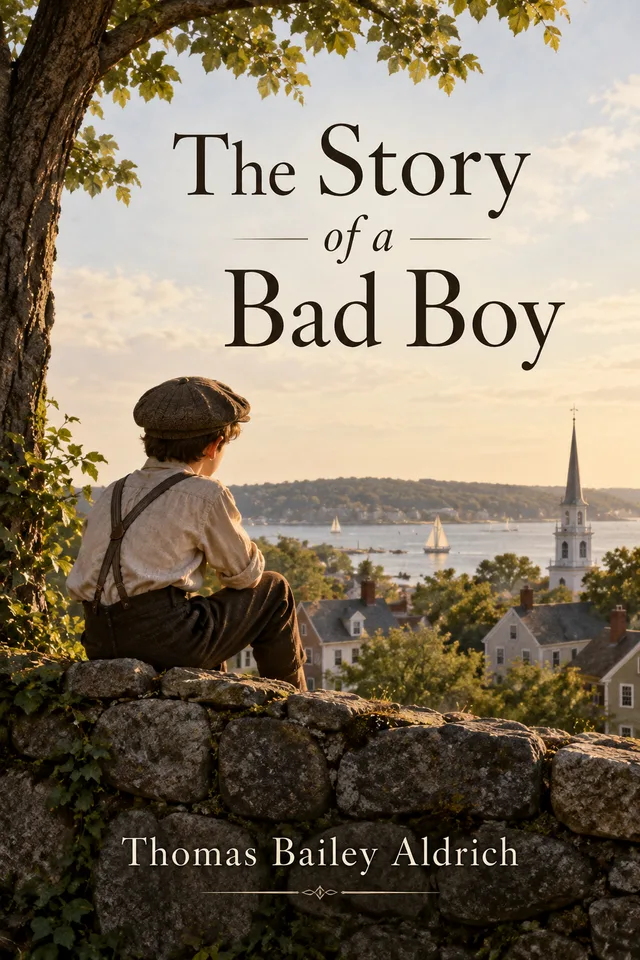
The Story of a Bad Boy
英语 BooksWhale 版本 · Thomas Bailey Aldrich
Tom Bailey recalls schoolboy adventures, friendships, and mischief in a New England town, with humor rooted in childhood experience.
- 预览
- 文本节选
- 格式
- 在线阅读, EPUB, PDF
- 访问
- Library 获取
图书简介
The Story of a Bad Boy
Tom Bailey looks back on his boyhood in Rivermouth, a New England town shaped by school, family, and neighborhood rivalries. His adventures include fights, pranks, friendships, and moments when youthful confidence meets painful experience. Thomas Bailey Aldrich combines an autobiographical voice with lively comic storytelling, offering a portrait of American childhood in which a troublesome boy gradually learns responsibility.
BooksWhale 版本
此版本如何整理
此版本基于公版文本,并由 BooksWhale 整理为适合数字阅读的版本。
公版依据
为什么此版本可以分享
Thomas Bailey Aldrich died in 1907; the work was first published in 1870. This edition presents the public-domain English original.
阅读预览
文本节选
预览选自整理后的阅读文本。
预览章节Full text阅读预览
The Story of a Bad Boy
预览章节Chapter One—In Which I Introduce Myself预览
This is the story of a bad boy. Well, not such a very bad, but a pretty bad boy; and I ought to know, for I am, or rather I was, that boy myself.
Lest the title should mislead the reader, I hasten to assure him here that I have no dark confessions to make. I call my story the story of a bad boy, partly to distinguish myself from those faultless young gentlemen who generally figure in narratives of this kind, and partly because I really was not a cherub. I may truthfully say I was an amiable, impulsive lad, blessed with fine digestive powers, and no hypocrite. I didn't want to be an angel and with the angels stand; I didn't think the missionary tracts presented to me by the Rev. Wibird Hawkins were half so nice as Robinson Crusoe; and I didn't send my little pocket-money to the natives of the Feejee Islands, but spent it royally in peppermint-drops and taffy candy. In short, I was a real human boy, such as you may meet anywhere in New England, and no more like the impossible boy in a storybook than a sound orange is like one that has been sucked dry. But let us begin at the beginning.
Whenever a new scholar came to our school, I used to confront him at recess with the following words: “My name's Tom Bailey; what's your name?” If the name struck me favorably, I shook hands with the new pupil cordially; but if it didn't, I would turn on my heel, for I was particular on this point. Such names as Higgins, Wiggins, and Spriggins were deadly affronts to my ear; while Langdon, Wallace, Blake, and the like, were passwords to my confidence and esteem.
Ah me! some of those dear fellows are rather elderly boys by this time—lawyers, merchants, sea-captains, soldiers, authors, what not? Phil Adams (a special good name that Adams) is consul at Shanghai, where I picture him to myself with his head closely shaved—he never had too much hair—and a long pigtail hanging down behind. He is married, I hear; and I hope he and she that was Miss Wang Wang are very happy together, sitting cross-legged over their diminutive cups of tea in a skyblue tower hung with bells. It is so I think of him; to me he is henceforth a jewelled mandarin, talking nothing but broken China. Whitcomb is a judge, sedate and wise, with spectacles balanced on the bridge of that remarkable nose which, in former days, was so plentifully sprinkled with freckles that the boys christened him Pepper Whitcomb. Just to think of little Pepper Whitcomb being a judge! What would he do to me now, I wonder, if I were to sing out “Pepper!” some day in court? Fred Langdon is in California, in the native-wine business—he used to make the best licorice-water I ever tasted! Binny Wallace sleeps in the Old South Burying-Ground; and Jack Harris, too, is dead—Harris, who commanded us boys, of old, in the famous snow-ball battles of Slatter's Hill. Was it yesterday I saw him at the head of his regiment on its way to join the shattered Army of the Potomac? Not yesterday, but six years ago. It was at the battle of the Seven Pines. Gallant Jack Harris, that never drew rein until he had dashed into the Rebel battery! So they found him—lying across the enemy's guns.
How we have parted, and wandered, and married, and died! I wonder what has become of all the boys who went to the Temple Grammar School at Rivermouth when I was a youngster? “All, all are gone, the old familiar faces!”
It is with no ungentle hand I summon them back, for a moment, from that Past which has closed upon them and upon me. How pleasantly they live again in my memory! Happy, magical Past, in whose fairy atmosphere even Conway, mine ancient foe, stands forth transfigured, with a sort of dreamy glory encircling his bright red hair!
预览章节Chapter Two—In Which I Entertain Peculiar Views预览
I was born at Rivermouth, but, before I had a chance to become very well acquainted with that pretty New England town, my parents removed to New Orleans, where my father invested his money so securely in the banking business that he was never able to get any of it out again. But of this hereafter.
I was only eighteen months old at the time of the removal, and it didn't make much difference to me where I was, because I was so small; but several years later, when my father proposed to take me North to be educated, I had my own peculiar views on the subject. I instantly kicked over the little Negro boy who happened to be standing by me at the moment, and, stamping my foot violently on the floor of the piazza, declared that I would not be taken away to live among a lot of Yankees!
You see I was what is called “a Northern man with Southern principles.” I had no recollection of New England: my earliest memories were connected with the South, with Aunt Chloe, my old Negro nurse, and with the great ill-kept garden in the centre of which stood our house—a whitewashed stone house it was, with wide verandas—shut out from the street by lines of orange, fig, and magnolia trees. I knew I was born at the North, but hoped nobody would find it out. I looked upon the misfortune as something so shrouded by time and distance that maybe nobody remembered it. I never told my schoolmates I was a Yankee, because they talked about the Yankees in such a scornful way it made me feel that it was quite a disgrace not to be born in Louisiana, or at least in one of the Border States. And this impression was strengthened by Aunt Chloe, who said, “dar wasn't no gentl'men in the Norf no way,” and on one occasion terrified me beyond measure by declaring that, “if any of dem mean whites tried to git her away from marster, she was jes'gwine to knock 'em on de head wid a gourd!”
The way this poor creature's eyes flashed, and the tragic air with which she struck at an imaginary “mean white,” are among the most vivid things in my memory of those days.
To be frank, my idea of the North was about as accurate as that entertained by the well-educated Englishmen of the present day concerning America. I supposed the inhabitants were divided into two classes—Indians and white people; that the Indians occasionally dashed down on New York, and scalped any woman or child (giving the preference to children) whom they caught lingering in the outskirts after nightfall; that the white men were either hunters or schoolmasters, and that it was winter pretty much all the year round. The prevailing style of architecture I took to be log-cabins.
With this delightful picture of Northern civilization in my eye, the reader will easily understand my terror at the bare thought of being transported to Rivermouth to school, and possibly will forgive me for kicking over little black Sam, and otherwise misconducting myself, when my father announced his determination to me. As for kicking little Sam—I always did that, more or less gently, when anything went wrong with me.
My father was greatly perplexed and troubled by this unusually violent outbreak, and especially by the real consternation which he saw written in every line of my countenance. As little black Sam picked himself up, my father took my hand in his and led me thoughtfully to the library.
I can see him now as he leaned back in the bamboo chair and questioned me. He appeared strangely agitated on learning the nature of my objections to going North, and proceeded at once to knock down all my pine log houses, and scatter all the Indian tribes with which I had populated the greater portion of the Eastern and Middle States.
目录
本版本内容
- 01Full text
- 02Chapter One—In Which I Introduce Myself
- 03Chapter Two—In Which I Entertain Peculiar Views
- 04Chapter Three—On Board the Typhoon
- 05Chapter Four—Rivermouth
- 06Chapter Five—The Nutter House and the Nutter Family
- 07Chapter Six—Lights and Shadows
- 08Chapter Seven—One Memorable Night
- 09Chapter Eight—The Adventures of a Fourth
- 10Chapter Nine—I Become an R. M. C.
- 11Chapter Ten—I Fight Conway
- 12Chapter Eleven—All About Gypsy
- 13Chapter Twelve—Winter at Rivermouth
- 14Chapter Thirteen—The Snow Fort on Slatter's Hill
- 15Chapter Fourteen—The Cruise of the Dolphin
- 16Chapter Fifteen—An Old Acquaintance Turns Up
- 17Chapter Sixteen—In Which Sailor Ben Spins a Yarn
- 18Chapter Seventeen—How We Astonished the Rivermouthians
- 19Chapter Eighteen—A Frog He Would A-Wooing Go
- 20Chapter Nineteen—I Become A Blighted Being
- 21Chapter Twenty—I Prove Myself To Be the Grandson of My Grandfather
- 22Chapter Twenty-One—In Which I Leave Rivermouth
- 23Chapter Twenty-Two—Exeunt Omnes